Your internal device inventory is wrong. This isn’t a criticism — it’s a structural reality of how enterprise telecom operates. The invoice is the only document that reflects what you’re actually paying, and every effective audit starts from the carrier bill outward, not from your spreadsheet inward. This post walks through how to run a structured first audit against Bell, Rogers, or TELUS enterprise invoices, what Canadian-specific traps to watch for, and where most teams find the biggest recoverable spend. For a broader view of telecom expense management in Canadian enterprises, start with our practitioner’s guide.
Start from the invoice, not from your asset spreadsheet
Picture this: you pull your MDM console showing 1,200 active lines. Then you open the Bell invoice. It shows 1,347 billed lines.
Those 147 lines are real charges hitting your P&L every month. They’re invisible to anyone who starts their audit from internal records — because internal records don’t know what they don’t know. The MDM tracks enrolled devices. The invoice tracks what the carrier is billing you. These are not the same thing.
This gap isn’t exceptional. When you look at the CCTS complaint data for 2024–25, billing issues rank as the number one category — over 23,000 complaints, up 17% year-over-year. And that dramatically understates the enterprise problem, because the CCTS primarily serves consumers and small businesses. Enterprise billing errors are largely invisible in complaint data. You’re on your own.
Here’s what actually happens when we onboard a new managed lifecycle management client: the first thing we do is pull three months of carrier invoices and compare billed line counts against MDM enrolment. The gap is never zero. We routinely find entire departments — field services, seasonal operations, pilot programmes — with lines that exist on invoices but nowhere in IT’s records.
One distribution client discovered 200 tablets still billing for data plans on devices that had been decommissioned and physically returned to a warehouse 18 months earlier. The disconnect request went from IT to procurement, but it never made it to the carrier. The devices sat on a shelf. The invoices kept coming.
Why MDM and ServiceNow records lag behind carrier billing
The structural problem is workflow fragmentation. When an employee leaves, HR closes out their profile. IT deactivates their device in the MDM. But the carrier disconnection request? That lives in a different system, often owned by a different team, and it doesn’t automatically trigger from either HR or IT actions.
Test lines are worse. Someone spins up a pilot with 15 SIMs to evaluate a new application. The pilot ends. The application doesn’t get adopted. But nobody owns the cleanup — so the SIMs keep billing quietly in the background, invisible until someone audits invoice line items against active business use.
This is why the invoice-first methodology matters. Industry benchmarks show 5–15% of enterprise lines typically show zero usage upon initial audit. On a 1,000-line fleet, that’s 50–150 lines generating charges with no business value. Those are the easiest savings to capture, because cancelling them affects nobody.
The five line items that hide the most waste on Canadian carrier invoices
After auditing thousands of Canadian enterprise invoices, the same five categories account for the bulk of recoverable spend. None of them are exotic. All of them are fixable.
The temptation is to audit everything — every line item, every charge code, every variance from the previous month. That’s how audits stall out in spreadsheet purgatory. Instead, check these five areas first. You’ll find 80% of the recoverable spend before you touch anything else.
Zero-use lines and dormant SIMs
The most obvious waste category, yet the most persistent. Bell’s Q1 2024 subscriber adjustment tells you everything you need to know: the carrier removed approximately 106,000 “very low to non-revenue generating business market subscribers” from their books. If a single carrier had over 100,000 dormant business lines, the aggregate across all carriers represents hundreds of millions in charges for services nobody uses.
Your audit should pull every line with zero voice minutes, zero SMS, and zero data usage over the past 90 days. But distinguish between truly dormant lines and seasonal patterns — a line that shows zero usage in January but heavy usage in July belongs to a seasonal worker, not to a cancellation queue. The decision framework: if the line can’t be tied to an active employee or a documented seasonal role, it’s a cancellation candidate. If it’s tied to a device that’s been physically decommissioned, it’s an immediate cancellation.
Roaming charges that don’t match travel patterns
The one that surprises people most is phantom roaming at border locations. Devices in Windsor, Niagara Falls, and Surrey regularly connect to US towers without ever leaving Canada. The invoice shows US roaming charges for workers standing on Canadian soil.
Rogers Roam Like Home charges $12/day for US roaming. A team of 50 employees with 10 US travel days per month accumulates $6,000–$8,000 monthly — often without anyone noticing because the charges are buried in line-level detail. We manage fleets for transportation companies running routes along the 401 corridor. Without a specific audit check for border-location roaming patterns, they’d pay AT&T rates for domestic operations.
Cross-reference roaming charges against employee travel records or device location data. If you’re seeing roaming charges for employees who never left Canada, you’ve found recoverable spend.
Plan-to-usage mismatches across the fleet
Heavy data users on small plans generate overages. Light users on large plans waste capacity. The math seems simple — just right-size the plans.
Pooled plans only solve this if the pool is correctly sized, and most aren’t. We see fleets where the pool looked adequate in aggregate, but 30% of users were hitting overages while 40% used less than 500MB. The pool masked the distribution problem.
Your audit should segment usage by user — not just by line — and map actual consumption against plan tiers. This data becomes negotiation currency at your next carrier renewal.
Legacy rate plans that outlived their contracts
Evergreen clauses keep enterprises on pricing from two or three years ago. Nobody proactively migrates you to better rates.
To find these, pull the plan codes from your invoice and compare them against current rate card offerings. Any line on a plan code that doesn’t appear in the current catalogue is a migration candidate. This is particularly common after carrier acquisitions — legacy brand plans get grandfathered indefinitely until someone notices.
One-time charges that became permanent
Activation fees that bill monthly. “Temporary” add-ons that auto-renewed. Features that were supposed to be removed after a pilot but weren’t.
These are individually small — $5 here, $12 there — but they compound across hundreds of lines. Your audit should flag any recurring charge that doesn’t match the base plan definition, then trace it back to when it first appeared and whether it was ever supposed to be permanent.
Canadian telecom billing complexity your US colleagues don’t face
If you’re following a US-based telecom audit guide, you’re missing at least three categories of waste that only exist in Canadian enterprise billing. The regulatory environment, the tax structure, and the carrier market dynamics all create audit considerations that generic guides don’t cover.
Provincial tax treatment that breaks chargeback files
We had a national retailer with stores in every province receiving one consolidated Bell invoice. Page 1 showed $847,000 total. Pages 2–189 contained 8,000 lines of service across 10 provinces and 3 territories.
The AP team needed this split by cost centre with proper tax coding by Tuesday. Without understanding that HST applies in Ontario, GST+QST in Quebec, GST+PST in BC, and GST-only in Alberta — all on the same invoice — the chargeback file was rejected by finance three months in a row before they called us.
Here’s what you’re dealing with:
| Tax Regime | Provinces | Combined Rate | ITC Recovery |
|---|---|---|---|
| HST | ON, NB, NS, NL, PE | 13–15% | Fully recoverable |
| GST + QST | QC | 5% + 9.975% | GST recoverable; QST via ITR |
| GST + PST | BC, SK, MB | 5% + 6–7% | GST recoverable; PST not recoverable |
| GST only | AB, NT, NU, YT | 5% | Fully recoverable |
Your chargeback file must code each line to the correct province with the correct tax treatment. If Ontario HST and Quebec QST get lumped together, finance will reject the allocation — and you’ll spend hours untangling what should have been clean from the start.
No enterprise Wireless Code protection for dispute resolution
Here’s the part that catches most IT directors off guard. The CRTC Wireless Code — the regulatory framework that caps overages, mandates trial periods, and provides a complaint pathway for billing disputes — applies only to individuals and businesses with fewer than 100 employees.
If you’re managing a fleet at an enterprise with 100+ employees, you have no regulatory backstop. No CCTS escalation path for billing disputes. No mandated overage caps. No trial period protections.
What this means practically: your audit process is your only safety net. When you find a billing error, you can’t invoke consumer protections — you need to rely on whatever dispute resolution terms exist in your enterprise contract. Most contracts have 60–90 day windows for disputing charges. Miss that window, and the charge stands regardless of whether it was legitimate.
This is why documentation matters at every audit step. The audit file isn’t just internal analysis — it’s your evidence package for carrier disputes and your leverage for contract negotiations.
The interprovincial price variation in Canadian wireless runs 26–50% depending on the province, with Saskatchewan and Manitoba consistently cheapest and Ontario and BC highest. A “national rate” that looks competitive in Alberta may be significantly above market in Saskatchewan — and without regulatory protection, the only way you’ll know is by auditing what you’re actually paying against what the market actually offers.
With the Canadian-specific context established, the next step is building the actual audit workflow — a repeatable process you can run this month and refine every month after.
A step-by-step first telecom invoice audit for Canadian enterprises
Your first audit will take longer than every subsequent one. Expect to spend two to three days building baseline inventory and surfacing accumulated issues. By the third month, the same process runs in half a day.
The step most teams skip is pulling the full invoice detail — not just the summary. Bell’s enterprise invoices can run 120+ pages. The summary shows your total. The audit lives on page 47, where a feature code that shouldn’t exist has been billing $8.50 per line across 600 lines since someone requested it during a 2021 pilot. That’s $61,200 a year hiding in line-level detail that nobody reads.
Step 1 — Gather three months of full invoices from every BAN
Request the complete billing detail from every billing account number (BAN) across all carriers. Not the summary PDF your AP team downloads — the full line-level export showing every charge, every line, every feature code.
Three months provides a baseline for variance detection. A single month might catch a snapshot; three months reveals patterns. You’ll see which charges are consistent (and therefore legitimate) versus which appeared suddenly (and therefore warrant investigation).
Bell, Rogers, and TELUS all provide enterprise portals for downloading detailed billing. If you don’t have access, your account representative can provision it within 48 hours.
Step 2 — Build a line inventory from the invoices themselves
Extract every billed line from the invoices and build your inventory from there — not from your MDM, not from your HR system, not from the spreadsheet someone started three years ago.
For each line, capture the phone number, the assigned plan, the monthly recurring charge, and any usage data available. Then attempt to map each line to an employee or device in your internal records.
The lines you can’t match are your first audit findings. They’re either legitimate lines your records don’t reflect, or they’re orphaned lines billing for nothing.
Step 3 — Flag zero-use lines and anomalous charges
Define your variance thresholds before you start. A useful starting point: flag any line showing zero usage over 90 days, any charge change greater than 20% month-over-month, and any single charge exceeding $500 that wasn’t present in prior months.
Don’t chase $50 variances while $5,000 errors slip through. Prioritise by dollar impact, not by count of anomalies.
Manual invoice processing takes an average of 9.2 days, compared to 3.1 days for best-in-class AP teams. The bottleneck isn’t analysis — it’s data extraction. Anything that accelerates parsing changes the economics of whether auditing is feasible at all.
Step 4 — Reconcile provincial tax coding for finance
Before you hand findings to finance, ensure every line is coded to the correct province with the correct tax treatment. Refer back to the tax regime table — HST provinces, GST+PST provinces, GST+QST for Quebec, GST-only for Alberta and the territories.
Your chargeback file will be rejected if Ontario and Quebec charges aren’t distinguished. Build this into your audit workflow from the start rather than fixing it after finance sends the file back.
Step 5 — Document disputes and track expected credits
For every anomaly you identify, document when the charge first appeared, what the expected charge should have been, and the dollar value of the variance. This becomes your evidence package.
Carrier dispute windows are typically 60–90 days from invoice date. Track submission dates and expected credit timelines. If a credit doesn’t appear within two billing cycles, escalate with your documentation in hand.
Turning audit findings into carrier negotiation leverage
Carriers know that most enterprises don’t have clean data about their own usage patterns. When you show up with three months of parsed invoices and usage segmented by worker type, the conversation changes.
Your audit data proves gaps that carriers would prefer remain invisible. The cost of a 10GB wireless plan dropped 47% between 2020 and 2024 — from $69.42 to $28.03. If your enterprise contract was negotiated before 2023, you’re almost certainly paying above current market rates. Your audit data quantifies exactly how much above.
Segment usage by worker persona before negotiating
Group your fleet by role: field workers, office workers, drivers, seasonal staff. Calculate actual data consumption for each segment.
You’ll likely find that heavy data users cluster in specific roles while other segments barely touch their allocation. This distribution data becomes a negotiation talking point — you can request custom tiered structures that match actual usage patterns rather than accepting standard plan tiers designed for average consumers.
They didn’t get that deal by asking nicely. They got it by showing the carrier they knew exactly what they were paying and exactly what they were using.
When the manual audit breaks down — and what replaces it
One BAN with 500 lines? The manual process works. Five BANs across three carriers with 5,000 lines? That’s a full-time job just building the inventory — before any actual analysis begins.
The dirty secret of enterprise TEM is that most mid-market implementations fail within 18 months. Not because the software doesn’t work, but because the maintenance burden exceeds the savings. Traditional TEM platforms require someone to configure carrier rate libraries, maintain rule sets, and interpret output. When that person changes roles, the platform becomes an expensive invoice archive.
What AI-powered invoice parsing changes for Canadian fleets
This is exactly the kind of problem that’s invisible in a spreadsheet but obvious the moment you feed an invoice through an AI parser.
AI-powered TEM platforms reduce per-invoice analysis time from 18.5 minutes to 8 seconds while detecting anomalies at 99% accuracy versus 60–70% for manual review. This isn’t a marginal improvement — it’s the difference between auditing invoices and not auditing them.
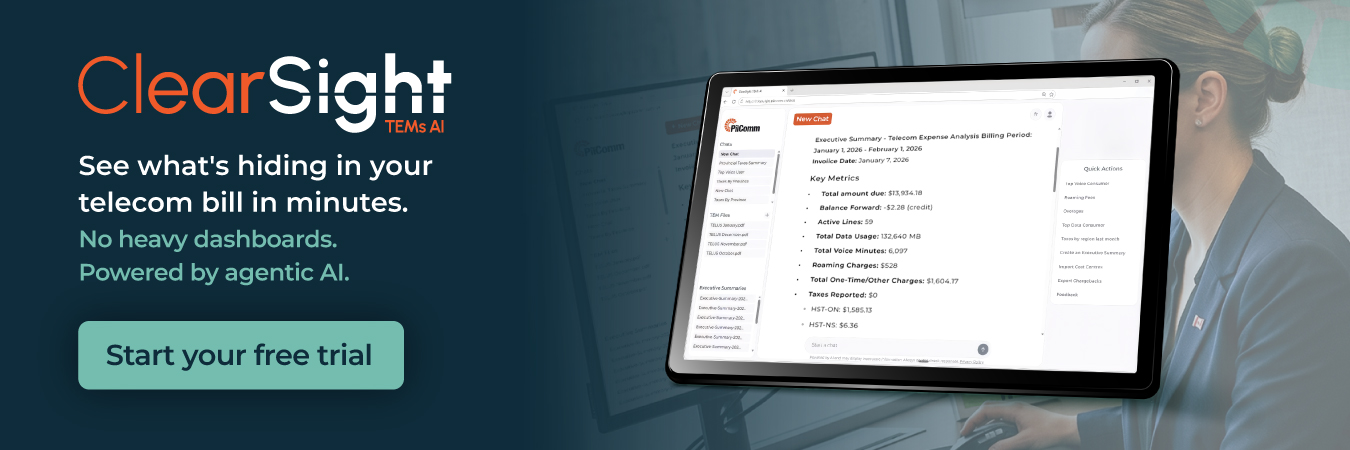
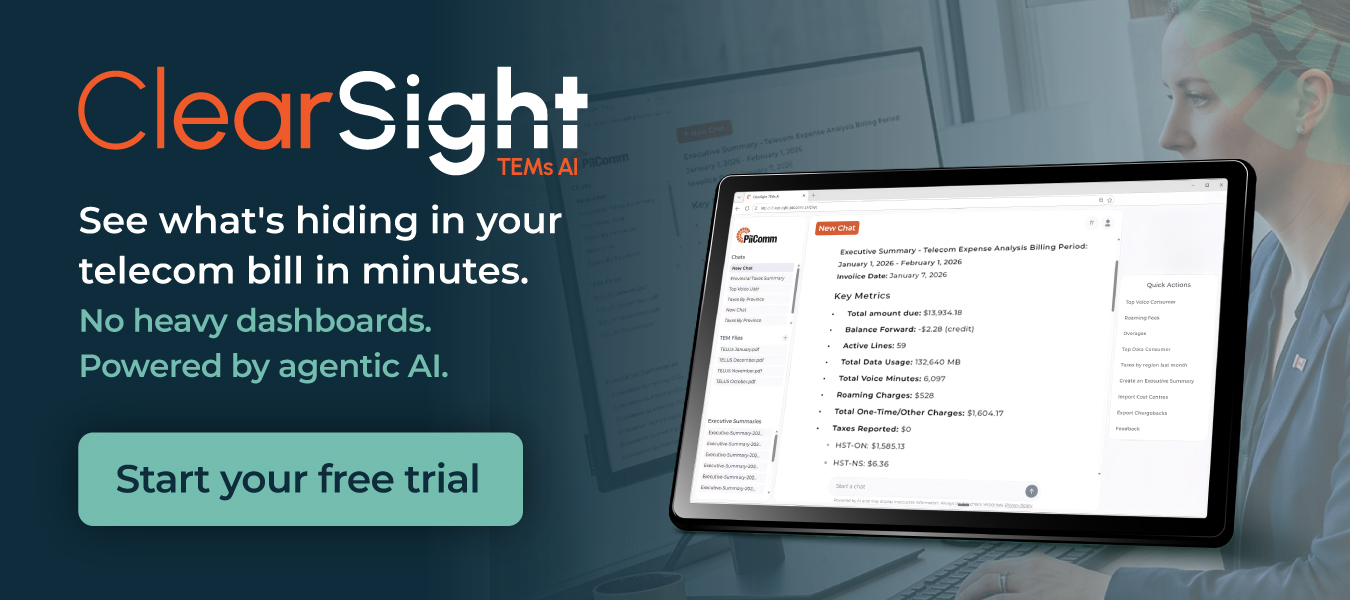
ClearSight TEMs AI parses Bell, Rogers, and TELUS invoices in minutes. It handles the provincial tax disaggregation that breaks chargeback files. It produces bilingual output for organisations with Quebec operations. And at $99/month per billing account, the math is straightforward: if it finds two zero-use lines at $50 each, it pays for itself.
The platform is hosted in Canada — no cross-border data transfer, no US-jurisdiction exposure for your employee telecom data. Upload your first invoice and see what it finds.
Privacy rules that affect how you handle telecom audit data
An invoice audit touches personal information the moment it ties a device to a person — so Canadian privacy rules apply to your audit files, not just to your production systems.
Under PIPEDA, you’re accountable for personal information you collect and process. The moment your audit spreadsheet includes employee names alongside phone numbers and usage data, you’ve created a privacy-regulated dataset.
Quebec’s Law 25 can impose administrative monetary penalties up to $10 million or 2% of worldwide turnover, with penal fines reaching $25 million or 4%. The compliance exposure is real.
Why your TEM platform’s hosting location is a compliance decision
If your TEM tool hosts data outside Canada, processing Quebec employee data without a privacy impact assessment creates compliance exposure under Law 25.
Most US-based TEM platforms don’t flag this requirement because they don’t know Canadian privacy law requires it. Your choice of tool is a compliance decision, not just a technology decision.
For organisations whose audit reveals problems beyond invoice analysis — orphaned devices, disconnection workflow gaps, fleet governance issues — the next conversation is about integrating TEM with device lifecycle management so the gaps that created your billing waste don’t reappear next quarter.
Frequently asked questions
What is a telecom invoice audit?
A systematic line-by-line review of carrier bills comparing billed services against contracted rates, actual usage, and authorised inventory. Not a summary-page scan — the audit lives in the line-level detail that most teams never read. Billing issues rank as the CCTS’s number one complaint category, confirming that errors are systemic.
How often should Canadian enterprises audit their telecom invoices?
Monthly, using automated variance detection against a baseline. The first audit takes two to three days to build baseline inventory; subsequent monthly audits should take half a day with proper tooling. Best-in-class teams process invoices in 3.1 days versus 9.2 days average.
Does the CRTC Wireless Code protect enterprise telecom customers?
No. The Wireless Code applies only to individuals and businesses with fewer than 100 employees. Enterprises must rely on negotiated contract terms for dispute resolution — your audit process and documentation are your only safety net.
What are the most common telecom billing errors in Canada?
Zero-use lines, missing promotional credits, incorrect plan rates, and phantom roaming at border locations. The CCTS reports billing as the number one complaint category, up 17% in 2024–25. Enterprise errors are underreported because the CCTS primarily serves consumers.
How much can a telecom audit save a Canadian enterprise?
First-time audits typically recover 10–18% of annual telecom spend, with zero-use line elimination and plan optimisation as the highest-value categories. Industry benchmarks show 5–15% of enterprise lines show zero usage upon initial audit.
Are telecom invoices taxed the same across Canadian provinces?
No — four distinct tax regimes apply. HST provinces charge 13–15% combined. GST+PST provinces split taxes with PST generally non-recoverable. Quebec applies GST+QST. Alberta charges GST only. Your chargeback file must code each line correctly or finance will reject it.
Do Canadian privacy laws affect how I handle telecom audit data?
Yes. The moment you tie a device to a person, PIPEDA applies. Quebec’s Law 25 requires a privacy impact assessment before processing employee data through infrastructure outside Quebec, with penalties up to $25 million.
Can AI tools audit Canadian carrier invoices?
Yes. AI-powered platforms parse Bell, Rogers, and TELUS invoices in minutes rather than days, handling provincial tax disaggregation and bilingual output automatically. ClearSight TEMs AI is built specifically for Canadian carrier formats at $99/month per billing account.
The audit is the starting point, not the destination
Running your first telecom audit will surface waste you didn’t know existed. That’s valuable. But the audit also reveals something more important: the workflow gaps that allowed the waste to accumulate in the first place.
Disconnect requests that never reached the carrier. Test lines that outlived their projects. Plan structures negotiated when data cost twice what it costs today. These aren’t invoice problems — they’re operational problems that happen to show up on invoices.
The organisations that capture lasting value from telecom auditing are the ones that treat the audit as diagnostic, then fix the underlying processes. Monthly invoice review becomes routine. Disconnection workflows get documented and enforced. Carrier renewals happen with data in hand rather than hope in heart.
Start with the invoice. Build your inventory from what you’re actually paying. Find the waste. Then build the discipline that prevents it from coming back.