If your team is comparing brightfin and ClearSight TEMs AI, the decision likely comes down to one question: do you need an enterprise IT financial management platform that lives inside ServiceNow, or do you need a focused AI tool that parses your Canadian carrier invoices and gives you answers in minutes?
These platforms aren’t direct competitors because they serve different buyers with different operational realities. This comparison breaks down where each platform fits, where it doesn’t, and what Canadian IT leaders should weigh before committing.
Two platforms built for different operational realities
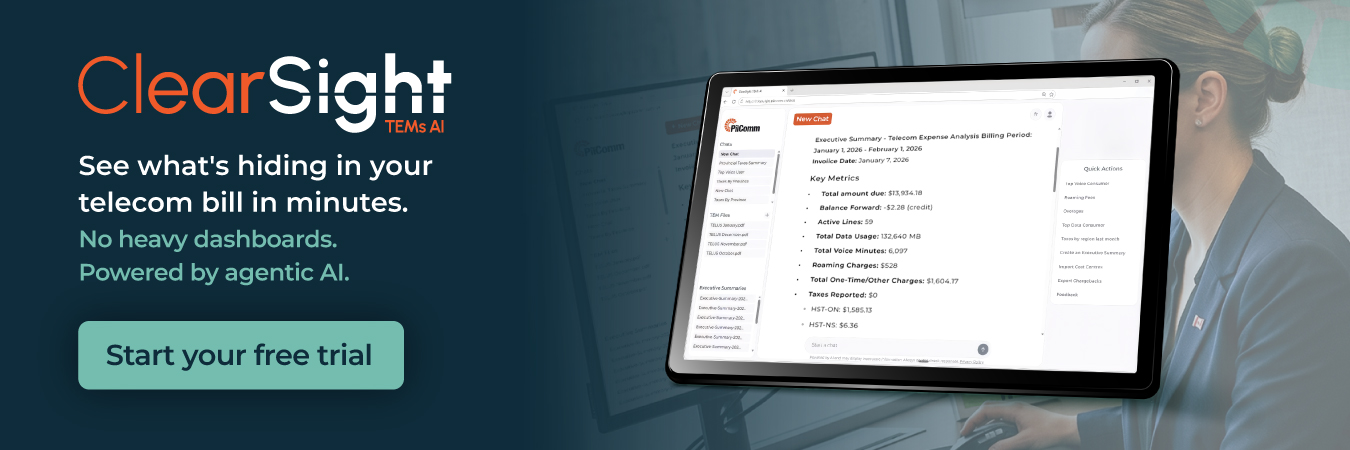
Brightfin is an IT financial management platform that includes telecom expense management (TEM) as one module within a broader ServiceNow-native ecosystem. ClearSight TEMs AI is a focused, agentic AI tool that does one thing: parse Canadian telecom invoices and surface actionable insights through a conversational interface.
Comparing them feature-for-feature misses the point. The real question is which problem you’re actually trying to solve.
Brightfin recently unified its brand following its merger with Proven Optics. The combined company now positions itself as “the first AI-Native Cost Optimization Platform” combining TEM and IT Finance Management on ServiceNow. That’s a meaningful strategic shift, signaling that brightfin is doubling down on large enterprises that want unified financial visibility across all IT spending, not just telecom.
ClearSight takes the opposite approach. It’s priced at $99/month per billing account with no implementation cycle, no ServiceNow dependency, and no adjacent modules you didn’t ask for.
Here’s what actually happens in the field: we’ve seen enterprises spend four to six months implementing a full IT financial management platform only to discover that the TEM module (the part they actually needed) still can’t parse a TELUS enterprise invoice correctly. The implementation was successful by every project metric. The invoices were still being reconciled in spreadsheets.
The architecture difference isn’t about which platform is “better.” It’s about which problem you’re paying to solve. If you need enterprise-wide IT financial visibility with TEM as one component, brightfin’s integrated approach makes sense. If you need someone to tell you why your wireless bill spiked 18% last month, you don’t need an IT financial management platform. You need a tool that can read your invoice and answer the question.
Brightfin’s strengths and where Canadian buyers hit friction
Brightfin has earned its position in the US enterprise TEM market. Its native ServiceNow integration is genuinely differentiated—if your organization runs ITSM, ITAM, and financial planning through ServiceNow, brightfin slots into that ecosystem without requiring a separate platform.
Gartner describes brightfin as specializing in IT Expense Management and IT Finance Management accessible natively through ServiceNow or as standalone SaaS. That dual-deployment model matters, meaning organizations without ServiceNow can still use the platform, though the deepest functionality is designed for ServiceNow environments.
The platform has built a solid reputation. Brightfin holds a 4.7/5 rating across 36 reviews on Software Advice, which suggests genuine customer satisfaction among its target market.
But the question we hear from Canadian IT leaders isn’t “Is brightfin a good platform?” It’s “Can it handle our specific carrier invoices?”
When you ask a US-based TEM vendor to demonstrate parsing a Bell enterprise invoice and a TELUS enterprise invoice side by side, the surcharge categorization often doesn’t match how those carriers actually label their charges. This design assumption is inherited from US carrier formats.
ServiceNow dependency as a decision filter
ServiceNow dependency isn’t inherently good or bad. It’s a filter that helps you self-select.
If your organization already runs ServiceNow for IT service management, asset management, and financial planning, brightfin’s native integration eliminates the friction of adding another standalone platform. Your telecom data flows into the same environment where your IT team already works. The dashboards, workflows, and reporting structures align with tools they already know.
If your organization doesn’t run ServiceNow, that integration becomes a cost rather than a benefit. Brightfin does offer a standalone SaaS deployment, but you’re paying for architecture designed around an ecosystem you don’t use. More importantly, you’re evaluating a platform whose roadmap, feature priorities, and support resources are oriented toward its ServiceNow-native customers.
The mid-market reality is that most Canadian enterprises in the 250–2,500 employee range aren’t running ServiceNow. They’re running a mix of tools: maybe Freshservice for ITSM, maybe Sage or NetSuite for financials, maybe nothing more structured than shared drives and spreadsheets for telecom. For these organizations, ServiceNow-native integration isn’t a differentiator. It’s irrelevant at best, a barrier at worst.
Canadian carrier invoice parsing gaps
Every TEM platform claims to process invoices from “all major carriers.” The question is whether it processes them accurately. That accuracy depends on whether the platform was designed for the invoice formats you actually receive.
Bell, Rogers, and TELUS each structure enterprise invoices differently. Different surcharge taxonomies. Different line-item categorization. Different ways of presenting provincial taxes, regulatory fees, and usage tiers.
A TEM platform built for AT&T and Verizon invoice structures will parse Canadian invoices. It will extract numbers and populate dashboards. But the categorization often doesn’t match how Canadian carriers actually label their charges. You’ll see surcharges grouped incorrectly, provincial taxes applied at flat national rates, and regulatory fees attributed to the wrong cost centers.
Here’s a concrete example: a $50/month plan costs $52.50 in Alberta (5% GST), $56.50 in Ontario (13% HST), and $57.49 in Quebec (14.975% combined GST/QST). A TEM platform that applies a flat national tax rate produces incorrect departmental chargebacks across every province. When your finance team discovers the allocations don’t match the invoices, they stop trusting the tool entirely. They go back to spreadsheets, which is exactly what happened before you bought the TEM platform.
The parsing accuracy question isn’t about whether a platform can read a Canadian invoice. It’s about whether the platform was designed with Canadian carrier billing structures as a primary use case rather than an afterthought.
If you’re evaluating any TEM platform for Canadian operations, request a live demonstration with your actual Bell, Rogers, or TELUS invoices. Ask the vendor to show you how surcharges are categorized, how provincial taxes are disaggregated, and how the output maps to your departmental cost centers. The platforms built for this market do it without hesitation. The ones adapted for it offer to “get back to you.”
That response tells you everything you need to know about where their parsing engine was designed and which buyers they’re actually built to serve.
ClearSight TEMs AI—built for Canadian carrier invoices from day one
What does a TEM platform designed specifically for Canadian carrier invoices actually look like in practice? Do the operational differences justify evaluating a focused alternative?
Imagine uploading your TELUS enterprise invoice, 180 pages, thousands of line items, and asking in plain language: “Which lines had zero usage last month?”
ClearSight returns an answer in minutes. Not because it’s faster software, but because it was designed from the ground up to parse Canadian carrier billing structures. The surcharge taxonomies, the provincial tax disaggregation, the way Bell labels regulatory fees differently than Rogers are the primary use cases ClearSight was built for.
This matters because the interaction model determines whether a TEM tool actually gets used.
A mid-market IT director managing 800 wireless lines doesn’t have a dedicated telecom analyst. They have maybe two hours a month to think about wireless costs, usually prompted by finance asking why the bill went up. If those two hours are spent navigating dashboard hierarchies and running pre-configured reports, the tool becomes shelfware by month three.
Conversational AI vs. dashboard navigation
Brightfin uses traditional dashboards within ServiceNow, a powerful solution for users who live in that environment, but requiring navigation, report configuration, and familiarity with the interface structure.
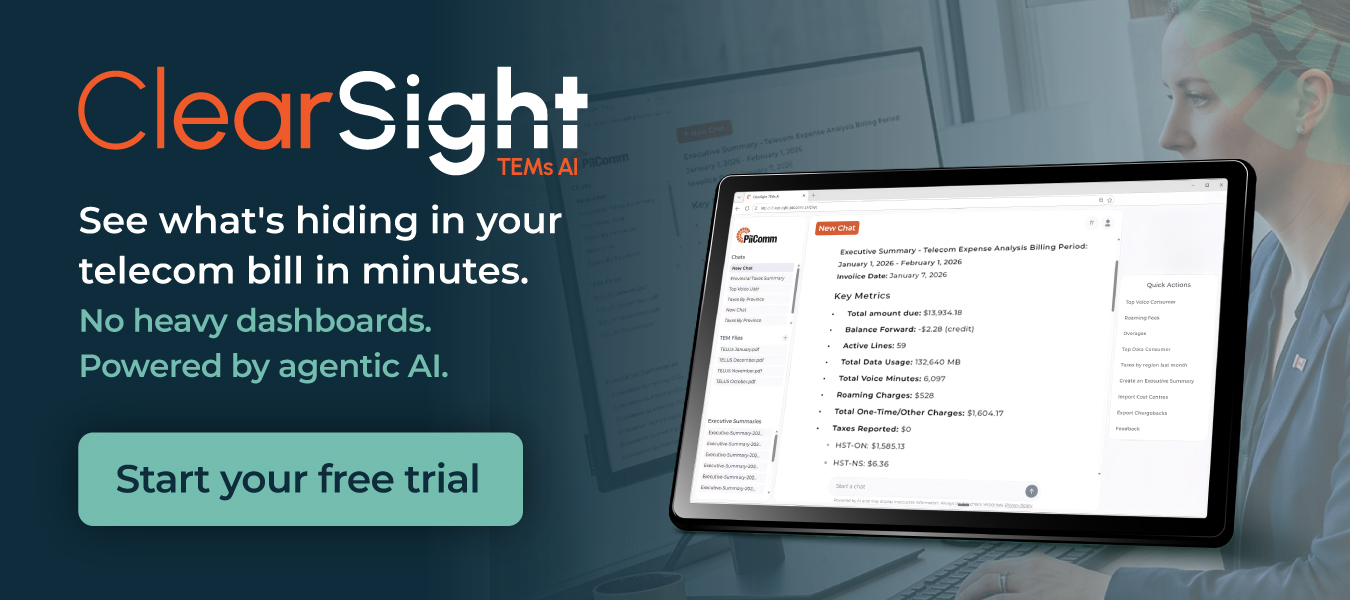
ClearSight uses a conversational interface. You ask questions in plain language and get answers. “Why did our bill spike this month?” “Show me all lines with less than 100MB of data usage.” “Which department has the highest roaming charges?”
The difference isn’t cosmetic. It’s the difference between a tool that requires training and a tool that works the way you already think. When your CFO asks why wireless spend increased 12%, you can have an answer in the time it takes to type the question, not in the time it takes to schedule a meeting with whoever knows how to run the report.
AI-driven TEM platforms reduce per-invoice analysis from 18.5 minutes to under 10 seconds with 99% anomaly detection accuracy. That’s not a marginal improvement. It’s the difference between auditing your invoices and not auditing them.
No implementation cycle, no configuration burden
The mid-market reality is that a 500-person company can’t justify a four-month implementation for a TEM platform. The savings don’t compound fast enough to offset the project cost, and by month two, the initiative has lost executive attention to more urgent priorities.
ClearSight eliminates that barrier entirely. The platform is priced at $99/month per billing account with no implementation fees, no configuration cycles, and no training requirements. You upload an invoice, the AI agents parse it, and you start asking questions.
The time-to-value calculation changes completely. Instead of “Will this platform pay for itself over 18 months?”, the question becomes “Can we afford not to audit our invoices when the tool costs less than a single unused line per month?”
For most mid-market fleets, the answer is obvious the moment you find your first zombie line.
The comparison framework Canadian IT leaders should use
Most TEM comparison articles evaluate platforms on features every vendor claims: invoice processing, contract management, and reporting. Those criteria don’t separate anyone.
The criteria that actually matter for Canadian buyers only surface after you’ve tried to make a TEM tool work across three national carriers, five provincial tax regimes, and two official languages. Here’s how brightfin and ClearSight TEMs AI compare on those dimensions:
| Criterion | Brightfin | ClearSight TEMs AI |
|---|---|---|
| Canadian carrier invoice parsing | Adapted from US carrier formats | Built for Bell, Rogers, TELUS from day one |
| Bilingual output (French/English) | English primary; French support limited | Full bilingual output included |
| Canadian data residency | US-based platform; data hosting varies | Hosted exclusively in Canadian data centers |
| ServiceNow requirement | Native integration; standalone available | No ServiceNow dependency |
| Implementation timeline | Weeks to months depending on scope | Minutes—upload and ask |
| Pricing model | Enterprise licensing; not publicly listed | $99/month per billing account |
| AI interaction model | Dashboard-based reporting | Conversational AI interface |
| Provincial tax disaggregation | Flat rate application common | Province-specific tax handling |
We’ve sat through vendor evaluations where the TEM provider was asked to demonstrate parsing a real Canadian enterprise invoice on the spot. The platforms built for this market do it without hesitation. The ones adapted for it offer to “get back to you.”
That response tells you which market the platform was actually designed for.
Data residency and Canadian privacy compliance
Call detail records such as who your employees called, when, for how long, and from where are personal information under PIPEDA. The hosting location of your TEM platform determines whether that data is subject to Canadian law or US law.
This isn’t a theoretical compliance checkbox. It’s a practical question about who can compel access to your employee data and under what circumstances.
US CLOUD Act exposure for Canadian employee data
The US CLOUD Act allows US law enforcement to compel disclosure of data from US-based companies regardless of where that data is physically stored. A US-headquartered TEM provider with servers in Canada is still subject to CLOUD Act requests.
For Canadian enterprises, particularly in healthcare, government, and financial services, this creates jurisdictional ambiguity that procurement and legal teams increasingly flag during vendor evaluation. The question isn’t whether a CLOUD Act request is likely. It’s whether your organization wants to accept that exposure when Canadian-hosted alternatives exist.
The federal government has signaled the strategic importance of data sovereignty, with Budget 2024 earmarking approximately $2 billion including $700 million specifically for Canadian cloud data center infrastructure. That investment reflects a policy direction that procurement teams are wise to anticipate.
ClearSight operates in isolated tenant environments hosted exclusively in Canadian data centers, eliminating cross-border data transfer concerns entirely.
Quebec Law 25 and Bill 96 compliance
For any enterprise with Quebec operations, French-language output serves as a compliance requirement with real penalties.
Bill 96 requires French-language commercial documentation. Violations carry penalties of $3,000 to $30,000 per day, doubled for second offences. A TEM platform that produces English-only reports creates a daily compliance liability for any Quebec operation.
Most US-based TEM platforms, including brightfin, do not support Canadian French output as a standard capability. ClearSight includes full bilingual output, not simply as an add-on module, but as a core feature reflecting its Canadian design origin.
If your fleet includes Quebec lines, this single criterion may be determinative regardless of how the platforms compare on other dimensions.
Which platform fits which buyer?
The right platform depends on three things: whether you’re on ServiceNow, how many wireless lines you manage, and whether your operations include Quebec.
Choose brightfin if: You’re a large enterprise with 5,000+ employees, your IT operations run on ServiceNow, you need unified IT financial management and TEM in a single platform, and your Canadian operations are a small fraction of a global fleet.
Choose ClearSight TEMs AI if: You’re a mid-market Canadian enterprise with 250–2,500 employees, you need immediate invoice clarity without implementation overhead, you operate across Canadian carriers, you need bilingual output for Quebec, and you need Canadian data residency.
Consider both if: You’re a large Canadian enterprise on ServiceNow that wants IT financial management capabilities globally but needs a focused Canadian TEM tool that handles carrier-specific parsing and provincial compliance.
The scenario we see most often: a Canadian enterprise evaluates brightfin, realizes the implementation timeline and ServiceNow dependency don’t fit their operational reality, and defaults back to spreadsheets. ClearSight exists to prevent that default.
Only 5–10% of mid-market Canadian companies use a dedicated TEM approach. The other 90% are managing telecom through spreadsheets, not because they don’t want visibility, but because the available tools required more commitment than the problem justified. A $99/month tool with no implementation cycle changes that calculation entirely.
If you’re ready to see what ClearSight finds in your actual invoices, book a 20-minute demo and upload a real Bell, Rogers, or TELUS invoice. The platform’s value becomes obvious the moment you ask your first question.
What happens after you choose a TEM platform
A TEM platform that identifies 50 unused lines is useful. A TEM practice that automatically suspends those lines when the corresponding device enters repair status and cancels them when the device is securely decommissioned is what actually stops the waste.
The distinction matters because the number-one cause of zombie lines in every fleet we manage is the gap between HR terminating an employee and someone remembering to cancel the wireless line. That gap averages three to six months.
No TEM platform, regardless of how good its AI is, can prevent that without integration into device lifecycle workflows.
The scale of this problem is visible in carrier financials. Bell’s Q1 2024 subscriber adjustment removed approximately 106,000 “very low to non-revenue generating business market subscribers”—lines that were billing but essentially unused. Those weren’t consumer lines. They were enterprise lines that slipped through whatever processes those organizations had in place.
This is why ClearSight exists within PiiComm’s broader managed mobility services ecosystem rather than as a standalone software company. The invoice intelligence ClearSight surfaces connects directly to lifecycle management workflows that can act on what the data reveals—suspending lines, flagging devices for recovery, triggering cancellation requests through proper carrier channels.
TEM as a standalone purchase creates visibility. TEM integrated with device lifecycle management creates accountability.
If your organization needs to connect invoice insights to device actions, talk to a mobility strategist about how those workflows connect in practice.
Frequently asked questions
Does brightfin work for Canadian enterprises?
Brightfin serves Canadian clients through its US-based platform, but its core design targets US carrier formats and the ServiceNow ecosystem. Canadian buyers should evaluate carrier parsing accuracy, bilingual output capability, and data residency before committing. Request a live demonstration with your actual Bell, Rogers, or TELUS invoices to verify categorisation accuracy.
What is ClearSight TEMs AI?
ClearSight TEMs AI is a Canadian-built agentic AI telecom expense management platform from PiiComm. It parses invoices from Bell, Rogers, TELUS, and other Canadian carriers through a conversational interface, provides bilingual English/French output, and hosts all data exclusively in Canadian data centres.
Does brightfin require ServiceNow?
Brightfin offers both a ServiceNow-native deployment and a standalone SaaS option. However, its deepest functionality and primary differentiation are built around ServiceNow integration. Organisations without ServiceNow should evaluate whether the standalone version delivers comparable value to their specific use case.
How much does ClearSight TEMs AI cost compared to brightfin?
ClearSight TEMs AI is $99/month per billing account with no implementation fees or long-term contracts. Brightfin’s pricing is not publicly listed and typically involves enterprise-level licensing tied to the scope of IT financial management and TEM modules deployed.
Can brightfin parse Canadian carrier invoices from Bell, Rogers, and TELUS?
Brightfin processes invoices from multiple carriers, but its parsing engine was built for US carrier formats. Canadian enterprises should request a live demonstration with their actual Canadian invoices to verify that surcharge categorisation and provincial tax handling match how those carriers structure their billing.
Where does ClearSight TEMs AI store Canadian employee data?
ClearSight operates in isolated tenant environments hosted exclusively in Canadian data centres. This eliminates cross-border data transfer concerns under PIPEDA and satisfies Quebec Law 25 data residency requirements for organisations with Quebec operations.
What is the difference between TEM and ITFM?
Telecom expense management focuses specifically on managing telecom invoices, usage, and contracts. IT Financial Management is a broader discipline covering all IT spending: telecom, cloud, software, and hardware. Brightfin combines both capabilities; ClearSight focuses exclusively on TEM with depth in Canadian carrier billing.
The choice between brightfin and ClearSight TEMs AI isn’t really about which platform has more features. It’s about which problem you’re solving and which operational reality you’re working within.
If you’re a large enterprise on ServiceNow that needs unified visibility across all IT spending globally, brightfin’s integrated IT financial management approach makes strategic sense.
If you’re a Canadian mid-market organization that needs to understand why your wireless bill increased last month, and you need that answer before your next finance meeting, not after a four-month implementation, the platforms serve fundamentally different purposes.
The 90% of mid-market Canadian enterprises still managing telecom through spreadsheets aren’t there because they don’t care about visibility. They’re there because the available tools asked for more commitment than the problem justified. That’s the gap worth closing.