Most Canadian enterprises renegotiate their wireless carrier contracts the same way every cycle: the account manager calls 90 days before expiry, presents a modest discount as a loyalty gesture, and the IT team accepts because they have no independent data to push back with. In a market where three national carriers control the vast majority of enterprise wireless revenue, that approach leaves significant money on the table. This post covers what actually moves the needle in Canadian carrier contract negotiation—and why the current market creates an unusually favourable window.
The Canadian carrier market gives you less competition but more leverage than you think
Most IT leaders misread the Canadian carrier landscape. They see three dominant carriers and assume they have no negotiating leverage. But concentration cuts both ways—when you represent a fleet of 500+ lines, you’re a meaningful revenue block that any of those three carriers wants to retain or acquire.
Bell, Rogers, and TELUS collectively hold approximately 87% of wireless subscriber market share. Your carrier knows you have limited alternatives. But losing your account to a competitor is a revenue event they want to avoid—and they’ll negotiate harder than you expect to prevent it.
The competitive landscape shifted materially in 2026. TD Cowen analyst Vince Valentini downgraded all three national carriers to “hold” for the first time in over 30 years, driven by a fierce price war with flanker brand plans dropping as low as $25/month. This price war is filtering through to enterprise rate cards. IT leaders who negotiate during this window will lock in pricing that reflects genuine competitive pressure rather than coordinated pricing.
We see this play out in every carrier negotiation we support. The account manager’s first offer is always positioned as generous—”We’re giving you 10% off your current rate.” But when we come to the table with line-level usage data showing that 15% of the fleet is on plans that cost twice what current market rates justify, and that a competitor has already quoted a lower rate for the same coverage footprint, that 10% becomes 20–25% within two meetings.
The difference isn’t the carrier’s willingness to negotiate. It’s the buyer’s preparation.
Five enterprise contract terms worth more than the per-line rate
Every enterprise negotiation starts with per-line pricing. That’s the wrong place to start. The terms buried in the contract’s middle pages—the ones your carrier’s account manager hopes you’ll skim—often have a larger impact on your total cost of ownership than the headline rate.
I’ve seen a client celebrate a 15% per-line rate reduction, only to discover six months later that the Minimum Annual Revenue Commitment in their new contract locked them into spending $50,000 more than their actual usage required. The rate was lower, but the floor was higher. Net result: they paid more than before.
Here’s what to focus on instead:
| Contract term | What the carrier wants | What to negotiate for |
|---|---|---|
| Minimum Annual Revenue Commitment (MARC) | High floor tied to current spend, locking in revenue even if you optimise | MARC set 15–20% below current spend, or eliminated entirely in exchange for longer term |
| Evergreen clause | Auto-renewal at existing rates with 60-day notice window | 90–120 day notice window, or removal of auto-renewal |
| Early termination fees | High ETF per line, making mid-contract switching prohibitive | Pro-rated ETF that decreases monthly, or ETF waiver if carrier fails SLA |
| Data pooling structure | Per-line overage charges, national pool without rollover | Fleet-wide pool with rollover, per-pool overage (not per-line) |
| Device subsidy/hardware credits | Large upfront credit tied to 36-month term extension | Decoupled device procurement, or credit applied to shorter term |
The headline rate matters. But these five terms determine whether that rate translates to actual savings.
Minimum Annual Revenue Commitments and volume floors
A MARC is a carrier’s insurance policy against you optimising your fleet after signing. If your contract commits you to $200,000/year in spend, and your actual usage drops to $150,000 after you eliminate unused lines, you still owe the $200,000.
Carriers insert MARCs precisely because they know enterprises carry dormant lines, overprovisioned plans, and legacy devices that will eventually be rationalised. The MARC captures that future optimisation as carrier revenue.
Your negotiating position: demand a MARC that reflects your optimised fleet, not your current bloated one. If you can’t get the MARC eliminated, negotiate it to 15–20% below your current run rate. That gives you room to cut zero-use lines without hitting a floor that makes the cuts meaningless.
Evergreen clauses and the 60-day renewal trap
Canadian enterprise wireless contracts typically auto-renew at existing rates unless you provide written notice 60–90 days before expiration. Most enterprises miss this window—not because they forgot, but because nobody was tracking it.
The cost of missing that window is substantial. AOTMP research indicates 80% of organisations overspend due to poorly managed contracts, with enterprises that fail to renegotiate at renewal overpaying by 15–25% per year. In a market where the cost of a 10GB plan dropped 47% between 2020 and 2024, auto-renewing a contract from 2023 means paying rates that no longer reflect competitive reality.
Your negotiating position: push for a 90–120 day notice window, or better, eliminate the evergreen clause entirely. And calendar the notice deadline the day you sign—not the day before it’s due.
Early termination fees and migration flexibility
The CRTC’s March 2026 ban on activation and switching fees removed one of the friction points carriers relied on to keep enterprise fleets locked in. But early termination fees remain, and their structure determines whether mid-contract switching is financially viable.
Most enterprise contracts set ETFs as a flat per-line charge multiplied by remaining months. A 500-line fleet with 18 months remaining at $25/line/month ETF is looking at $225,000 to exit—enough to make any competitive quote irrelevant.
Your negotiating position: push for pro-rated ETFs that decrease monthly, not flat charges that persist until expiry. Or negotiate an ETF waiver clause triggered by carrier SLA failures—missed uptime commitments, unresolved billing disputes, or coverage gaps that affect operational sites.
Data pooling structures and overage thresholds
Two carriers can quote you the same per-GB rate and deliver materially different costs depending on how they structure the data pool.
The questions that matter: Is data pooled nationally or by province? Do unused GBs roll over to the next month? Are overages charged per-line (expensive) or per-pool (manageable)? What’s the per-GB overage rate once you exceed the pool?
A national pool with rollover and per-pool overage charges can cost 30% less than a provincial pool with no rollover and per-line overages—even at identical per-GB headline rates. The structure matters more than the number on the rate card.
Device subsidy and hardware credit terms
Carrier hardware subsidies look attractive until you calculate the total cost of the contract term they’re attached to.
A $400 device credit per line across 500 lines is $200,000 in apparent savings. But if that credit requires a 36-month term commitment at rates $5/line/month above current market—which totals $90,000 over the term—and locks you into an evergreen clause at those inflated rates, the subsidy cost you money.
Decoupling device procurement from carrier contracts often saves more than the subsidy appears to be worth. You source devices at wholesale pricing through a partner with OEM relationships, and you negotiate your carrier contract on airtime economics alone—without the term extension and rate inflation that subsidies typically require.
The carrier hardware subsidy isn’t free. It’s a financing arrangement with terms you didn’t negotiate.
The per-line rate your account manager leads with is the least interesting number in your carrier contract. The five terms above determine whether that rate translates to actual cost control—or whether you’ve traded a smaller number on page one for larger obligations buried in the appendix.
But even perfect contract terms won’t save you money if you’re negotiating a national rate that averages away the interprovincial pricing variation built into every Canadian wireless market.
How interprovincial pricing variation hides inside “national” rates
When your carrier quotes a “national enterprise rate,” they’re averaging across provinces with wildly different competitive dynamics. Your employees in Saskatchewan are probably overpaying relative to the local market. Your employees in Ontario are paying what the market will bear. And your finance team is allocating the same per-line cost to every cost centre, masking the variation entirely.
The price gap isn’t subtle. According to ISED’s 2024 Price Comparison Study, interprovincial price variation runs 26–50% depending on the province, with Saskatchewan and Manitoba consistently cheapest due to regional carrier competition from SaskTel and MTS. A fleet of 1,000 lines distributed across Ontario, Alberta, Saskatchewan, and Quebec could be overpaying by $50,000–$100,000 annually if priced on a blended national rate instead of province-optimised plans.
Tax treatment compounds the variation. The same $50/month plan costs $52.50 in Alberta (5% GST), $56.50 in Ontario (13% HST), and $57.49 in Quebec (14.975% GST+QST)—per CRA place-of-supply rules. Accurate departmental chargebacks require province-level cost allocation, not national averaging.
We onboarded a transportation company with 1,800 lines across six provinces. Their carrier had them on a single national rate. When we broke the billing down by province, we found their Saskatchewan lines were costing 30% more than what SaskTel was quoting for equivalent service. Their Quebec lines were 20% above Vidéotron’s enterprise rate.
The “national rate” was convenient for the carrier—it simplified their billing. It was expensive for the client because it eliminated the competitive pressure that exists in certain provinces.
Your negotiating position: request province-level billing breakdowns and benchmark each region against local alternatives. The national rate is a starting point for negotiation, not a final answer.
What you need before you sit down at the negotiation table
The single biggest mistake in carrier contract negotiation isn’t accepting a bad rate—it’s negotiating without data. Your carrier’s account manager has your complete billing history, usage patterns, and contract terms memorised. If you walk into the negotiation with a vague sense that you’re “probably overpaying,” you’ve already lost.
One healthcare organisation we worked with had been told by their carrier that their enterprise rate was “among the best in the market.” When we ran their invoices through analysis and benchmarked against current market rates, we found they were paying 22% above what a comparable fleet was getting from the same carrier.
The carrier wasn’t lying—the rate was competitive when it was negotiated three years earlier. But the market had moved, and the client had no data to see the gap.
Here’s what you need before your next renewal meeting:
- Line-level usage data for the past 12 months (not aggregate spend—per-line detail)
- Inventory of zero-use and low-use lines with billing status
- Current contract terms including MARC, ETF structure, and notice deadlines
- At least one competitive quote from an alternative carrier
- Current market benchmark for your fleet size and geography
Walking in without these is like negotiating a salary without knowing the market rate for your role. You’ll accept whatever sounds reasonable—and reasonable is whatever the carrier decides to offer.
Build a line-level usage profile before renewal
Your carrier will negotiate on total fleet economics. You need to negotiate on line-level reality. That means knowing exactly which lines are underutilised, which are on the wrong plan, and which are generating zero usage.
Zero-use lines are more common than most IT teams realise. Bell’s Q1 2024 subscriber adjustment removed approximately 106,000 “very low to non-revenue generating business market subscribers” from their reported totals. If one carrier alone had over 100,000 dormant business lines, the aggregate across all Canadian carriers represents a substantial volume of enterprise lines billing for nothing.
Identifying and eliminating yours before negotiation does two things: it reduces your baseline spend, and it lowers the MARC commitment your carrier can reasonably demand. A fleet that’s already optimised negotiates from a position of control. A fleet carrying 15% deadweight negotiates from a position of hoping the carrier doesn’t notice.
Benchmark against current market rates, not your existing contract
Comparing your renewal offer to your current contract tells you whether the carrier is offering a discount. Comparing it to the current market tells you whether the discount is meaningful.
The gap can be substantial. ISED’s 2024 data shows the cost of a 10GB plan dropped 47% between 2020 and 2024—from $69.42 to $28.03. A carrier offering you 10% off your 2023 rate is still charging you significantly more than the current market supports.
Your benchmark should be today’s competitive pricing, not yesterday’s contract. And the only way to establish that benchmark is to solicit quotes from alternative carriers—even if you have no intention of switching.
Why most enterprises negotiate blind—and how invoice visibility changes the outcome
The reason most enterprise carrier negotiations produce modest results isn’t that the IT leader is a poor negotiator. It’s that they’re negotiating with incomplete information against a counterparty that has complete information.
The carrier knows your usage patterns, your cost per line, your contract history, and your switching costs. You know your total monthly bill and a vague sense that it’s too high.
Manual invoice analysis doesn’t close that gap at enterprise scale. AI-driven TEM platforms reduce per-invoice analysis time from 18.5 minutes to 8 seconds while detecting anomalies at 99% accuracy versus 60–70% for manual review. Across a 1,000-line fleet, that’s the difference between “done before the meeting” and “we’ll get to it next quarter.”
The outcomes reflect the data quality. One healthcare organisation pushed a carrier’s initial 5% discount offer to a 28% reduction worth $1.2 million over three years after benchmarking with TEM data. The carrier’s first offer reflected what they thought the client would accept. The final outcome reflected what the data justified.
The most common thing we hear from IT leaders after their first invoice analysis is: “I knew we were overpaying, but I didn’t know it was this much.”
That’s not a failure of intuition—it’s a failure of visibility. You can’t negotiate what you can’t see. When you upload your Bell and TELUS invoices and, within minutes, see exactly which lines are on the wrong plan, which ones have zero usage, and how your per-line cost compares to current market benchmarks—that’s the moment the negotiation shifts from “please give us a discount” to “here’s what we should be paying, and here’s the data.”
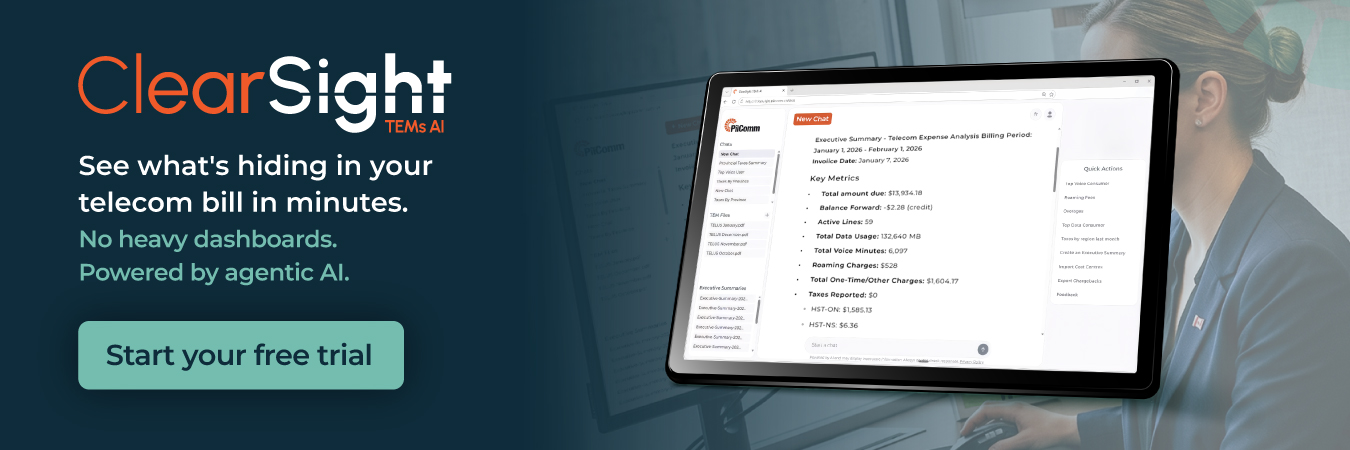
This is exactly what ClearSight TEMs AI does. It parses Canadian carrier invoices—Bell, Rogers, TELUS, and regional carriers—and surfaces the line-level intelligence you need before you sit across from your account manager. Zero-use lines. Plan mismatches. Billing anomalies. Provincial cost variation. The patterns that are invisible in a spreadsheet but obvious the moment you feed an invoice through an AI parser built for Canadian carrier billing complexity.

What happens when enterprise buyers have no regulatory safety net
If your enterprise has 100 or more employees, the CRTC Wireless Code doesn’t apply to your carrier contracts. The $50 domestic data overage cap, the $100 international roaming cap, the 15-day trial period—none of those protections extend to enterprise accounts.
Most IT leaders don’t know this. They assume the same rules that protect their personal wireless account protect their corporate fleet.
They don’t.
The CCTS accepted a record 23,647 complaints in 2024–25, up 17% year-over-year, with billing as the number-one issue. But the CCTS primarily serves consumers and small businesses. Large enterprises absorb billing errors or fight them individually. There is no ombudsman, no escalation path, and no regulatory backstop.
We had a manufacturing client discover $14,000 in roaming charges on a single invoice—a field technician’s device had been roaming in the US for three weeks without anyone noticing. A consumer account would have been capped at $100. This enterprise account had no cap, no alert, and no recourse except disputing the charge directly with the carrier.
Proactive invoice auditing isn’t an optimisation for enterprise accounts. It’s the only protection you have.
Timing your negotiation for maximum leverage
The best contract terms go to enterprises that negotiate proactively, not reactively. If you’re calling your carrier 30 days before expiry, you’ve already lost your strongest leverage—the carrier knows you don’t have time to switch.
Start the process 6–9 months before your contract expires. That gives you time to audit your invoices, benchmark against market rates, solicit competitive quotes, and negotiate from a position where switching is a credible option—not a bluff.
The current market makes timing even more important. The 2026 carrier price war, the CRTC’s ban on activation and switching fees, and Freedom Mobile’s national expansion have created the most favourable enterprise negotiation environment in decades. This window won’t last indefinitely—competitive intensity will normalise, and the urgency that’s driving aggressive carrier pricing will fade.
If your contract renews in the next 12–18 months, the groundwork you do now determines whether you lock in pricing that reflects this competitive moment or whether you auto-renew into rates that assume you weren’t paying attention.
Frequently asked questions
Can you negotiate enterprise wireless contracts with Canadian telecom carriers?
Yes—enterprise contracts are fully negotiable. Carriers are most willing to offer concessions when competitive quotes exist or when the buyer demonstrates line-level usage data. The question isn’t whether you can negotiate but whether you have the data to negotiate effectively. A 10% initial offer often becomes 20–25% with proper preparation.
Does the CRTC Wireless Code protect enterprise customers?
No. The Wireless Code applies only to individuals and businesses with fewer than 100 employees. Enterprise accounts lack the protections consumers assume: no domestic data overage caps, no international roaming caps, no 15-day trial period, and no formal CCTS dispute resolution channel for billing errors.
How much can a Canadian enterprise save by renegotiating carrier contracts?
Proactive renegotiation typically yields 15–25% rate reductions. One healthcare organisation achieved 28% after benchmarking with TEM data—turning a carrier’s initial 5% offer into $1.2 million in savings over three years. The outcome depends entirely on data quality and preparation, not negotiation skill alone.
When is the best time to start carrier contract negotiation?
Begin 6–9 months before contract expiry. This provides time to audit invoices, benchmark against current market rates, solicit competitive quotes, and negotiate without deadline pressure. The 60–90 day notice window for evergreen clauses is a hard deadline—miss it and you auto-renew at existing rates.
What is a Minimum Annual Revenue Commitment in a carrier contract?
A MARC is a spending floor obligating your enterprise to a minimum annual spend regardless of actual usage. Carriers insert MARCs because they know you’ll eventually optimise your fleet. If your MARC exceeds your optimised spend, the per-line rate reduction you negotiated becomes meaningless—you pay the floor either way.
How does interprovincial pricing affect enterprise wireless costs in Canada?
Interprovincial price variation runs 26–50%, with Saskatchewan and Manitoba cheapest due to SaskTel and MTS competition. “National rates” mask this variation by averaging high-cost provinces (Ontario, BC) with low-cost ones. Province-level benchmarking can reveal $50,000–$100,000 in annual overpayment for distributed fleets.
What changed in the Canadian wireless market in 2026 that affects enterprise contracts?
A fierce carrier price war drove flanker brand plans to $25/month, filtering through to enterprise rate cards. The CRTC banned activation and switching fees in March 2026. Freedom Mobile expanded nationally. Combined, these factors created the most favourable enterprise negotiation environment in decades—but the window is time-limited.
Your carrier’s account manager will call 90 days before expiry with an offer that sounds reasonable. It will be positioned as a loyalty gesture—an acknowledgment of your long relationship, a modest improvement on your current terms.
That offer reflects what the carrier thinks you’ll accept, not what your fleet is worth on today’s market.
The enterprises that pay fair rates aren’t better negotiators. They’re better prepared. They know their line-level usage. They’ve benchmarked against current pricing. They’ve had conversations with alternative carriers. And they’ve done all of this months before the renewal window opened—not in the 30-day scramble after the account manager’s first call.
The data exists. The competitive window exists. The question is whether you’ll use both before your next contract locks in rates for another two to three years.
Talk to a PiiComm mobility strategist about preparing for your next carrier contract renewal.