You close the month thinking you’ve got telecom spend contained, then page 47 of the Bell invoice shows $3,200 in roaming charges nobody flagged. Two devices somehow stayed active in Mississauga six months after that office closed. The Quebec team’s new plan discount only applied to 12 of their 40 lines.
This isn’t rare, it’s routine. If you manage more than a few hundred lines across Canada, billing errors aren’t an exception to manage. They’re a predictable pattern to govern. The only reliable way to catch them is to treat the invoice as your source of truth, not a spreadsheet someone updated in February or what you remember from the last renewal conversation.
Here’s how Canadian enterprises build that muscle, and where the real money hides.
The pattern: errors aren’t rare — they’re routine in Canada’s concentrated carrier market
If you manage more than a few hundred lines in Canada, assume every month contains at least one bill you should push back on.
This is operational reality backed by the numbers. Billing problems are the leading complaint issue across Canada, with 46% of all issues in 2024–25. These aren’t just consumer frustrations bleeding into the stats. Enterprise accounts face the same structural issues, just at fleet scale where a 2% error rate across 5,000 lines means real money.
The volume keeps climbing too. Complaints rose 17% year over year to a record 23,647, and while the CCTS primarily handles consumer and small business escalations, the underlying billing complexity that drives those complaints hits enterprise accounts harder. You’re dealing with pooled plans, multiple billing account numbers, cost center allocations, and renewal terms negotiated three CFOs ago.
Here’s what actually happens: An enterprise gets a new volume discount letter after threatening to walk during renewal. The master BAN adjusts properly. But three subsidiary accounts stay on the old plan family for another quarter because the MACD request went to the wrong account team inbox. By the time you catch it, you’re fighting for retroactive credits the carrier says expired after 90 days.
We’ve watched this movie hundreds of times. A transportation client found $47,000 in wrong-plan charges across their driver fleet because nobody reconciled the renewal terms against the actual bills for six months. The plans looked similar enough on paper (unlimited talk and text) but the data tiers were off by 10GB per line.
The concentrated carrier market in Canada amplifies this. You’re dealing with Rogers, Bell, or TELUS for the vast majority of your lines. Each has different billing formats, different plan structures, different ways of showing the same charge. A “system access fee” on one invoice might be “network charge” on another. Unless you’re parsing 100% of every invoice every month, these discrepancies compound.
Where the real waste hides on Canadian telecom invoices
A Windsor warehouse supervisor’s phone roams onto a Detroit tower for 48 hours straight. Nobody notices until the invoice shows $480 in US roaming charges spread across three cost centers.
This is the kind of operational leak that turns a controlled telecom budget into a monthly surprise. Border roaming is just one category. The real taxonomy of waste on Canadian carrier invoices is surprisingly consistent once you know the patterns.
Zero-use lines are the silent killer. These aren’t just forgotten devices in desk drawers. They’re seasonal scanner SIMs from last year’s holiday surge, backup tablets that were supposed to be suspended but got moved to a minimum plan instead, and devices for employees who left eight months ago but IT was never notified. The carriers have publicly acknowledged this problem — business line “clean-ups” have removed tens of thousands of low or no-revenue lines from their subscriber counts in recent years, which tells you how common dormant enterprise lines really are.
Standard roaming day passes remain one of the most common unexpected charges, especially for organizations operating near the border or with field teams. The structure seems simple: $15/day for Roam Like Home, until you realize that’s per device, automatically triggered, and often invisible until the bill arrives. A crew of six technicians working a week in Buffalo just added $630 to your invoice.
Here’s what actually happens: Your Sarnia facility’s devices intermittently catch US towers even though the workers never leave Ontario. The first month, you write it off as a one-time glitch. By month three, you’ve eaten $2,000 in charges because nobody implemented a roaming block at the plan level or configured the devices to prefer Canadian networks only.
Then there’s the plan mismatch problem. A device using 2GB monthly sits on a 20GB plan because “that’s what we always order.” Meanwhile, your field supervisors burn through their 5GB allocations and trigger overage charges. The pool might balance out on paper, but you’re paying premium rates for the overage while wasting capacity elsewhere.
Feature creep rounds out the waste categories. Visual voicemail, international calling packs, premium text packages: features that made sense three years ago for specific users but never got reviewed. Each one might only be $5 to $15 monthly, but across 1,000 lines, you’re looking at real money for services nobody uses.
Why most telecom expense audits miss the tax and province problem
The same Rogers invoice can legitimately carry HST at 15%, GST+PST totalling 12%, GST+QST hitting 14.975%, and GST-only at 5%, all on different line items. If your finance team’s upload fails because the tax coding is wrong, you’ve just added a week to month-end close.
This isn’t a carrier error. It’s how Canadian telecom taxation actually works across provinces. The CRA’s place-of-supply rules for telecommunications determine which tax regime applies based on where the service is primarily used, not where it’s billed or where your head office sits.
Your Ontario head office account might include devices used by teams in:
- Nova Scotia (15% HST)
- Manitoba (5% GST + 7% PST = 12% total)
- Quebec (5% GST + 9.975% QST = 14.975% total)
- Alberta (5% GST only)
Each line item needs the correct tax treatment for your accounting system to accept the upload. Get it wrong, and your AP team bounces the file.
Here’s what actually happens: Your telecom admin builds a beautiful chargeback spreadsheet allocating costs by department. Finance rejects it because the Quebec lines were coded as 13% HST (Ontario rate) instead of 14.975% GST+QST. Now someone has to manually separate every Quebec line, recalculate the tax split, and rebuild the journal entry. The Revenu Québec input tax credit claim sits in limbo for another month.
The complexity multiplies when devices move between provinces. A truck driver based in Calgary (5% GST) does a two-week route through Ontario (13% HST) and Quebec (14.975% GST+QST). The invoice might split that device’s charges across three tax treatments in a single month, depending on usage patterns and the carrier’s billing logic.
Most manual audits treat tax as an afterthought; as a number to copy from the invoice summary. But when you’re managing thousands of lines across multiple provinces with employees who travel, the aggregate tax variance can represent thousands of dollars monthly in incorrect allocations, delayed credits, or failed uploads.
The month-end workflow that catches errors before they become write-offs
The teams that win month-end do the same seven things, in the same order, every month.
This isn’t philosophical. It’s a practical cadence refined across hundreds of Canadian enterprises managing complex carrier relationships. Skip a step or shuffle the order, and you’ll miss the patterns that matter.
- Pull invoice-derived inventory — Not your spreadsheet, not your MDM, but what the carrier actually billed. Every line, every feature, every charge code.
- Map usage versus plans — Match actual consumption against plan allocations. Flag every device using less than 20% or more than 80% of its allowance.
- Triage 20% variances — Any line jumping 20% month-over-month gets investigated. Seasonal pattern? New user? Roaming event? Document the cause.
- Build finance-ready chargeback — Cost center allocations with correct provincial tax splits. HST for Atlantic Canada, GST+PST for Manitoba and Saskatchewan, GST+QST for Quebec, GST-only for Alberta.
- File and track disputes — Every dispute gets a ticket number, expected credit amount, and follow-up date. Track aging like receivables.
- Execute MACD hygiene — Process all moves, adds, changes, and disconnects from the month. Include seasonal suspension policy for cyclical operations.
- Update renewal calendar — Note any plan changes, usage trends, or issues that affect next negotiation. Build your benchmark pack monthly, not during renewal panic.
Best-in-class AP operations push invoice cycle times down to three days, but most telecom invoices take weeks because of manual complexity. This seven-step rhythm changes that. It front-loads the investigation, standardizes the output, and builds institutional memory that compounds monthly.
Here’s what actually happens: A $2,400 credit only posts if you re-file the dispute on day 31 because the carrier’s first-level ticket auto-closed when the billing cycle rolled. Your dispute tracking spreadsheet shows this pattern after three months — now you know to always re-open on day 31 for this specific credit category. That intelligence doesn’t exist in your contract or their documentation. It only emerges from systematic monthly execution.
Canadian governance realities that shape your error playbook
Consumer protections don’t apply to your enterprise account. Your contract and your governance do.
This distinction matters more than most IT leaders realize. The Wireless Code that limits consumer bills and caps overage fees explicitly excludes enterprises with 100+ employees. You can’t escalate to the CCTS when Rogers won’t credit those roaming charges. You need documented evidence, contract references, and often legal involvement for significant disputes.
The governance burden falls entirely on your internal processes. While consumers can file CCTS complaints online and expect investigation, enterprises operate in a pure B2B contract environment where every protection needs to be negotiated upfront and enforced through documentation.
This extends to privacy obligations that most enterprises underestimate. Telecom billing data linked to individual users is personal information under PIPEDA. You must report breaches “as soon as feasible” where there’s real risk of significant harm, and maintain incident records for 24 months. That Excel sheet of employee phone numbers and usage sitting on a shared drive? That’s a governance risk if it includes personal devices or BYOD lines.
Quebec adds another layer. Law 25 requires privacy impact assessments for any cross-border processing and French-language contracts, with penalties up to $25M or 4% of worldwide turnover. Your TEM workflow, including the tools you use to parse invoices, needs to comply.
Here’s what actually happens: Your privacy officer halts the invoice analysis project because the TEM tool stores data in Virginia. The Quebec team can’t use an English-only expense portal under Bill 96. The whole optimization initiative stalls for six months while legal reviews vendor compliance. Meanwhile, billing errors keep compounding at $15,000 monthly because nobody can legally process the data the way you planned.
The governance reality shapes every decision: which tools you can use (Canadian-hosted or with approved cross-border agreements), how you handle employee data (BYOD versus corporate-liable), who can access billing information (role-based access with audit trails), and how disputes get escalated (documented process with SLA tracking).
This isn’t red tape, it’s the operational framework that determines whether your telecom expense management is legally compliant and defensible during audit. Build it into the process from day one, or rebuild everything later when compliance catches up.
The carrier price war changes the math — if your data is credible
The 60GB plan that cost $95 per line in 2020 now runs closer to $50. Your 2023 contract might already be outdated.
Canada’s wireless pricing has shifted dramatically as higher-tier data plans dropped 47% for 10GB and 70% for 50GB between 2020 and 2024. But here’s the catch: carriers won’t volunteer to move you to better rates. You need to prove your usage patterns justify the adjustment.
This is where clean invoice data becomes negotiation ammunition. A heat map showing 80% of your workforce uses under 5GB monthly while paying for 20GB plans changes the conversation. The carrier can’t argue with their own billing data showing systematic overcapacity.
Here’s what actually happens: We pulled three months of Rogers usage data for a logistics client, mapped by persona. Warehouse staff averaged 1.8GB monthly. Drivers averaged 4.2GB. Office managers hit 12GB. The initial renewal offer was a flat 5% discount on existing plans. Armed with usage segmentation, they restructured into three plan tiers and cut their monthly spend by 28%. The carrier couldn’t dispute their own data showing the mismatch.
The CRTC confirms enterprise wireless markets remain highly concentrated across provinces, which means negotiation leverage comes from information asymmetry, not from playing carriers against each other. When you know exactly which devices need what capacity, you flip the script.
But credibility requires more than a screenshot from the carrier portal. You need line-level detail, historical trending, and the ability to model different plan scenarios against actual usage. The renewal conversation changes from “we’d like a better rate” to “here’s the exact plan configuration that matches our proven usage pattern, price it.”
Build a minimal TEM stack that actually works in Canada
Don’t chase 40 features — chase three outcomes: invoice in, insights out, clean file to finance.
Most TEM platforms collapse under their own complexity. They promise 47 dashboards, predictive analytics, and AI-powered optimization. Six months later, you’re still trying to get basic invoice parsing to work while manually fixing export files that accounting keeps rejecting.
The Canadian enterprise needs five core capabilities, and everything else is nice-to-have:
100% invoice parsing — Every line from Bell, Rogers, and TELUS invoices captured and categorized. Not summaries or samples, every single charge.
Bilingual outputs — French isn’t optional for Quebec operations or federal contracts. Your TEM platform becomes a compliance blocker if it can’t generate French reports.
Canadian data residency — Federal policy directs departments to consider in-Canada computing facilities for sensitive data. Healthcare and government buyers increasingly require it. US-hosted platforms create procurement friction.
Accounting integration — Automated exports with correct cost centers, GL codes, and provincial tax splits. If you’re still manually building journal entries, you don’t have TEM, you have expensive spreadsheets.
Audit workflows — Dispute tracking, aging reports, and carrier response documentation. A dispute without a paper trail is a donation to your carrier.
Alberta PIPA requires explicit cross-border processing notices and published policies, another reason Canadian-hosted infrastructure simplifies compliance. Every US platform requires privacy impact assessments and legal review that Canadian-hosted options avoid.
Here’s what actually happens: Your AP team stops chasing you when the monthly export lands with proper cost centers, correct HST/GST/QST allocations by line, and GL codes that match your ERP. The three-day scramble at month-end disappears. Finance gets their file on the 2nd of the month instead of the 15th.
Here’s where automation pays for itself
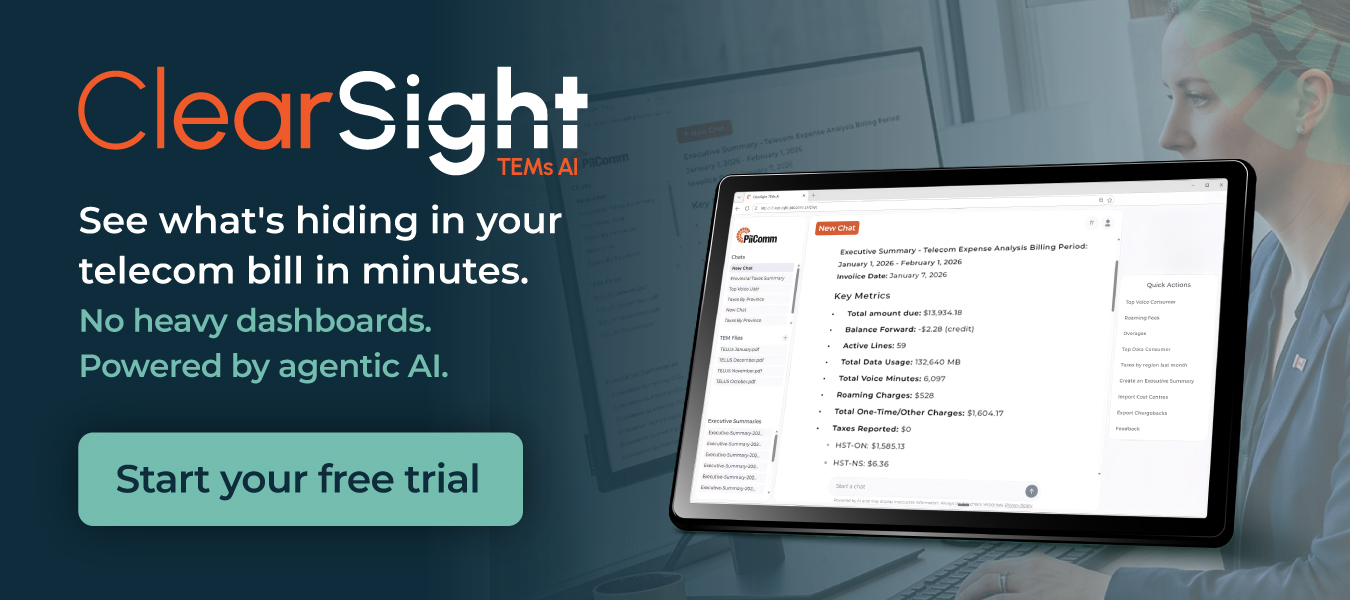
You upload a Bell PDF at noon. By 12:05, you’ve got every zero-use line flagged, top roamers identified, and a QuickBooks-ready file sitting in your downloads folder.
This isn’t theoretical. AI parsing can process invoices in seconds versus hours manually, and more importantly, it catches patterns humans miss. An AI parser doesn’t get tired on page 47 of a 200-page invoice. It doesn’t assume the subtotal is correct. It reads every line, every time.
The first run typically pays for the entire program. One client found $8,400 in duplicate charges across three BANs — charges that looked legitimate individually but were obvious duplicates when analyzed together. Another discovered 47 lines still active for a location that closed 11 months earlier. The savings from that first audit covered their TEM investment for two years.
If you’re spending more time stitching spreadsheets than managing spend, this is where a purpose-built Canadian parser changes the week.
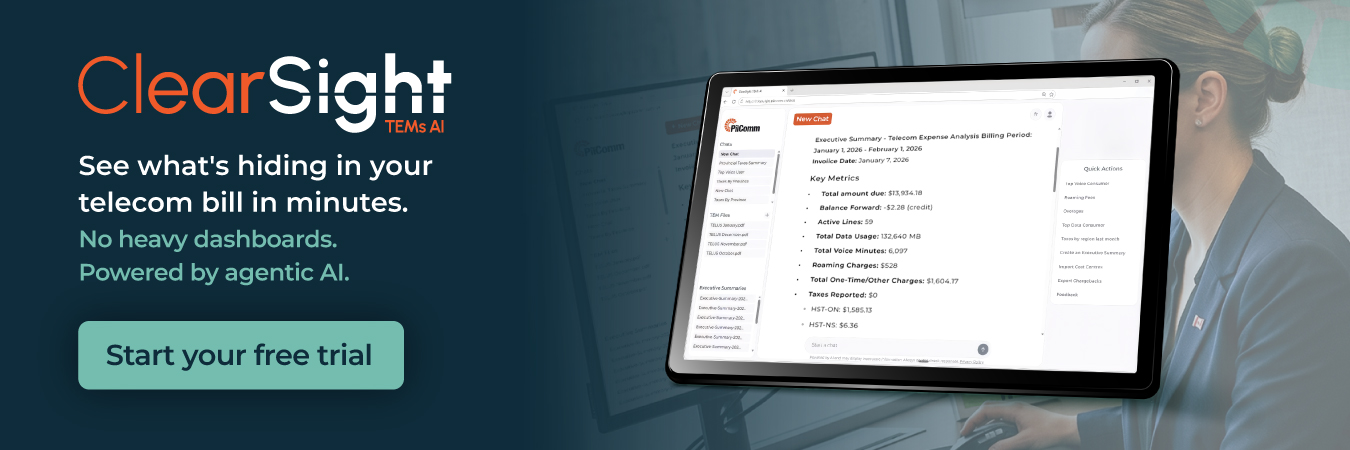
ClearSight TEMs AI reads Bell, Rogers, and TELUS invoices natively with no manual mapping or configuration needed. It runs entirely in Canadian data centers with isolated tenants for each customer, outputs everything bilingually, and starts at $99/month per billing account. Most enterprises see their first actionable insight within 20 minutes of uploading their first invoice.
The workflow is deliberately simple. Upload one BAN to start. Ask three natural-language questions: “Show me all zero-use lines.” “Which devices triggered roaming charges?” “What changed more than 20% from last month?” Export your finance-ready chargeback file with provincial taxes properly split. You’ve just compressed a week of manual audit work into a coffee break.
Here’s what actually happens: A retail chain uploaded six months of Rogers invoices on a Thursday afternoon. By Friday morning, they had identified $31,000 in recoverable credits, 89 zero-use lines, and a systemic plan mismatch affecting their Quebec stores. The parsed data also revealed their upcoming renewal represented 40% of total spend, information buried across multiple invoices that became obvious once aggregated.
For organizations needing execution beyond insights (including implementing those disconnections, managing the disputes, and handling device swaps), PiiComm’s Lifecycle Management operationalizes what ClearSight surfaces. But start with visibility. You can’t manage what you can’t see.
A 90-day action plan to reduce errors and recover spend
Think one BAN, one business unit, one renewal window, and build the rhythm.
Trying to fix everything at once guarantees you’ll fix nothing. The organizations that successfully reduce telecom waste focus their first 90 days on proving the model before scaling it.
Days 1-30: Establish baseline truth Upload your highest-spend BAN first. Parse six months of historical invoices to establish patterns. Document every anomaly, variance, and suspected error. Don’t action anything yet, just build the intelligence. Calculate the potential recovery if you fixed just the top five issues.
Days 31-60: Execute quick wins File disputes for the clearest errors: duplicate charges, wrong plans, services never ordered. Disconnect every confirmed zero-use line. These are non-controversial changes that generate immediate savings and build credibility for bigger moves. Track every dispute with expected credit amounts and aging.
Days 61-90: Build the forward rhythm Implement the seven-step monthly workflow. Train your team on the process. Set up automated exports to finance. Document plan optimization opportunities for your next renewal. By day 90, you should have recovered enough to fund the next year of optimization.
Here’s what actually happens: By day 45, you’ve posted your first meaningful credit, usually $5,000 to $15,000 for a mid-size enterprise. Finance notices their upload worked on the first try. Your CFO stops asking why telecom closes late. The early wins create organizational permission to tackle the harder structural issues like plan restructuring and pooling optimization.
The 90-day mark also aligns with carrier dispute windows and quarter-end reporting. You’ll have one complete quarter of clean data to show the impact. This becomes your business case for expanding the program.
When to escalate — and how to document it in Canada
Most enterprise disputes resolve faster when you attach the carrier’s own contract schedule and the annotated bill page to the ticket.
Escalation for enterprise accounts follows different rules than consumer complaints. You can’t file with CCTS as they primarily handle consumer and small business issues. Your escalation path runs through account management, legal, and ultimately contract remedies.
Document everything from day one. Every dispute needs:
- The specific contract clause being violated
- The invoice page showing the error (highlighted and annotated)
- The dollar impact across all affected lines
- Previous ticket numbers if this is a recurring issue
- Your requested resolution and timeline
If initial carrier response is inadequate, escalate to your account executive with the full documentation package. Include a simple spreadsheet showing dispute aging as carriers respond differently when they see you’re tracking patterns, not just complaining about individual charges.
Here’s what actually happens: You file a dispute about roaming charges that should have been covered under your negotiated rate. First response: “Working as designed.” You resubmit with the contract addendum showing your negotiated roaming rate, the invoice pages with charges highlighted, and a calculation showing $4,200 in overcharges. Second response: “Credit will appear on next invoice.”
The CRTC directs unresolved service issues to CCTS, but for enterprise accounts, this rarely applies. Your leverage comes from the contract, the renewal value, and your ability to document systematic billing problems that suggest broader account issues.
Keep an escalation log that tracks: dispute date, carrier ticket number, amount disputed, resolution date, actual credit received. This becomes powerful during renewal negotiations when you can show a pattern of billing errors requiring constant correction.
Frequently asked questions
Which telecom company has the most complaints in Canada?
CCTS reports complaint shares by provider annually, with proportions varying by year. Bell, Rogers, and TELUS as the largest providers naturally receive the most absolute complaints. Check the latest CCTS annual report for current percentages by provider.
How do I escalate a telecom billing dispute in Canada?
For consumers and small businesses, resolve with your provider first, then file with CCTS online if needed. Large enterprises work through account teams and documented contract disputes — CCTS typically doesn’t handle enterprise escalations.
Does the Wireless Code protect enterprise accounts?
No. The Wireless Code applies to individuals and small businesses. Enterprises with 100+ employees rely on negotiated contracts and internal governance for protection.
What counts as a telecom billing error?
Any charge inconsistent with contracted terms: wrong plan rates, unapproved features, misapplied credits, services never activated, roaming charges outside agreed limits, or taxes applied to the wrong jurisdiction.
Where do I file complaints about phone service?
Consumers and small businesses should file with CCTS after attempting provider resolution. The CRTC directs service complaints there. Enterprise accounts use contract remedies and account escalation paths.
Do Quebec’s language rules affect telecom billing and TEM?
Yes. Bill 96 requires French contracts, service, and interfaces. Your TEM platform needs French capability for Quebec operations. This is a legal requirement, not optional.
Do we need Canadian data residency for TEM?
Public sector and regulated industries increasingly require it. Federal policy prioritizes Canadian facilities for sensitive data. Confirm requirements with your privacy and security teams before vendor selection.
The pattern is predictable. Your response doesn’t have to be reactive.
Every month, Canadian enterprises process millions in telecom charges they shouldn’t pay. Not because of fraud or malice but because of complexity that compounds when nobody’s watching the details.
The invoices already contain everything you need. The line-level truth about what you’re actually using versus what you’re paying for. The patterns that predict next month’s surprises. The ammunition for your next renewal negotiation.
You know the seven-step rhythm that works. You know where the waste hides. You know which governance rules apply to your organization and how to build compliant workflows around them.
The question isn’t whether errors exist in your invoices. We’ve established they do. The question is whether you’ll keep fighting them manually every month or build the systematic governance that catches them automatically.
Start with one BAN. Parse the invoice. Find the patterns. Fix the obvious. Build the rhythm.
Your finance team will stop chasing you for clean uploads. Your CFO will stop asking about variance. And you’ll stop treating billing errors like surprises when they’re really just patterns you haven’t documented yet.
If manual audits are eating your weeks, book a 20-minute walkthrough to see your own invoice parsed in real time. For broader mobility transformation from device lifecycle to MDM governance, connect with our enterprise team about integrated managed mobility services designed for Canadian operations.
The errors won’t stop appearing. But you can stop letting them through.