Your finance team just flagged a 15% spike in wireless costs. When you pull up the invoices from Bell and TELUS, you’re staring at 200 pages of line items across three provinces with different tax treatments, roaming charges nobody approved, and 40 lines that might belong to employees who left six months ago.
This is the moment most Canadian IT leaders realise they don’t have a telecom expense management practice—they have a payment process.
This guide covers what TEM actually means in the Canadian context, where Canadian enterprises lose the most money, why the Canadian carrier landscape creates unique cost management challenges, and how to build a TEM practice that accounts for Canadian regulatory, linguistic, and operational realities.
The scale of the problem is significant. Canadian enterprises waste an estimated 15–30% of their telecom spend annually—applied to the roughly $23–26 billion Canadian businesses spend on telecom services, that represents $3.5 billion to $6.9 billion in recoverable cost leakage every year according to audit data from Canadian TEM practitioners. This isn’t a rounding error. It’s a budget line item large enough to fund entire IT transformation programmes, hiding in plain sight on invoices nobody has time to audit properly.
Let’s start with what TEM actually looks like when it’s done properly—and why the Canadian version of this problem is different from what you’ll read in US-focused guides.
What telecom expense management actually looks like in Canadian enterprises
Telecom expense management is one of those terms that sounds self-explanatory until you try to do it across four provinces with three national carriers and a Quebec operation that requires French-language invoicing.
The textbook definition—”managing the lifecycle of telecom expenses from procurement through payment”—obscures the operational reality. In practice, TEM means reconciling what your carriers say you owe against what you should actually be paying, then maintaining that discipline month after month across hundreds or thousands of lines.
Canada’s telecommunications sector generated $59.6 billion in total revenue in 2024, with mobile services accounting for 56.4% of that figure. Enterprise wireless is a substantial component of that spend, yet the vast majority of Canadian organisations have no systematic approach to managing it. Industry estimates suggest only 20–30% of large Canadian enterprises use a dedicated TEM approach, dropping to 5–10% for mid-market companies. The rest are managing telecom expenses the same way they managed them in 2010—spreadsheets, manual invoice review, and periodic phone calls to carrier account managers.
Here’s what actually happens when we onboard a new fleet for lifecycle management. One of the first things we do is pull the carrier invoices. Nine times out of ten, the client’s internal inventory doesn’t match what’s actually being billed. We find 50 lines assigned to employees who left the company, 30 lines on legacy rate plans that cost twice what current plans offer, and a handful of data add-ons that nobody remembers ordering. That’s not a software problem—it’s a visibility problem.
The five core functions of a TEM practice
A functioning TEM practice covers five interconnected disciplines, each with Canadian-specific considerations:
Invoice processing means receiving, validating, and paying carrier invoices—but in Canada, that means parsing materially different invoice formats from Bell, Rogers, and TELUS, each with unique surcharge taxonomies and line-item structures.
Inventory management means maintaining an accurate record of every line, device, and service—but accuracy requires reconciling MDM enrolment data against what carriers are actually billing, not just trusting either source independently.
Contract management means tracking rate plans, term expirations, and renewal windows—but Canadian enterprise contracts often include interprovincial rate variations that aren’t visible without province-level analysis.
Usage optimisation means matching rate plans to actual usage patterns—but Canadian plans vary significantly by province, and a “national rate” often masks substantial overpayment in high-cost regions.
Dispute resolution means identifying and recovering billing errors—but enterprises with 100+ employees operate without the CRTC Wireless Code protections that consumers enjoy, making proactive auditing the only safety net.
Why Canadian TEM differs from US-centric approaches
Most TEM content online is written for US audiences, and the differences matter more than they might appear.
Canada’s three national carriers—Bell, Rogers, and TELUS—collectively hold approximately 90% of wireless revenue. This concentration creates less competitive pressure on enterprise pricing than exists in the US market, where four national carriers and aggressive regional players compete more intensely for business accounts.
Provincial tax treatment adds complexity that doesn’t exist in most US states. HST in Ontario, GST+QST in Quebec, GST+PST in British Columbia, GST-only in Alberta—each province applies different tax rates to the same telecom service, and accurate departmental chargebacks require a TEM approach that handles provincial tax disaggregation automatically.
Then there’s language. If you operate in Quebec, your carrier contracts must comply with Bill 96 French-language requirements, and any TEM platform generating reports for those operations needs French output capability. Most US-based TEM platforms don’t support this.
These aren’t minor variations. They’re structural differences that make Canadian TEM a distinct discipline from what’s described in generic TEM guides.
The Canadian carrier landscape and its impact on enterprise costs
If you operate in Ontario, Alberta, and Quebec, you’re likely dealing with at least two national carriers and possibly a regional player. Each one structures enterprise contracts differently, applies different surcharges, and uses different billing formats. A Bell invoice from Ontario looks nothing like a TELUS invoice from Alberta, and neither one looks like a Vidéotron invoice from Quebec.
This complexity has direct cost implications. The ISED 2024 Price Comparison Study found Canada had the highest wireless price among G7 countries plus Australia at the 5GB service level—$63.80 versus $45.50 in the US and $22.50 in Australia. Higher baseline costs mean higher absolute savings from optimisation. A 20% reduction on a $50/line Canadian plan recovers more per line than the same percentage reduction on a $30/line plan in a more competitive market.
The most common mistake we see is an IT team negotiating a national rate with one carrier and assuming the pricing is uniform. It isn’t. Interprovincial price variation runs 26–50% depending on the province. Saskatchewan and Manitoba are consistently cheaper because of regional carrier competition from SaskTel and MTS. Ontario and British Columbia are the most expensive. If you’re not benchmarking by province, your “national rate” is hiding significant overpayment in your highest-cost regions.
Interprovincial pricing variation most enterprises miss
The same 10GB plan can cost materially different amounts depending on where your employee is based—not because of usage differences, but because of how carriers price by region.
Saskatchewan and Manitoba benefit from robust regional carrier competition, which forces national carriers to price more aggressively. Alberta and Ontario, despite having large enterprise populations, lack that competitive pressure and consistently show higher per-line costs for equivalent plans.
For a distributed enterprise with employees across multiple provinces, this creates a hidden cost structure. Your Toronto-based employees might be on the same “corporate plan” as your Regina-based employees, but the effective cost per line differs substantially. Most enterprise telecom reporting aggregates these costs nationally, making the interprovincial variation invisible.
Provincial tax treatment compounds the issue. A $50/month plan in Alberta (5% GST) costs $52.50 all-in. The same plan in Ontario (13% HST) costs $56.50. In Quebec (14.975% combined GST+QST), it’s $57.49. Across a fleet of 1,000 lines, these differences add up to real money—and they affect departmental chargebacks if finance is allocating telecom costs by cost centre.
The 2026 carrier price war and what it means for enterprise contracts
The Canadian wireless market is experiencing its most significant competitive disruption in a decade, and enterprise buyers who aren’t paying attention are missing a negotiation window that won’t stay open indefinitely.
The cost of a 10GB plan dropped 47% between 2020 and 2024—from $69.42 to $28.03. A fierce carrier price war in Q1 2026 pushed flanker brand plans as low as $25/month, and while enterprise pricing doesn’t track consumer pricing directly, the competitive pressure is filtering through to business rate cards.
The CRTC’s ban on activation and switching fees removes one of the friction points that historically kept enterprises locked into incumbent carriers. Freedom Mobile’s national expansion adds a fourth viable option for enterprise buyers willing to evaluate coverage maps carefully.
For enterprises currently mid-contract, this creates a decision point at renewal. The rate you negotiated in 2023 almost certainly doesn’t reflect the current competitive reality. An enterprise that auto-renews without renegotiating is locking in pricing that’s 15–25% above what a proactive negotiation could achieve.
The window is time-limited. Contract cycles are typically 2–3 years. Miss this renewal window, and you’re waiting until 2028 or 2029 to capture the competitive shift.
Five cost leakage patterns draining Canadian telecom budgets
After 15 years of auditing Canadian enterprise telecom invoices, the same five patterns show up in nearly every fleet we examine. The amounts vary, but the categories don’t.
| Leakage category | Typical % of spend | Typical recovery range |
|---|---|---|
| Billing errors and incorrect charges | 1–3% | 80–100% recoverable |
| Unused lines and zombie services | 3–8% | 100% recoverable |
| Data overages and roaming charges | 2–5% | 50–80% preventable |
| Contract renewal overpayment | 5–15% | 60–90% negotiable |
| Shadow IT and decentralised procurement | 2–5% | Varies by governance |
The CCTS accepted a record 23,647 complaints in 2024–25, up 17% year-over-year, with billing-related complaints as the number-one issue. But that number dramatically understates the enterprise problem. The CCTS primarily serves consumers and small businesses—enterprises with 100+ employees have no formal ombudsman channel. They absorb billing errors or fight them one by one, with no aggregate visibility into how much they’re losing.
Here’s what actually happens. We had a retail client with 2,400 mobile lines across Canada. When we ran the initial invoice audit, we found 310 lines—nearly 13% of the fleet—generating zero usage for three consecutive months. Some were assigned to seasonal workers who hadn’t returned. Others were spares sitting in a drawer. A few were test devices that had been provisioned years earlier and never decommissioned. That’s $130,000 a year in carrier charges for devices nobody was using.
Billing errors and incorrect charges
Carrier billing systems are complex, and complexity creates errors. We routinely see charges for features that were supposed to be removed, promotional credits that expired without notice, and rate plan changes that were requested but never applied.
The CCTS complaint data represents the visible tip of the iceberg. Enterprise billing errors are largely invisible in those numbers because large organisations have no formal complaint channel—they either catch errors through manual review or they don’t catch them at all.
The compounding factor is that most enterprises don’t audit invoices line-by-line. A $15 error on one line, repeated across 500 lines for 12 months, is $90,000. Nobody intended to overcharge anyone—the billing system just applied the wrong rate code, and nobody caught it.
Unused lines and zombie services
This is the most immediately actionable leakage category. Every fleet has lines that are active and billing but generating zero usage.
Bell’s Q1 2024 subscriber adjustment removed approximately 106,000 “very low to non-revenue generating business market subscribers”—a proxy for the scale of dormant enterprise lines across the market. If Bell alone had over 100,000 such lines, the aggregate across all carriers represents hundreds of millions of dollars in charges for services nobody is using.
The root cause is process, not technology. When an employee leaves, HR processes the termination. IT reclaims the laptop. But the wireless line? That often falls through the cracks—no automated workflow triggers a cancellation request, and the carrier keeps billing until someone notices.
In theory, carriers cancel lines when you ask. In practice, we regularly find lines still billing three to six months after disconnection requests. Without audit visibility, those billing tails are invisible.
Data overages and roaming charges
Even with modern pooled plans, overages persist—especially in fleets with rugged devices used by field workers who move between coverage zones.
A warehouse worker whose device connects to cellular backup when WiFi drops might not know they’re burning through data. A driver crossing into the US for a border run might not realise their device is roaming. A technician in a remote area might be on a legacy plan that charges by the megabyte instead of pooling.
The fix is matching rate plans to actual usage patterns, but that requires usage visibility most enterprises don’t have. Without automated variance detection, these overages appear on invoices as line items that nobody questions because nobody knows what “normal” looks like.
Contract renewal overpayment
Canadian carrier enterprise contracts typically include evergreen clauses that automatically renew at existing rates unless the customer provides notice 60–90 days before expiration. Most enterprises miss these windows because nobody is tracking them.
Auto-renewal might sound convenient, but it locks in pricing from 2–3 years ago without capturing competitive shifts. The carrier has no incentive to proactively offer better rates—they’ll wait for you to ask, and if you don’t ask before the window closes, you’ve committed to another term at the old price.
We see 15–25% rate reductions as the standard outcome of proactive contract renegotiation. The enterprises that don’t renegotiate are effectively subsidising the ones that do.
Shadow IT and decentralised procurement
When individual departments order their own telecom services—often because centralised procurement is too slow or too rigid—the enterprise loses volume leverage and visibility.
A marketing team that orders 20 tablets with their own carrier account isn’t just fragmenting the invoice trail. They’re paying retail rates instead of enterprise rates, they’re outside MDM governance, and they’re invisible to any centralised TEM practice.
This isn’t a technology problem—it’s a governance problem. The fix is making centralised procurement fast enough that departments don’t feel the need to go around it.
These five patterns account for the bulk of recoverable telecom spend in most Canadian enterprises. But cost isn’t the only consideration. For organisations operating under Canadian privacy legislation, the choice of TEM platform or service has compliance implications that most buying conversations never address.
How Canadian privacy and compliance rules shape TEM requirements
Most TEM buying conversations focus on cost savings and invoice automation. Almost none of them start with “Where will our employee call detail records be stored and processed?”—but in Canada, that question determines whether your TEM practice creates a compliance liability.
Call detail records include who your employees called, when, for how long, and from what location. Usage data shows where devices connected to cellular networks throughout the day. This is personal information under PIPEDA, and how your TEM platform handles it matters.
We’ve had clients come to us after discovering that their US-based TEM platform was routing Canadian employee call detail records through a data centre in Virginia. Under PIPEDA, that’s a cross-border transfer of personal information that requires documented consent and adequate protection. Under Quebec’s Law 25, it triggers a mandatory privacy impact assessment. The TEM platform vendor didn’t flag any of this—because they didn’t know Canadian privacy law required it.
The Government of Canada’s Budget 2024 earmarked approximately $2 billion including $700 million for Canadian cloud data centres, signalling the federal priority on data sovereignty. That investment reflects a broader recognition that where data resides determines which laws govern it—and Canadian organisations increasingly need Canadian-hosted infrastructure for sensitive operational data.
PIPEDA and the cross-border data transfer question
PIPEDA doesn’t prohibit cross-border data transfers, but it does require organisations to ensure personal information receives comparable protection wherever it’s processed. For TEM platforms, this means understanding exactly where your invoice data, usage records, and employee information flow.
A TEM platform hosted in the United States operates under US legal jurisdiction. When US authorities issue a lawful request for data held by a US-based provider, that provider must comply—even if the data belongs to Canadian employees of a Canadian company. Canadian organisations using US-hosted TEM platforms should understand this exposure exists.
The practical implication: if your TEM provider can’t tell you precisely where your data is stored and processed, you can’t complete the due diligence PIPEDA expects. Canadian-hosted alternatives eliminate this ambiguity.
Quebec Law 25 and Bill 96 bilingual requirements
Quebec operates under its own privacy framework, and Bill 96 adds language requirements that most US-based TEM platforms cannot meet.
Law 25 requires privacy impact assessments before transferring personal information outside Quebec—directly relevant when a TEM platform processes Quebec employee data through out-of-province or out-of-country infrastructure. Bill 96 requires all commercial contracts to be in French, with penalties of $3,000 to $30,000 per day per violation, doubled for second offences.
If your TEM platform generates contract summaries, audit reports, or chargeback files for Quebec operations, those outputs need to be available in French. This isn’t a preference—it’s a legal requirement with daily financial penalties. Most US-based TEM platforms produce English-only output, creating a compliance gap that your legal team will flag during procurement review even if IT doesn’t catch it first.
Traditional TEM software vs. AI-powered telecom expense management
The TEM category has gone through three distinct generations in the past decade, and most Canadian enterprises are still operating in generation one—manual invoice review and spreadsheet tracking.
Understanding where your organisation sits on this spectrum helps clarify what’s actually possible. The gap between manual processes and AI-driven analysis isn’t incremental—it’s a category shift that changes what questions you can even ask about your telecom spend.
| Approach | Typical savings | Per-invoice analysis time | Canadian carrier support | Bilingual capability |
|---|---|---|---|---|
| Spreadsheets and manual review | 15–20% | 18–30 minutes | N/A | Depends on staff |
| Traditional TEM software | 20–25% | 5–10 minutes | Varies by vendor | Rare |
| AI-driven TEM platforms | 33–40% | Under 1 minute | Built for specific markets | Platform-dependent |
Industry benchmarks from AOTMP show organisations implementing comprehensive TEM achieve first-year cost reductions of 10–35%, with ROI multiples of 5:1 to 10:1 within the first 12 months. But those numbers assume the organisation actually uses the TEM approach they’ve adopted. The dirty secret of the TEM software market is that most mid-market implementations fail within 18 months—not because the software doesn’t work, but because the maintenance burden exceeds the savings.
Generation one: spreadsheets and manual invoice review
This is where most Canadian enterprises still operate. Someone in IT or finance downloads the monthly invoice PDFs, opens Excel, and manually enters the totals. Maybe they spot-check a few line items. Maybe they don’t.
The approach works for small fleets—under 50 lines, a competent analyst can maintain reasonable visibility with a few hours of monthly effort. But it doesn’t scale. At 500 lines across three carriers, manual review becomes a full-time job that nobody actually has time to do. So invoices get paid without audit, errors accumulate, and the gap between what you’re paying and what you should be paying widens every month.
The limitation isn’t effort—it’s pattern recognition. A human reviewer looking at 200 pages of line items can’t hold the previous 12 months of billing history in their head while scanning for anomalies. They miss the line that’s been $15 higher than it should be since March. They miss the data add-on that was supposed to be temporary. They miss the 40 lines with zero usage because those lines don’t look wrong—they just look quiet.
Generation two: TEM software platforms
Traditional TEM platforms address the scale problem by centralising invoice data in a searchable repository. You upload invoices, the platform extracts the data, and you get dashboards showing spend by carrier, by department, by cost centre.
This is a genuine improvement over spreadsheets. You can see trends over time. You can run reports. You can set up alerts for spending thresholds. The major TEM platforms—Tangoe, Calero, Cimpl, and others—have built substantial businesses serving enterprises that need this visibility.
The limitation is that these platforms require someone to configure the rules, maintain the carrier rate libraries, and interpret the output. For a Canadian enterprise dealing with Bell, Rogers, TELUS, and possibly a regional carrier, each with different invoice formats that change quarterly, maintaining those rule sets is a full-time job.
That’s why most mid-market companies buy TEM software and then stop using it within 18 months. The initial implementation surfaces obvious savings—the 50 unused lines, the contract that auto-renewed at the old rate. But ongoing value requires ongoing configuration, and without a dedicated TEM analyst, the platform becomes an expensive invoice archive.
Generation three: AI-driven telecom expense analysis
The emerging generation of TEM tools approaches the problem differently. Instead of requiring pre-configured rules for every carrier and every charge type, AI-driven platforms parse invoices autonomously—identifying line items, categorising charges, and detecting anomalies without being told what to look for.
The difference is fundamental. A traditional TEM platform asks: “Did any line exceed the overage threshold I configured?” An AI-driven platform asks: “Is there anything unusual about this invoice compared to the previous 12 months?”—and it asks that question across every line, every charge type, every carrier, simultaneously.
Analysis from Socium IT shows AI-driven TEM platforms reduce per-invoice analysis time from 18.5 minutes to 8 seconds while detecting anomalies at 99% accuracy versus 60–70% for manual review. That’s not a marginal improvement—it’s the difference between auditing invoices and not auditing them.
For Canadian enterprises specifically, the question becomes whether the AI understands Canadian carrier invoice formats. A platform trained on AT&T and Verizon invoices won’t parse a TELUS enterprise invoice correctly. The surcharge taxonomies are different. The line-item structures are different. The provincial tax treatments don’t exist in US billing at all.
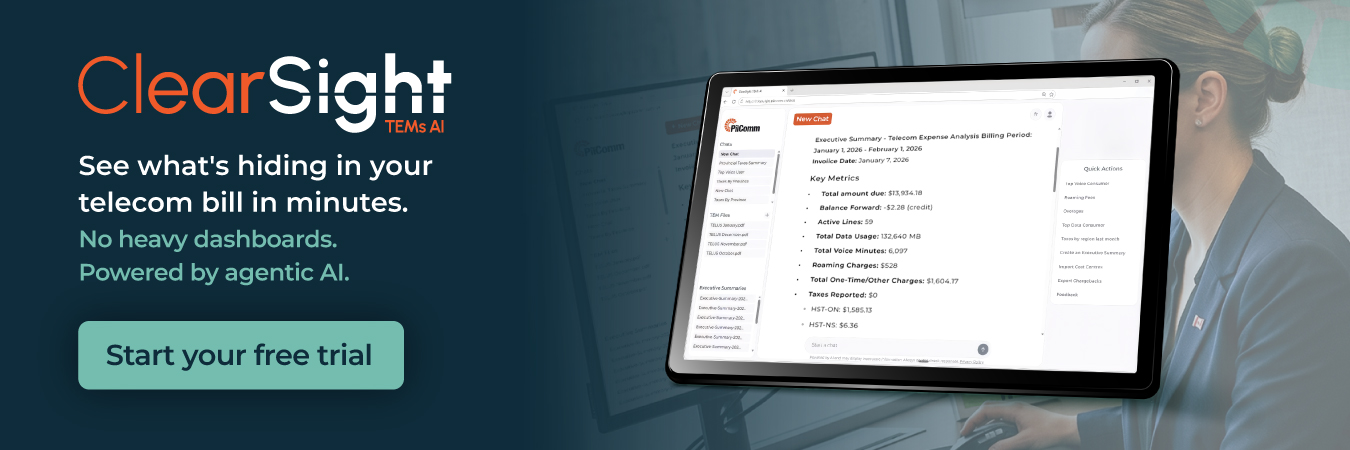
This is where AI-powered telecom expense management built for Canadian carrier invoices changes the equation. Upload a Bell or TELUS invoice and ask “Why did our bill spike this month?” in plain language—and get an answer in minutes instead of days. Ask “Which lines had zero usage last month?” and get a list you can act on immediately. Ask “How much are we spending on mobile data compared to last year?” and see the trend without building a pivot table.
The conversational interface matters because it eliminates the configuration barrier that kills traditional TEM implementations. You don’t need to know what report to run or what threshold to set. You ask a question in the same language you’d use asking a colleague, and the AI surfaces the answer from your actual billing data.
ClearSight TEMs AI was built specifically for this Canadian reality—parsing invoices from Bell, Rogers, TELUS, and regional carriers, handling provincial tax disaggregation automatically, and producing bilingual output for organisations with Quebec operations. At $99/month per billing account, it’s priced for mid-market organisations that can’t justify a six-figure TEM platform but can’t afford to keep ignoring their telecom spend either.
See what ClearSight TEMs AI finds in your first invoice—book a 20-minute demo

Building a telecom expense management practice for Canadian operations
You don’t need to overhaul your entire telecom governance model in one quarter. The most effective TEM implementations we’ve seen start with a single, focused action: audit your current invoices against your actual device inventory.
Everything else—the dashboards, the automated workflows, the carrier renegotiations—builds on that foundation. Without accurate baseline data, you’re optimising in the dark.
Step one: conduct a carrier invoice audit
The first step is always the same—reconcile what your carriers are billing you for against what you actually have deployed. We call this the “invoice-to-asset match,” and it’s surprising how few organisations have ever done it.
Pull three months of invoices from each carrier. Export your MDM device inventory. Compare the line counts. If you have 800 lines in MDM and 870 lines on the invoices, those 70 lines are either devices you don’t know about or lines you’re paying for that shouldn’t exist.
The gap between billed lines and active devices is typically 8–15% of the fleet. That gap is pure cost recovery—lines you can cancel immediately without affecting any user.
Step two: establish a single inventory of record
Once you’ve completed the initial reconciliation, you need a system that maintains accuracy going forward. This is harder than it sounds.
MDM tells you what’s enrolled. Carrier invoices tell you what’s billing. HR tells you who’s employed. Asset management tells you what was purchased. These systems rarely agree, and none of them is authoritative on its own.
The inventory of record needs to be invoice-derived—because at the end of the day, you’re trying to control what you’re paying for. Start with the billing data and reconcile everything else against it. When a device drops off MDM, check whether the line is still billing. When an employee terminates, verify the line was cancelled. When a new line appears on an invoice, confirm it was authorised.
Step three: implement automated variance detection
With a baseline established, the ongoing discipline is catching changes before they become cost leakage.
Automated variance detection flags deviations from expected patterns: a line that jumped from $50 to $150, a new charge code that wasn’t on last month’s invoice, a plan change that increased the per-line cost. Without automation, these variances hide in the noise of a 200-page invoice. With automation, they surface as exceptions that require human review.
The goal isn’t eliminating human judgment—it’s focusing human attention on the items that actually need it. An AI that flags 15 anomalies on a 2,000-line invoice is infinitely more useful than a human who doesn’t have time to look at any of them.
Step four: integrate TEM with device lifecycle management
TEM in isolation optimises invoices. TEM integrated with lifecycle management that tracks every device from deployment through decommissioning optimises the entire cost of mobile enablement.
When you deploy a device, the corresponding line should activate on the right plan. When a device goes into repair, the line should suspend to avoid billing during downtime. When a device is decommissioned through secure decommissioning with certified data erasure, the line should cancel—automatically, not through a manual process that someone forgets to complete.
This integration closes the loop that creates zombie lines in the first place. The device lifecycle drives the line lifecycle, and the billing reflects reality instead of lagging months behind it.
For organisations that want to go further, a Device as a Service model that converts unpredictable CapEx into a fixed monthly fee bundles TEM visibility with device lifecycle costs—one predictable per-device charge that includes hardware, management, support, and connectivity governance.
Talk to a mobility strategist about integrating TEM with your device lifecycle management
What to look for in a Canadian TEM provider
The Canadian TEM vendor landscape is notably thin. Most platforms available to Canadian enterprises are US-headquartered, with Canadian coverage as an afterthought rather than a design principle.
The Canadian-headquartered TEM market includes a small number of dedicated providers—Upland Cimpl in Montreal, Avotus in Mississauga, SpikeFli in Calgary, Adaptis Mobile in Edmonton—while the market is dominated by US-headquartered vendors serving Canadian clients. The question isn’t whether a vendor can technically process a Canadian invoice—it’s whether their platform was built to handle the specific complexities of Canadian carrier billing, tax treatment, and compliance requirements.
Ask any TEM vendor you’re evaluating one question: “Can you parse a TELUS enterprise invoice and a Bell enterprise invoice in the same platform, and show me provincial tax breakdowns for Ontario, Quebec, and Alberta on the same dashboard?” If they hesitate, they’re not built for Canadian operations.
Canadian carrier invoice parsing and bilingual output
The non-negotiable technical requirements for any TEM platform serving Canadian enterprises start with carrier format support.
Bell, Rogers, and TELUS each use materially different invoice structures for enterprise accounts. Line items are categorised differently. Surcharges are labelled differently. The way pooled data appears on a Bell invoice doesn’t match how TELUS structures the same information. A TEM platform that can parse one carrier accurately but struggles with another is operationally useless for a multi-carrier fleet.
Beyond parsing, the platform needs to produce output in both official languages. For organisations with Quebec operations, French-language audit reports, chargeback files, and executive summaries aren’t optional—they’re a Bill 96 compliance requirement.
Data residency and Canadian hosting
Where your TEM platform stores and processes data determines your compliance posture.
Canadian-hosted infrastructure means Canadian privacy law governs access to your data. It means your breach notification obligations are clear. It means you can answer “Where is our employee telecom data stored?” with a specific Canadian location rather than “Somewhere in AWS.”
For organisations subject to provincial regulations—healthcare under PHIPA, broader public sector under various provincial frameworks—Canadian data residency may be a procurement requirement rather than a preference. Verify hosting location before you’re deep into vendor evaluation and discover it’s a dealbreaker.
Integration with managed mobility and device lifecycle
The most sophisticated TEM practices don’t exist in isolation—they feed into broader fleet management decisions.
A TEM platform that connects to your MDM environment can correlate billing data with device status. A TEM platform that integrates with managed mobility services that cover the full device lifecycle can trigger line actions based on device events. A TEM platform that stands alone can tell you what you’re paying—but it can’t close the loop between what you’re paying and what you’re actually using.
When evaluating TEM providers, ask how the platform connects to your existing device management infrastructure. The answer will tell you whether you’re buying an invoice analyser or a telecom governance capability.
The ROI case for telecom expense management in Canadian enterprises
The business case for TEM in Canada is unusually straightforward because the baseline waste is so high. When 15–30% of your telecom spend is recoverable, the question isn’t whether TEM pays for itself—it’s how quickly.
First-time billing audits typically recover 12–18% of annual telecom spend according to enterprise audit data from TEM practitioners. A Canadian oil and gas producer saved $150,000 per month—$1.8 million annually—after a single TEM audit identified over-provisioned services. The Enterprise Telecom Management Association cites 22% average optimisation savings across its member base.
For a mid-market Canadian enterprise spending $500,000 annually on wireless, a conservative 15% recovery represents $75,000 in first-year savings. Against a TEM investment of $10,000–$50,000 depending on approach, the ROI math is unambiguous.
But the most compelling ROI metric isn’t the percentage savings—it’s the IT hours recovered. We see mid-market IT teams spending 40–60 hours per month on manual invoice review, carrier disputes, and ad hoc reporting for finance. That’s a half-FTE dedicated to a task that AI can handle in minutes. Recovering that time for strategic projects is often worth more to the CIO than the direct cost savings.
The CFO sees the budget line reduction. The CIO sees the IT capacity recovered. The operational leaders see invoices that finally match what they’re deploying. A properly implemented TEM practice creates value across all three perspectives.
Frequently asked questions about telecom expense management in Canada
What is telecom expense management (TEM)?
TEM encompasses five interconnected disciplines: invoice processing, inventory management, contract tracking, usage optimisation, and dispute resolution for an organisation’s telecom services. It’s a governance practice, not just bill payment—the difference between knowing what you’re paying and knowing what you should be paying.
How much can TEM save a Canadian enterprise?
First-time TEM implementations typically recover 10–35% of annual telecom spend, with ongoing annual savings of 10–18% and ROI multiples of 5:1 to 10:1 within 12 months. Canadian recovery rates tend toward the higher end due to concentrated carrier pricing and limited competitive pressure.
What types of billing errors are most common on Canadian carrier invoices?
The CCTS reports billing as the number-one complaint category, with unexpected charges, unauthorised price increases, and failure to apply promised credits as top issues. Enterprise errors are underrepresented in CCTS data because the ombudsman primarily serves consumers and small businesses with fewer than 100 employees.
Does the CRTC Wireless Code protect enterprise customers?
No. The Wireless Code’s protections—$50 domestic data overage caps, $100 international roaming caps, 15-day trial periods—apply only to individuals and businesses with fewer than 100 employees. Enterprises above that threshold operate without these regulatory safeguards.
What Canadian privacy laws affect TEM platform selection?
PIPEDA governs the collection and processing of employee telecom data nationally, Quebec’s Law 25 requires privacy impact assessments for out-of-province data transfers, and Bill 96 requires French-language output for Quebec operations. Platform selection directly affects compliance posture.
How does AI change telecom expense management?
AI-driven TEM platforms reduce per-invoice analysis time from 18.5 minutes to under 10 seconds while detecting anomalies without pre-configured rules. Conversational interfaces let users ask plain-language questions—”Why did our bill spike?”—instead of building custom reports.
What should I look for in a TEM provider for Canadian operations?
Non-negotiable requirements include Canadian carrier invoice parsing (Bell, Rogers, TELUS formats), bilingual English/French output for Quebec compliance, Canadian data residency, and interprovincial tax handling for accurate departmental chargebacks. PiiComm’s ClearSight was built specifically for these requirements.
Can TEM be integrated with mobile device management (MDM)?
The most effective TEM practices integrate with device lifecycle management so line activations, suspensions, and cancellations are triggered by device deployment and decommissioning events. This integration eliminates the gap between what’s deployed and what’s billed—the root cause of zombie line accumulation.
The window is open
Canadian wireless pricing has dropped nearly 50% in five years. Carrier competition is more intense than it’s been in a decade. AI has made invoice analysis accessible to organisations that could never justify a dedicated TEM analyst.
The enterprises that act now—auditing their current spend, establishing visibility, renegotiating contracts before the next renewal window closes—will lock in rates and recover costs that their competitors will still be leaking in 2028.
The ones that don’t will keep paying invoices they don’t understand, for services they’re not fully using, at rates that don’t reflect the current market.
The math hasn’t changed. Only the tools have.