Tangoe vs ClearSight TEMs AI: Which TEM platform fits Canadian operations?
If your primary pain is month-end invoice chaos across Bell, Rogers, and TELUS accounts and you need answers this week, not next quarter, ClearSight TEMs AI was built for that specific job. If you’re consolidating global technology expenses across 10,000+ devices in multiple countries and need deep workflow governance, Tangoe’s breadth earns its complexity. The rest of this post unpacks that call through the operational realities that actually determine which tool works in a Canadian environment.
Two different tools built for two different problems
Picture a procurement lead sitting in a vendor evaluation meeting, staring at a 47-row feature comparison spreadsheet. They’re six months into an evaluation process that hasn’t produced a single audited invoice. Someone asks about API integrations. Someone else wants to know about workflow automation capabilities. Meanwhile, the Bell invoice sitting in their inbox has three pages of roaming charges nobody can explain.
That spreadsheet is the wrong tool for the decision.
The question isn’t which platform has more features. The question is which platform matches your governance load, your timeline, and your Canadian compliance requirements.
Here’s the context most evaluation teams miss: the vast majority of Canadian enterprises haven’t adopted any formal TEM approach at all. Industry estimates from Canadian TEM practitioners suggest only 20–30% of large enterprises use a dedicated TEM platform, and that number drops to 5–10% for mid-market organizations. Choosing between platforms means you’re choosing whether to gain an advantage that 70-90% of your peers haven’t captured yet.
That changes the calculus. Time-to-value isn’t academic when you’re competing against organizations still reconciling invoices in Excel.
On the other end of the spectrum, Tangoe counts nearly half of the Fortune 500 among its clients, reflecting a platform built for the governance complexity that global multinationals face.
Here’s what actually happens in most mid-market TEM evaluations: the team spends four months comparing platforms, picks one, then spends another four months in implementation. Meanwhile, 12 months of invoices went unaudited. The zero-use lines kept billing. The roaming anomalies compounded. The tool that would have caught $80,000 in waste sat in procurement while $80,000 in waste walked out the door.
The right comparison framework starts with operational fit, not feature counts.
What Tangoe brings to global technology expense management
Tangoe One is a full technology expense management platform spanning mobile, fixed-line, cloud, and SaaS expenses. For enterprises coordinating spend across multiple countries, currencies, and carrier relationships, that breadth is the point.
The platform isn’t limited to telecom invoices. It handles IT asset management, SaaS subscription tracking, and cloud cost governance under a unified framework. For a multinational with 50,000 devices spread across North America, Europe, and Asia-Pacific, consolidating that visibility into a single system eliminates the fragmentation that creates audit gaps.
Tangoe has invested heavily in automation. The platform deploys AI, RPA, and predictive analytics across its technology expense workflows. Invoice processing, usage forecasting, anomaly detection, and procurement workflows all benefit from machine learning models trained on massive datasets.
A typical Tangoe implementation runs 12–16 weeks through discovery, configuration, and training. That’s the reality of configuring a platform that manages 50,000+ devices across global operations with multi-entity chargebacks flowing through SAP. If that’s your world, the implementation investment is proportional to the governance challenge.
The question is whether that investment makes sense when your world looks different.
Where Tangoe’s scale creates overhead for Canadian mid-market teams
The same platform depth that serves a Fortune 500 multinational creates configuration overhead that mid-market teams can’t absorb.
When you’re managing 500 devices across three Canadian carriers (not 50,000 devices across 40 countries) you don’t need multi-currency consolidation. You don’t need SAP integration workflows. You don’t need a 16-week implementation timeline.
What you need is someone to tell you why your Rogers bill spiked 23% last month.
For teams without dedicated TEM administrators, the configuration burden of enterprise platforms becomes a barrier rather than a benefit. The platform sits half-configured. The dashboards go unused. The quarterly audit never happens because nobody has time to learn the interface.
What ClearSight TEMs AI delivers for Canadian telecom operations
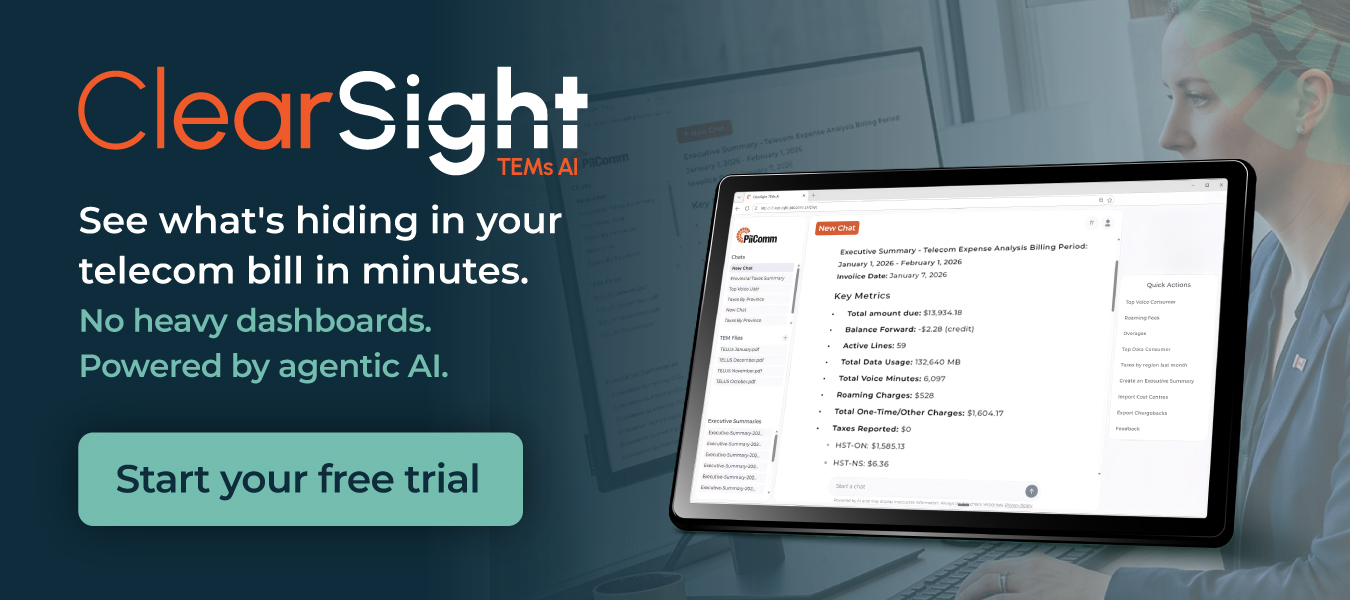
Drag and drop last month’s Bell and Rogers invoices. Ask “Why did Mobility BAN 003 spike?” Download a NetSuite-ready chargeback file before lunch.
That’s the entire value proposition.
ClearSight TEMs AI takes a fundamentally different approach to telecom expense management. Instead of building a comprehensive governance platform and asking buyers to configure it, ClearSight focuses on the highest-ROI layer of TEM: invoice parsing, anomaly detection, and accounting-ready exports.
The platform uses agentic AI to parse 100% of invoice data: every line item, every fee, and every usage record. It operates on Canadian-hosted infrastructure with isolated tenant environments, meaning invoice data never crosses borders. And it does this through a conversational, text-based interface rather than traditional dashboards.
Here’s what actually happens: you upload your invoice PDF, the AI agents parse every line item, and within minutes you’re asking questions about your spend. By day three, you’ve identified your zero-use lines and filed your first dispute. By week two, Finance has clean chargeback files. No consultants, no field mapping, no training videos.
The contrast with enterprise TEM isn’t about capability, it’s about operational fit. ClearSight is priced at $99/month per billing account, requires no implementation project, and delivers value the day you upload your first invoice.
The conversational interface and why it changes adoption
Most TEM platforms die in the adoption phase. Someone configures the dashboards, builds the reports, trains the team, and six months later, nobody logs in because the interface requires too much expertise to navigate.
ClearSight eliminates that barrier by replacing dashboards with conversation.
You don’t need to know where to click or which report to run. You type “Show me lines with zero usage last quarter” and get an answer. You ask “Why was our TELUS bill higher this month?” and the AI surfaces the exact charges driving the variance.
This isn’t a minor UX improvement. It’s the difference between a platform that requires TEM expertise and a platform that delivers TEM expertise. For teams without dedicated expense management staff, that distinction determines whether the tool gets used at all.
The adoption question becomes even more pointed when you layer in Canadian regulatory requirements—requirements that US-based platforms consistently miss.
Canadian data residency and compliance constraints that tip the comparison
Where your TEM platform stores and processes data determines your compliance posture. For Canadian enterprises subject to PIPEDA and provincial privacy frameworks, this is a deal-shaping constraint.
Telecom invoices contain employee names, phone numbers, call detail records, and location-derived usage data. Under PIPEDA, that’s personal information. When a TEM platform processes those invoices through US-based infrastructure, you’ve executed a cross-border transfer that requires documented consent and appropriate contractual protections.
The federal government has made its position clear. The Government of Canada’s Directive on Service and Digital identifies Canadian computing facilities as the “principal delivery option” for government data. That directive cascades through provincial procurement, healthcare, and broader public sector evaluation frameworks.
Budget 2024 reinforced the signal with approximately $2 billion earmarked for Canadian digital infrastructure, including $700 million specifically for Canadian cloud data centers. When federal spending prioritizes Canadian data sovereignty at that scale, the preference shows up in vendor evaluation scorecards across regulated industries.
We’ve had clients come to us after discovering their US-based TEM platform was routing Canadian employee call detail records through a data center in Virginia. Under PIPEDA, that’s a cross-border transfer that requires documented consent. Under Law 25, it triggers a mandatory privacy impact assessment. The vendor didn’t flag any of this because they didn’t know Canadian privacy law required it.
ClearSight TEMs AI operates on Canadian-hosted infrastructure with isolated tenant environments. Invoice data never crosses borders. For organizations navigating PIPEDA, PHIPA, or Law 25 compliance, that architectural decision eliminates an entire category of procurement risk.
Why Quebec operations demand bilingual TEM output
Quebec’s Law 25 and Bill 96 create requirements that US-based TEM platforms consistently miss.
Any platform generating reports, chargeback files, or audit summaries for Quebec operations must produce French-language output. This is a legal requirement with penalties of $3,000 to $30,000 per day for non-compliance.
ClearSight provides bilingual English/French output as a standard capability. For organizations with Quebec employees or Quebec-based operations, this is a procurement checkpoint that surfaces in the first governance review. Ask any vendor you’re evaluating to demonstrate French-language report generation with your actual invoice data before you sign anything.
How each platform handles Canadian carrier invoice formats
Bell, Rogers, and TELUS each use materially different invoice structures for enterprise accounts. A TEM platform that handles one carrier accurately but struggles with another is operationally useless for a multi-carrier fleet.
This isn’t theoretical. The CCTS logged a record 23,647 complaints in 2024–25, up 17% year-over-year, with billing as the top category. And that number understates enterprise exposure as organizations with 100+ employees have no formal ombudsman channel. The CRTC Wireless Code explicitly excludes enterprises from consumer protections like overage caps and mandatory contract disclosures.
Your TEM practice is your only safety net.
ClearSight was built specifically for Canadian carrier invoice parsing. The AI agents understand Bell’s hierarchical BAN structures, Rogers’ consolidated billing formats, and TELUS’ service-level breakdowns. Upload a PDF from any major Canadian carrier and the platform extracts every line item, fee, and usage record within minutes.
Here’s what actually happens with platforms built for US carriers first: they parse AT&T and Verizon invoices natively, then treat Canadian carriers as edge cases requiring custom configuration. Fields get misaligned. Taxes get miscategorized. Usage records get truncated. You spend the first three months of implementation debugging parser issues instead of auditing invoices.
The accounting export is where theory meets month-end reality. Finance doesn’t want your dashboard, they want a file that posts clean to QuickBooks with correct cost centers, proper HST/GST/PST splits by province, and account codes that match their chart of accounts.
We see teams burn half a day every month manually fixing export files because their TEM platform doesn’t understand that Ontario charges HST while BC charges GST plus PST. Alberta is GST-only. Quebec adds QST. A platform that treats “Canadian taxes” as a single line item creates reconciliation work that compounds every billing cycle.
There’s also the border-roaming problem that only surfaces in Canadian fleets. A device sitting in a Windsor yard locks onto a Detroit tower for an entire billing period accrues $360 in unexpected roaming charges; that looks like legitimate international travel unless you’re checking tower registration against device location. Same pattern along the Niagara corridor. Same pattern along the BC-Washington border.
ClearSight’s anomaly detection flags these patterns automatically because the platform was built by practitioners who’ve managed physical device fleets in Canadian border regions. That operational context doesn’t exist in platforms designed for US domestic operations.
Side-by-side fit summary by organization profile
Match the tool to your governance load and time-to-value expectations, not to a feature count.
| Evaluation Criteria | Tangoe One | ClearSight TEMs AI |
|---|---|---|
| Portfolio scope | Mobile, fixed-line, cloud, SaaS across global operations | Canadian mobile and telecom invoices |
| Time to first insight | 12–16 weeks (implementation + configuration) | Minutes (upload and ask) |
| Data residency | US-based infrastructure | Canadian-hosted with isolated tenants |
| Bilingual output | Not standard | English/French native |
| Implementation ownership | Requires dedicated TEM administrator | Self-service, no training required |
| Pricing model | Enterprise contract (typically six figures annually) | $99/month per billing account |
If you’re managing 10,000+ devices across multiple countries with chargebacks flowing through SAP, Tangoe’s governance depth justifies the implementation investment. That’s the tool built for your problem.
If you’re managing 500 devices across Bell, Rogers, and TELUS, need answers this month instead of next quarter, and don’t have a dedicated TEM administrator on staff, ClearSight was built for exactly that operational profile.
Most readers fall somewhere between those extremes. The 30-day pilot framework below helps you test fit with your own data before committing to either path.
A 30-day pilot that proves fit with your own data
The evaluation that matters happens when your actual invoices meet the actual platform, not when a vendor runs a polished demo with sample data.
Any TEM vendor confident in their platform will let you test with your own invoices before you commit. The ones who insist on lengthy proof-of-concept cycles before you see value? That tells you everything about where the risk sits in their deployment model.
Here’s what a meaningful 30-day pilot should accomplish:
- Week 1: Upload one complete billing account from your largest carrier. Verify the platform parses every line item accurately, including fees, usage, taxes, and service codes. If parser errors surface, document them and assess the vendor’s remediation timeline.
- Week 2: Generate your first chargeback file and send it to Finance. Does it post clean to your accounting system? Are cost centers mapped correctly? Are provincial taxes split accurately? If Finance rejects the file or requires manual edits, that’s your future every month.
- Week 3: Identify at least one billing anomaly, for example, a zero-use line, an unexpected fee, a roaming spike. Then, file a carrier dispute. The platform’s value isn’t in the dashboard; it’s in the action the insight enables.
- Week 4: Run an executive summary comparing this month’s invoice to the prior period. Can you explain the variance drivers to your CFO in plain language? Can you export a renewal variance pack your carrier account manager can’t argue with?
By day 30, you should have a filed dispute, a clean accounting file that Finance accepted without edits, and a clear answer on whether the platform fits your operational reality. If you don’t have those three things, you don’t have a TEM tool. You have a subscription to a dashboard nobody will use.
When invoice clarity needs operational execution behind it
Your variance report shows 50 dormant scanner lines and 20% savings available through plan optimization. Someone still needs to execute those changes without disrupting the frontline workers who depend on those devices.
This is where the gap between TEM software and managed mobility operations becomes material.
Finding the zero-use lines is the easy part. Disconnecting them requires coordinating with the carrier, confirming the line isn’t attached to a spare device in a warehouse, ensuring the disconnection doesn’t break a shared data pool, and verifying the change appears on next month’s invoice. Finding the roaming anomaly is straightforward. Deploying roaming controls across 200 devices without creating a support ticket surge requires MDM expertise and change management discipline.
PiiComm built ClearSight TEMs AI as the intelligence layer for organizations that need invoice clarity without six-figure TEM contracts. But PiiComm’s operational foundation is managed mobility services, with 15+ years of staging devices, managing carrier relationships, and keeping frontline fleets running across Canadian operations.
The Sunday night scenario matters. When a Zebra scanner fails in a Brandon distribution center at 9 PM, PiiComm’s Spare-in-the-Air program ships a pre-staged replacement for Monday delivery. The variance win you found in ClearSight shows up on next month’s invoice because operations actually changed: the zero-use line got disconnected, the roaming controls got deployed, and the obsolete rate plans got updated.
For organizations that need both invoice intelligence and operational execution, ClearSight becomes the diagnostic layer while PiiComm’s managed mobility team handles the implementation. The zero-use lines identified in ClearSight flow into a lifecycle management engagement that recalls devices, processes disconnections, and ensures the savings actually materialize.
When devices reach end-of-life, certified decommissioning with chain-of-custody documentation closes the loop. The invoice line disappears because the device was properly retired, not because someone forgot to cancel it and got lucky.
See your last invoice explained in minutes—request a ClearSight walkthrough using your own data.
If you’re evaluating how to connect TEM intelligence to device lifecycle execution, talk to a mobility strategist about the operational integration.
ClearSight TEMs AI vs. Tangoe: Frequently asked questions
How does Tangoe use AI in its telecom expense management platform?
Tangoe deploys AI, robotic process automation, and predictive analytics across its Tangoe One platform for invoice processing, usage forecasting, and anomaly detection. The platform is architected for global enterprise scale, with automation designed to handle technology expenses across mobile, fixed-line, cloud, and SaaS categories.
Is ClearSight TEMs AI a full replacement for a legacy TEM platform?
ClearSight focuses on invoice parsing, anomaly detection, and accounting-ready exports—the highest-ROI layer of telecom expense management. Organizations needing multi-category governance across fixed-line, cloud, and SaaS may need broader platforms. For Canadian mobile telecom, ClearSight delivers complete coverage without enterprise TEM complexity.
Does the CRTC Wireless Code protect enterprise customers from billing errors?
No. The Wireless Code explicitly excludes enterprises with 100 or more employees. Consumer protections like $50 domestic overage caps, $100 international roaming caps, and mandatory 15-day trial periods don’t apply. Enterprise TEM practices are your only systematic protection against billing errors.
Where does ClearSight TEMs AI store and process invoice data?
ClearSight operates on Canadian-hosted infrastructure with isolated tenant environments. Invoice data, including employee call detail records and usage information, never crosses borders. This architecture addresses PIPEDA cross-border transfer requirements and Law 25 privacy impact assessment triggers.
Can either platform generate French-language reports for Quebec operations?
ClearSight provides bilingual English/French output as standard. Bill 96 requires French-language commercial documents for Quebec operations, with penalties of $3,000–$30,000 per day for non-compliance. Verify French-language capability with any TEM vendor before procurement.
How fast can a mid-market team see value from a TEM platform?
ClearSight surfaces anomalies and generates chargeback exports within minutes of first invoice upload, and no implementation project required. Traditional enterprise TEM platforms typically require 12–16 weeks for discovery, configuration, and training before delivering comparable insights.
What does ClearSight TEMs AI cost compared to enterprise TEM platforms?
ClearSight is priced at $99/month per billing account. Enterprise TEM platforms typically require six-figure annual commitments plus implementation fees, professional services, and ongoing administration costs. The pricing difference reflects different operational models: self-service AI versus administered enterprise software.
The comparison between Tangoe and ClearSight isn’t really about features or capabilities. It’s about operational fit; matching the tool to your governance load, your timeline, and your Canadian compliance constraints.
Most organizations reading this comparison have invoices sitting in an inbox right now with anomalies nobody has time to find. The pricing environment has shifted dramatically as Canadian wireless plan costs dropped 47% between 2020 and 2024, which means contracts negotiated before last year almost certainly don’t reflect current market reality.
The question isn’t whether to adopt TEM. The question is how quickly you can get line-level visibility into spend that’s been invisible for years.
Upload an invoice. Ask a question. See what surfaces.