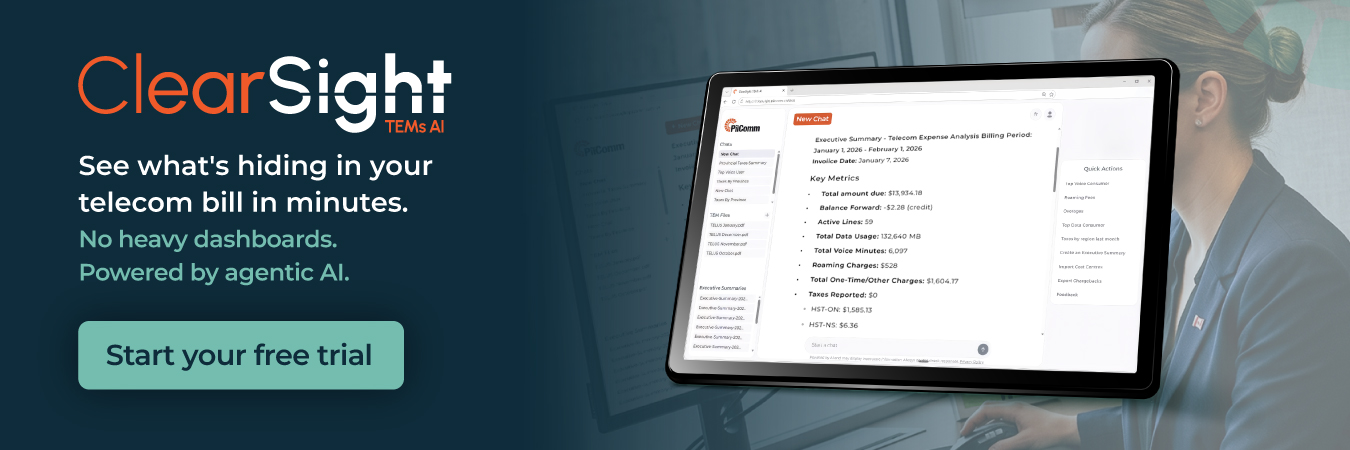
Your finance team just spent two days reconciling last month’s carrier invoices across Bell, Rogers, and TELUS. They still can’t tell you why wireless spend increased 12%.
You searched “best telecom expense management software” and found six listicles ranking platforms you’ve never heard of. None of them mentioned whether those platforms can parse a Canadian carrier invoice natively. None addressed whether they generate French-language chargeback reports for your Quebec operations. Most didn’t acknowledge that Canada exists as anything other than “international support.”
Here’s the cost of getting this decision wrong: Canadian enterprises waste an estimated 15–30% of their annual telecom spend due to billing errors, unused lines, and rate plan mismatches. Applied to the roughly $23–26 billion Canadian businesses spend on telecom services annually, that’s $3.5 billion to $6.9 billion in recoverable cost leakage sitting in invoices nobody has time to read properly.
The right TEM platform pays for itself in weeks, not years. The wrong one adds another dashboard to ignore.
This list evaluates eight TEM platforms through a Canadian operational lens—not just feature checklists, but how each one handles the specific challenges of managing telecom expenses in a market with three dominant carriers, interprovincial tax variation, and privacy legislation that most US-built platforms weren’t designed for.
How we evaluated these telecom expense management platforms
Most TEM comparison lists evaluate platforms on feature counts and G2 ratings. That’s useful if you’re buying software for a US enterprise with Verizon and AT&T invoices.
For Canadian buyers, the evaluation criteria that actually determine whether a TEM platform works for your organisation are almost never discussed. Here’s what we looked for.
Canadian carrier invoice parsing and format support
This is the first criterion because it’s the one most platforms fail quietly.
Bell, Rogers, and TELUS each use different invoice formats, surcharge taxonomies, and line-item structures. A TEM platform that “supports international invoices” may still require your team to export carrier data into a CSV template before the platform can ingest it.
That’s not automation—that’s a workaround dressed up as a feature.
We’ve evaluated TEM platforms that claim Canadian support but actually require manual preprocessing for every invoice. The sales team says “we support Canadian carriers.” What they mean is “we can import a CSV if you build it yourself.” Ask specifically: does your platform parse Bell, Rogers, and TELUS invoice PDFs natively, or does my team need to touch the data first?
Bilingual output and Quebec compliance readiness
If you operate in Quebec—and most national Canadian enterprises do—this isn’t a nice-to-have. It’s a legal requirement.
Bill 96 strengthened Quebec’s language requirements significantly. Penalties range from $3,000 to $30,000 per day per violation, doubled for second offences. If your TEM platform generates English-only chargeback reports, cost allocation files, or executive summaries that your Quebec operations use internally, you’re accumulating compliance exposure every month.
Most US-built platforms don’t offer French-language output at all. Some offer it as a “roadmap item.” Neither helps you when procurement asks for compliance documentation.
Data residency and Canadian privacy alignment
Call detail records processed by TEM platforms constitute personal information under PIPEDA. They show who called whom, when, for how long, and from where.
When you route that data through a US-hosted platform, you’ve created a cross-border data transfer that PIPEDA’s accountability principle requires you to document and protect. Worse, US-hosted data is subject to the US CLOUD Act, which can compel disclosure to US authorities regardless of where the data originated.
For organisations in healthcare, government, and financial services, Canadian data residency is often a procurement-blocking requirement. For everyone else, it’s a compliance question your legal team will eventually ask. Better to answer it during evaluation than after you’ve signed a three-year contract.
AI-driven automation vs. rule-based workflows
The TEM category is splitting in two.
Legacy platforms use rule-based workflows: you configure thresholds, build reports, set up alerts. They work, but they require significant implementation time, ongoing administration, and analyst hours to interpret the dashboards.
AI-native platforms take a different approach. You upload an invoice, ask a question in plain language, and get an answer. No configuration. No training. No six-month implementation.
The performance gap is measurable. AI-driven TEM platforms deliver 33–40% cost reductions compared to 15–20% for manual processes, with per-invoice analysis time dropping from 18.5 minutes to 8 seconds. For a Canadian enterprise processing 50+ carrier invoices monthly, that’s the difference between a full-time analyst role and a 15-minute upload.
Integration with Canadian accounting and ERP systems
Mid-market Canadian buyers don’t need Salesforce integrations or SAP connectors. They need clean CSV exports that QuickBooks and NetSuite can ingest without manual reformatting.
We evaluated whether each platform generates accounting-ready chargeback files with proper cost-centre mapping, or whether “export” means downloading a PDF summary that someone still has to re-key into the accounting system.
The 8 best telecom expense management software platforms for 2026
The rankings below reflect Canadian operational fit—not just global feature breadth. Each platform is evaluated on how well it serves organisations managing telecom expenses across Canadian carriers, provinces, and compliance requirements.
Platforms that were built for the Canadian market, or have demonstrated strong Canadian operational capability, rank higher than those treating Canada as an afterthought.
1. ClearSight TEMs AI (PiiComm)
ClearSight TEMs AI is the only TEM platform built from the ground up for the Canadian market, by a Canadian managed mobility services provider that has spent 15+ years parsing Canadian carrier invoices and managing enterprise wireless fleets across every province.
Brief description: Canadian-built agentic AI telecom expense management platform that analyses carrier invoices through a conversational interface. Upload a Bell, Rogers, or TELUS invoice and ask plain-language questions—”Why did our bill spike this month?” or “Which lines had zero usage last quarter?”—and get instant, specific answers.
Best for: Mid-market Canadian enterprises (250–2,500 employees) that need immediate invoice visibility without the 6–12 month implementation cycle of legacy TEM platforms. Particularly strong for organisations with Quebec operations requiring bilingual reporting.
Key features:
- Agentic AI invoice parsing for all major Canadian carriers
- Conversational interface—ask questions in plain language
- Automated anomaly detection (billing errors, zero-use lines, usage spikes)
- Automated cost allocation and chargeback file generation (QuickBooks, NetSuite compatible)
- Executive summary reports
- Bilingual (English/French) output
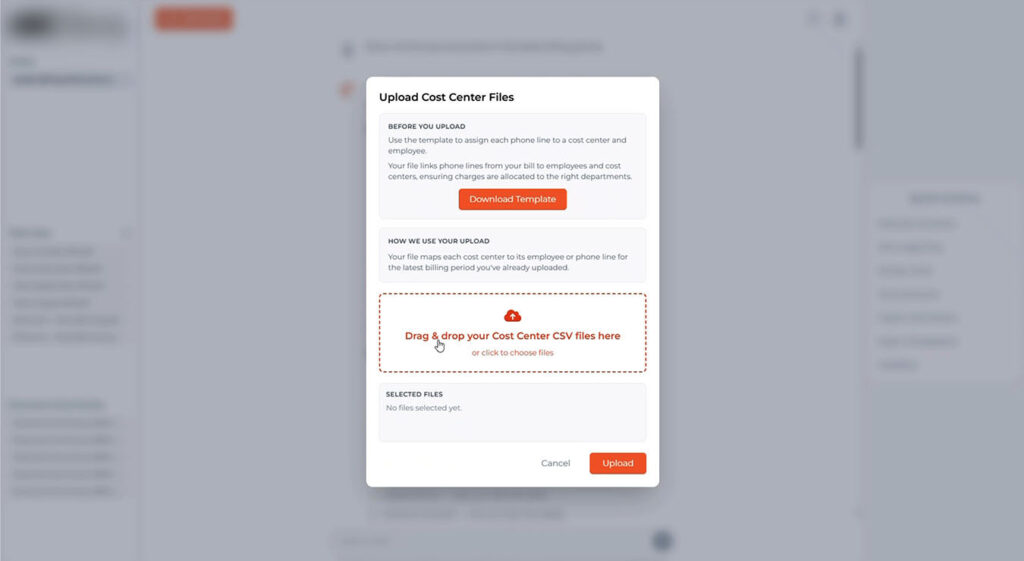
Simply drag and drop your telecom invoice directly into the ClearSight interface.
Pros:
- Purpose-built for Canadian carrier invoice formats
- Bilingual output built in, not bolted on
- Secure Canadian hosting with isolated tenant environments
- $99/month per billing account—fraction of legacy TEM platform costs
- No complex setup or training required—upload an invoice and start asking questions
- Fast time-to-value (minutes, not months)
Cons:
- Focused on invoice analysis and cost optimisation rather than full lifecycle TEM (ordering, provisioning, dispute management)
- Newer platform (launched December 2025) with less market tenure than established players
- Best suited for organisations that want self-service AI analysis rather than fully managed TEM services
Pricing: $99/month per billing account.
Canadian-specific takeaway: ClearSight is the only TEM platform with native Canadian carrier invoice parsing, bilingual output, and guaranteed Canadian data residency—eliminating the compliance gaps that come with routing employee telecom data through US infrastructure.

2. Upland Cimpl
Cimpl has Canadian roots—founded in Montreal, built by people who understood the Bell and Vidéotron invoice formats from day one. That heritage matters, though the ownership picture has changed.
Brief description: Full-lifecycle TEM platform originally built in Montreal, now part of Upland Software’s portfolio following a $25.7 million acquisition in 2019. Covers procurement, usage, allocation, and invoice management across carriers and service providers.
Best for: Large Canadian enterprises (2,500+ employees) with complex multi-carrier, multi-service environments that need comprehensive lifecycle TEM—not just invoice analysis.
Key features:
- Centralised telecom asset visibility
- Contract management and compliance tracking
- Cost allocation and usage analysis
- Automated invoice processing
- Reporting and analytics
Pros:
- Canadian-founded with understanding of Canadian carrier landscape
- Broad TEM functionality beyond just invoice analysis
- Established platform with Gartner Peer Insights ratings of 4.5/5 from 7 ratings
- Supports multi-carrier environments
Cons:
- Now owned by US-based Upland Software—data residency and hosting details should be confirmed during procurement
- Implementation timelines typical of enterprise TEM platforms (weeks to months)
- Pricing not publicly available—requires sales engagement
- Complexity may exceed what mid-market organisations need
Pricing: Custom enterprise pricing; not publicly listed.
Canadian-specific takeaway: Cimpl’s Montreal origins give it stronger Canadian carrier familiarity than most US-built platforms, but buyers should verify current data residency and hosting arrangements post-acquisition.
3. Tangoe One Telecom
If you’re managing telecom across 30 countries and Canada is one of them, Tangoe makes sense. If Canada is your primary market, the overhead may not be justified.
Brief description: AI-powered lifecycle management platform with 25+ years of TEM experience. Covers financial management, reporting, analytics, and compliance across global carrier ecosystems.
Best for: Large multinational enterprises (5,000+ employees) managing telecom expenses across multiple countries where Canada is one of several operating regions.
Key features:
- 70+ patented automation features
- Global carrier ecosystem integrations
- Billing error detection and dispute management
- SD-WAN and fixed network cost management
- Detailed reporting and analytics
Pros:
- Deep global carrier coverage and integration ecosystem
- 25+ years of TEM operational experience
- AI-powered automation for invoice processing and error detection
- Strong for organisations managing both wireline and wireless across multiple countries
Cons:
- US-headquartered with US infrastructure—Canadian data residency not guaranteed
- Implementation complexity and timeline suited to large enterprise, not mid-market
- Pricing reflects enterprise scale—not accessible for organisations with fewer than 1,000 lines
- No native bilingual (French) capability documented
Pricing: Custom enterprise pricing; typically engagement-based with managed services component.
Canadian-specific takeaway: Tangoe serves Canadian clients through its North American operations, but Canadian buyers should confirm data residency, French-language reporting capability, and whether Canadian carrier invoice formats are parsed natively or require manual preprocessing. Gartner Peer Insights rates Tangoe 4.3/5 from 19 ratings.
4. Sakon
Sakon consistently earns the highest user ratings in the TEM category. The platform quality is real—the question for Canadian buyers is whether that quality extends to Canadian-specific requirements.
Brief description: Cloud-based TEM platform focused on telecom asset, contract, and expense management with strong reporting and auditing capabilities.
Best for: Modern enterprises (1,000+ employees) looking for a cloud-native TEM platform with strong analytics and cost optimisation features.
Key features:
- Telecom usage and cost tracking across carriers
- Automated invoice processing
- Detailed reporting and auditing
- Contract and inventory management
- Budgeting accuracy tools
Pros:
- Highest-rated TEM platform on Gartner Peer Insights (4.6/5 from 35 ratings)
- Cloud-native architecture
- Strong analytics and reporting
- Good for organisations prioritising spend visibility and budgeting accuracy
Cons:
- US-headquartered—data residency and Canadian hosting should be verified
- No documented bilingual capability
- Canadian carrier invoice support should be confirmed during evaluation
- Enterprise pricing not publicly available
Pricing: Custom pricing; not publicly listed.
Canadian-specific takeaway: Sakon’s strong Gartner ratings reflect genuine platform quality, but Canadian buyers should confirm native support for Bell, Rogers, and TELUS invoice formats and ask specifically about data residency before proceeding.
The platforms ranked 5–8 round out the competitive landscape, each with specific strengths—and the same Canadian compliance questions that every US-built TEM platform must answer.
5. Calero
The January 2024 merger between Calero and MDSL created a broader technology expense management platform—telecom, cloud, SaaS, UCaaS under one roof. That breadth is genuinely useful for organisations whose expense management headaches extend beyond wireless invoices.
Brief description: Unified platform combining telecom, mobile, communications, and software expense management following the Calero-MDSL merger in January 2024.
Best for: Large enterprises managing complex technology expense portfolios that extend beyond telecom into cloud, SaaS, and UCaaS spending.
Key features:
- Combined telecom and technology expense management
- Invoice processing and billing error identification
- Contract compliance tracking
- Cost allocation and departmental reporting
- Multi-vendor management
Pros:
- Broad technology expense coverage (not just telecom)
- Established platform with Gartner Peer Insights presence (4.4/5 from 21 ratings)
- Strong for organisations wanting a single platform for telecom and broader IT expenses
- Scale from Calero-MDSL merger
Cons:
- US-headquartered—standard data residency and hosting concerns for Canadian buyers
- Platform complexity may exceed mid-market needs
- No documented French-language capability
- Merger integration may affect near-term product stability
Pricing: Custom enterprise pricing; not publicly listed.
Canadian-specific takeaway: Calero’s breadth is appealing for organisations managing both telecom and broader technology expenses, but the same Canadian compliance questions apply—confirm data residency, carrier format support, and bilingual capability before signing.
6. brightfin
If your organisation already runs ServiceNow for IT service management, brightfin eliminates the question of where TEM should live. It’s native to the platform your team already uses daily.
The flip side: if you don’t run ServiceNow, brightfin isn’t an option.
Brief description: TEM platform built natively on ServiceNow, managing mobile, fixed, and cloud service expenses within the ServiceNow environment.
Best for: Enterprises already running ServiceNow ITSM that want telecom expense management integrated into their existing IT service management workflows.
Key features:
- Native ServiceNow integration
- Invoice processing and usage analysis
- Cost allocation to departments and cost centres
- Billing error identification and dispute management
- Reporting and financial insights
Pros:
- Seamless for ServiceNow-centric organisations
- Reduces tool sprawl by operating within existing ITSM platform
- Automation features for invoice processing and cost allocation
- Gartner Peer Insights rated 4.5/5 (from 2 ratings)
Cons:
- Requires ServiceNow—not viable for organisations without it
- US-headquartered with standard Canadian data residency concerns
- Limited Gartner review volume (2 ratings) makes independent validation difficult
- No documented bilingual capability
Pricing: Not publicly listed; tied to ServiceNow licensing model.
Canadian-specific takeaway: If your organisation runs ServiceNow and wants TEM inside that ecosystem, brightfin is worth evaluating—but confirm Canadian carrier invoice parsing and data residency independently.
7. Lightyear
Lightyear approaches TEM from the procurement side first. The platform’s strength is automating the RFP and quoting process for telecom services—a genuinely differentiated capability that most TEM platforms don’t touch.
Brief description: Digital workflow platform covering the full lifecycle of enterprise telecom services—procurement, network inventory management, and AI-native expense management.
Best for: Enterprises (1,000+ employees) focused on telecom procurement efficiency and network inventory tracking alongside expense management.
Key features:
- Automated RFP creation and quoting for telecom services
- Network inventory manager tracking 30+ data points per service
- AI-native billing automation
- Lifecycle management workflows (MACD ticketing, renewals)
- Multi-carrier support
Pros:
- Modern, digital-first approach to telecom lifecycle management
- Strong procurement automation (not just expense tracking)
- AI-native billing and payment automation
- Closed-loop lifecycle platform (procurement through expense management)
Cons:
- US-focused platform—Canadian carrier and compliance support should be verified
- Relatively new entrant with limited Gartner review volume (3 ratings)
- Pricing not publicly available
- No documented bilingual capability
Pricing: Not publicly listed; custom pricing.
Canadian-specific takeaway: Lightyear’s procurement automation is genuinely differentiated, but Canadian buyers should treat it as a US platform until Canadian carrier parsing, data residency, and bilingual output are confirmed.
8. Tellennium (Management of Things)
Here’s the emerging reality: organisations aren’t just managing wireless lines anymore. IoT device fleets—fleet trackers, environmental sensors, connected equipment—are generating their own billing complexity. Tellennium is positioning for that convergence.
Brief description: TEM platform expanded to cover IoT and connected device management through its Management of Things (MoT) platform, addressing the convergence of telecom and IoT expense management.
Best for: Enterprises with growing IoT device fleets alongside traditional telecom services that need unified expense visibility across both categories.
Key features:
- Telecom expense management and IoT device lifecycle management
- Provisioning, auditing, and compliance tracking
- Real-time device tracking and reporting
- Integration with enterprise systems
- Automation for manual device management tasks
Pros:
- Unique positioning at the intersection of TEM and IoT management
- Perfect 5.0 Gartner Peer Insights rating (from 3 ratings)
- Addresses emerging IoT billing complexity
- Automation reduces manual device management overhead
Cons:
- US-headquartered with standard Canadian compliance considerations
- Small review sample size
- IoT focus may be premature for organisations not yet managing large IoT fleets
- No documented Canadian carrier or bilingual support
Pricing: Not publicly listed; custom pricing.
Canadian-specific takeaway: Canada’s IoT device market reached USD $5.25 billion in 2024 and is growing at 15.5% CAGR—Tellennium’s IoT+TEM positioning is forward-looking, but Canadian buyers should verify the same carrier, residency, and language requirements as with any US-based platform.
Telecom expense management software comparison table
This is the section your evaluation team will screenshot. The table summarizes all eight platforms across the criteria that matter most for Canadian buyers—not generic feature lists, but the specific capabilities that determine whether a TEM platform works for Canadian operations.
| Platform | Best For | Canadian Carrier Parsing | Bilingual (EN/FR) | Canadian Data Residency | AI-Powered | Pricing | Gartner Rating |
|---|---|---|---|---|---|---|---|
| ClearSight TEMs AI | Mid-market Canadian enterprises (250–2,500 employees) | ✓ Native | ✓ Built-in | ✓ Guaranteed | ✓ Agentic AI | $99/mo per billing account | New (Dec 2025) |
| Upland Cimpl | Large Canadian enterprises (2,500+) | ✓ Canadian heritage | Verify | Verify post-acquisition | Partial | Custom | 4.5/5 (7) |
| Tangoe One Telecom | Multinational enterprises (5,000+) | Verify | Not documented | Not guaranteed | ✓ AI-powered | Custom | 4.3/5 (19) |
| Sakon | Modern enterprises (1,000+) | Verify | Not documented | Verify | Partial | Custom | 4.6/5 (35) |
| Calero | Large enterprises with broad tech expenses | Verify | Not documented | Verify | Partial | Custom | 4.4/5 (21) |
| brightfin | ServiceNow-centric enterprises | Verify | Not documented | Verify | Partial | Custom | 4.5/5 (2) |
| Lightyear | Procurement-focused enterprises (1,000+) | Verify | Not documented | Verify | ✓ AI-native | Custom | Limited ratings |
| Tellennium | Enterprises with IoT fleets | Verify | Not documented | Verify | Partial | Custom | 5.0/5 (3) |
The pattern is clear. Every US-built platform requires Canadian buyers to verify the same three things: native carrier parsing, bilingual output, and data residency. These aren’t edge cases—they’re baseline requirements for Canadian operations.
What Canadian buyers should verify before committing to a TEM platform
Every platform on this list will demo well. The sales team will show you clean dashboards, impressive automation, and a polished walkthrough with sample data.
The differences that matter only surface when you ask the right questions during procurement.
Confirm native Canadian carrier invoice format support
There’s a significant difference between “we support Canadian clients” and “our platform natively parses Bell, Rogers, and TELUS invoice formats without manual preprocessing.”
The former is a sales claim. The latter is an operational capability.
We’ve seen organisations sign three-year TEM contracts only to discover that “Canadian support” meant their team still had to export carrier data into a template before the platform could process it. That’s not TEM—that’s data entry with extra steps.
Ask specifically: can I upload a Bell PDF invoice and have it parsed automatically? Or does someone on my team need to extract the data first?
Request a data residency attestation, not just a verbal assurance
“Canadian data residency” should be documented in writing—not just mentioned in a sales call.
Ask where invoice data, usage records, and employee information are stored and processed. Ask whether any data flows through US infrastructure at any point in the processing pipeline. For organisations in healthcare or government, this is often a procurement-blocking requirement.
The US CLOUD Act allows US authorities to compel disclosure of data held by US companies regardless of where that data is physically stored. If your TEM provider is US-headquartered, your Canadian telecom data may be subject to US jurisdiction even if it’s hosted in Canada.
Test bilingual output with your actual Quebec invoices
If you operate in Quebec, don’t accept “we’re working on it” as an answer to bilingual capability questions.
Upload a real Vidéotron or Bell Quebec invoice during the evaluation. Request French-language output—chargeback reports, cost allocation files, executive summaries. Bill 96 penalties apply now, not when the vendor’s roadmap catches up.
The organisations that skip this step during evaluation discover the gap when their Quebec operations flag the English-only reports. By then, they’re locked into a contract and accumulating compliance exposure monthly.
Ready to see how a Canadian-built TEM platform handles your actual carrier invoices?
Request a ClearSight demo and upload a real Bell, Rogers, or TELUS invoice. You’ll see exactly how the platform parses Canadian carrier formats, generates bilingual output, and surfaces the anomalies hiding in your telecom spend—all with guaranteed Canadian data residency.
Frequently asked questions about telecom expense management software
What is telecom expense management software?
TEM software automates the process of managing telecommunications expenses—invoice processing, usage tracking, contract management, and cost allocation. It replaces manual spreadsheet work with automated analysis, flagging billing errors, unused lines, and cost optimisation opportunities that would otherwise require analyst hours to identify.
How much can telecom expense management software save?
Organisations implementing TEM typically achieve first-year cost reductions of 10–35%, with ROI multiples of 5:1 to 10:1 within 12 months. AI-powered platforms deliver 33–40% reductions versus 15–20% for manual approaches—the difference between incremental improvement and material budget recovery.
How much does telecom expense management software cost?
Pricing ranges from $99/month per billing account for AI-native platforms like ClearSight TEMs AI to custom enterprise pricing (typically five to six figures annually) for full-lifecycle TEM platforms. The total cost depends on fleet size, service scope, and whether you need managed services or self-service analysis.
What features should I look for in TEM software for Canadian operations?
Canadian buyers should prioritise native Canadian carrier invoice parsing (Bell, Rogers, TELUS), bilingual output for Quebec Bill 96 compliance, Canadian data residency, and automated provincial tax disaggregation for accurate departmental chargebacks. Most US-built platforms don’t address these requirements natively.
Do I need TEM software if I only have 200–500 wireless lines?
Mid-market organisations are the most underserved segment—only 5–10% use dedicated TEM—yet they experience the same billing errors and cost leakage as large enterprises. At 300 lines averaging $50/month, even a 10% error rate represents $18,000 annually in recoverable costs.
What is the difference between TEM software and managed mobility services?
TEM software analyses invoices and identifies cost optimisation opportunities. Managed mobility services act on those findings—renegotiating contracts, decommissioning unused lines, managing device lifecycles, and administering MDM policies. TEM is the diagnostic; MMS is the treatment.
Can TEM software handle Canadian carrier invoices from Bell, Rogers, and TELUS?
Not all platforms can. Canadian carrier invoices use different formats, surcharge taxonomies, and line-item structures than US carriers. Buyers should confirm native parsing capability during evaluation—”international support” is often a proxy for manual preprocessing requirements.
Is my telecom data subject to PIPEDA if I use a US-based TEM platform?
Yes. Call detail records processed by TEM platforms are personal information under PIPEDA. Cross-border transfers to US-hosted platforms require documented due diligence and comparable protection—and US-hosted data remains subject to the US CLOUD Act regardless of where it’s physically stored.
Where does Calero rank among telecom expense management platforms?
Calero sits fifth on this list, and the position reflects fit rather than quality. Since its merger with MDSL, completed in January 2020, it has been a broad technology expense platform — telecom, mobile, cloud, SaaS and UCaaS in one view — which is genuinely useful if your expense problem extends past wireless invoices. For a Canadian buyer the questions to put to Calero are the ones to put to any global platform: native parsing for Bell, Rogers and TELUS invoice formats, bilingual output for Quebec, and a written data residency attestation rather than a verbal assurance. Those three, not feature count, are what separate the platforms on this list for Canadian operations.
The real decision isn’t which platform—it’s which questions to ask
The CCTS accepted a record 23,647 complaints in 2024–25, up 17% year-over-year, with billing as the number-one issue. Those numbers represent consumer and small business complaints only—enterprises with 100+ employees have no formal ombudsman channel, which means enterprise billing errors are systematically underreported.
You’re not imagining the problem. The carrier invoices really are getting more complex. The billing errors really are accumulating. The manual reconciliation really is eating hours your team doesn’t have.
The question isn’t whether you need better telecom expense visibility. The question is whether the platform you choose was built for a Canadian enterprise operating across Canadian carriers, Canadian provinces, and Canadian privacy requirements—or whether you’re buying a US tool and hoping the gaps don’t matter.
They matter.