Most Canadian enterprises should outsource telecom expense management (TEM) the moment their internal team can no longer answer basic questions about per-department wireless costs within 48 hours. That’s the inflection point where the cost of internal management exceeds the cost of bringing in a specialist.
This post covers what outsourced TEM actually looks like in practice, what stays with your team versus what transfers, how to evaluate providers for Canadian operations, and the compliance considerations most buying guides ignore entirely. If you’re researching telecom expense management in Canada for the first time—or reconsidering an approach that’s no longer working—start here.
The real reason Canadian enterprises outsource telecom expense management
A procurement director at a national retailer realises that the person who reconciled their Bell and TELUS invoices retired six months ago. Nobody replaced her. The invoices kept getting paid on time—accounts payable saw to that. But the analysis stopped completely. Six months of billing anomalies, zero-use lines, and rate mismatches went undetected because the institutional knowledge walked out the door and nobody noticed until the CFO asked a question nobody could answer.
This isn’t a failure of effort. It’s a structural problem.
Internal TEM capability depends on a specific person having carrier invoice fluency, time to audit every billing cycle, and institutional memory of what plans were negotiated, when contracts renew, and which cost centres own which lines. The moment that person leaves, gets reassigned, or simply runs out of hours—the analysis stops. The invoices keep coming.
You’d expect most Canadian enterprises to have addressed this by now. They haven’t. Only 20–30% of large Canadian enterprises use a dedicated TEM approach, dropping to 5–10% for mid-market companies. The majority are managing telecom expenses the same way they managed them a decade ago—which means the gap between what they’re paying and what they should be paying grows wider every year.
How wide? Canadian enterprises waste an estimated 15–30% of their telecom spend annually, representing $3.5 billion to $6.9 billion in recoverable cost leakage across the market. For a mid-market company spending $500,000 a year on wireless, that’s $75,000 to $150,000 in recoverable spend—enough to fund a device fleet refresh.
Here’s what actually happens when we onboard a new client’s fleet: the first thing we do is compare their internal device inventory against what the carriers are actually billing. In 15 years, we’ve never seen them match on the first pass. The gap is usually 8–15%—lines billing for devices nobody can locate, or devices in active use on plans nobody remembers selecting.
The problem isn’t that your team can’t do this work. It’s that the work scales faster than internal capacity, and the cost of getting it wrong compounds silently until someone finally asks the question.
What transfers and what stays in-house
Outsourcing TEM doesn’t mean outsourcing your carrier relationships. It means outsourcing the operational labour of invoice analysis, inventory reconciliation, and dispute resolution while retaining strategic decision authority over contracts and vendor selection.
The anxiety most IT and procurement leaders feel about outsourcing TEM comes from a reasonable place: handing over invoice data and carrier account access feels like handing over control. But the operational boundary is clearer than it looks—and drawing that line explicitly is the first thing any legitimate TEM engagement should do.
Functions that transfer to an outsourced TEM provider
The work that moves to an outsourced provider is the work your team doesn’t have time to do consistently:
- Invoice parsing and line-by-line auditing
- Zero-use line detection
- Usage anomaly flagging
- Rate plan mismatch identification
- Chargeback file generation for departmental cost allocation
- Billing dispute documentation and resolution
These functions are labour-intensive, require carrier invoice fluency, and produce diminishing returns when done inconsistently. They’re also the functions where a specialist—who has parsed thousands of Canadian carrier invoices—will catch things your internal team will miss.
Functions that should remain with your internal team
Strategic decisions stay internal. Carrier selection. Contract approval. Budget allocation. Acceptable use policies. Decisions about which lines to cancel versus which to retain.
The outsourced provider gives you the data to make those decisions; they don’t make them for you.
Here’s where engagements fail: when the provider tries to own the carrier relationship. The carrier account manager needs to hear from someone inside your organisation who has budget authority. That’s not optional—it’s how carrier negotiations actually work.
What the TEM provider does is arm that person with the audit data, the usage analysis, and the benchmarking that turns a renewal conversation from a guessing game into a negotiation. You show up knowing exactly what you’re paying per line by province, how that compares to current market rates, and which contract terms are costing you money. The leverage is yours. The analysis that creates the leverage is theirs.
| Functions that transfer | Functions that stay in-house |
|---|---|
| Invoice parsing and auditing | Carrier selection |
| Zero-use line detection | Contract approval and signing |
| Usage anomaly flagging | Budget allocation decisions |
| Rate plan mismatch identification | Acceptable use policy setting |
| Chargeback file generation | Strategic vendor relationships |
| Billing dispute resolution | Final authority on line cancellations |
How outsourced TEM works in practice for Canadian enterprises
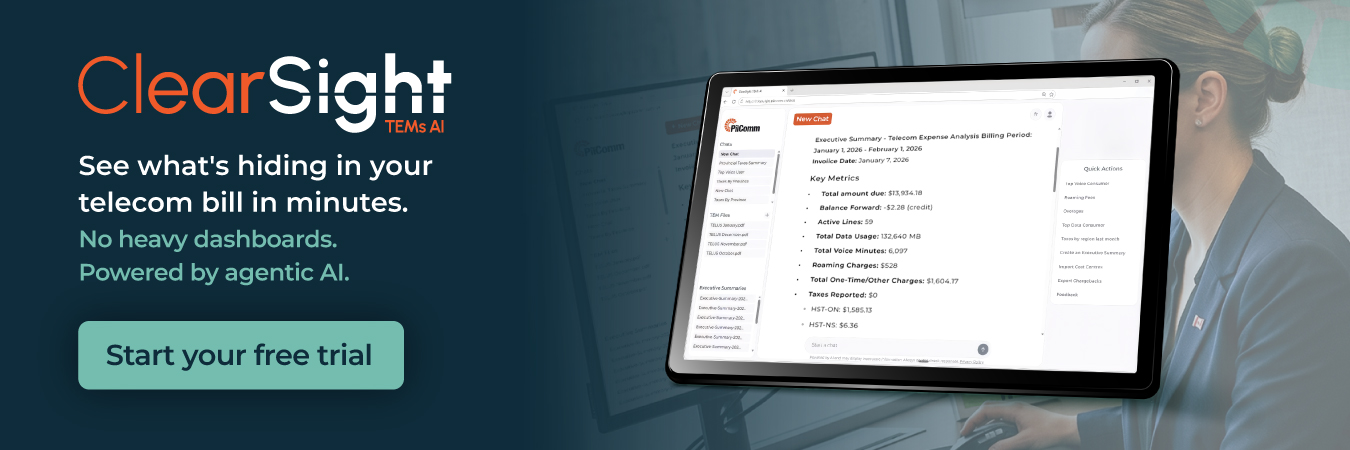
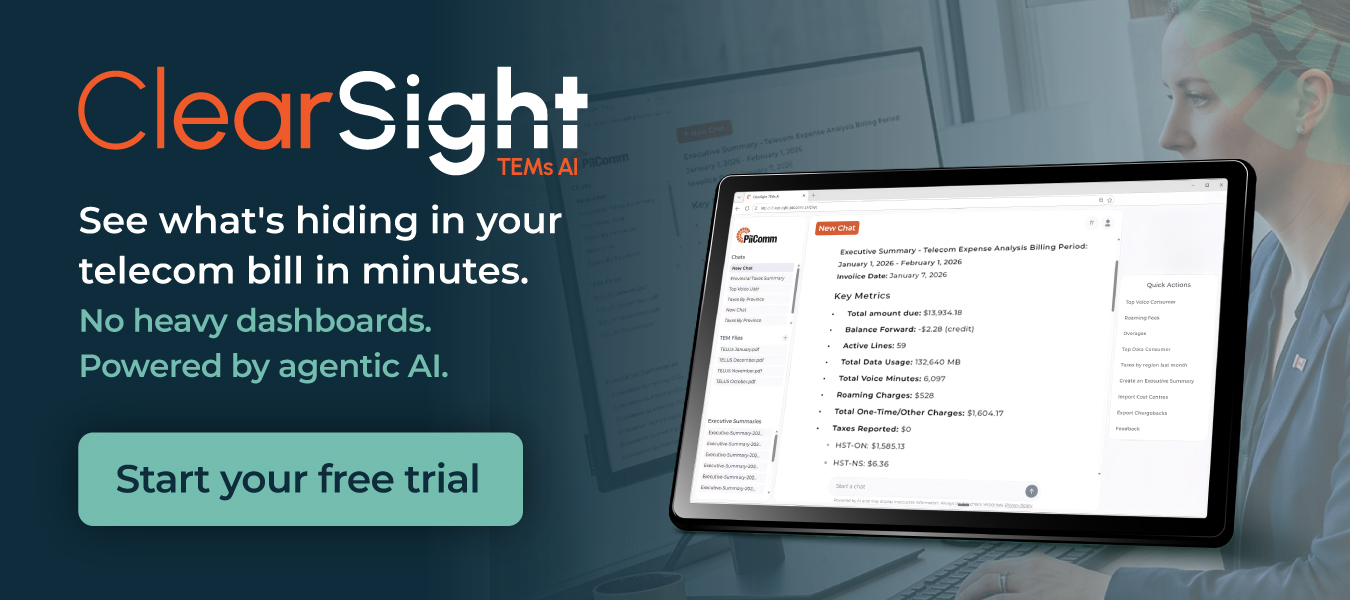
Your AP team uploads last month’s carrier invoices. Within minutes, the platform flags 47 lines with zero usage, three rate plan mismatches, and a roaming charge anomaly on a batch of devices assigned to your Alberta field team. Your monthly report lands with specific dollar amounts attached to each finding.
That’s what outsourced TEM looks like in steady state. But getting there requires a structured ramp—and setting realistic expectations for what the first 90 days produce versus what the ongoing rhythm delivers.
The first 90 days of an outsourced TEM engagement
The onboarding phase isn’t a flip-the-switch process. It’s a structured sequence that produces quick wins while building the baseline you’ll measure future savings against.
The first billing cycle focuses on inventory reconciliation—matching every line on your carrier invoices to a device, a user, and a cost centre. This is where the gaps surface. Lines billing for terminated employees. Devices on plans that don’t match their usage profile. Cost centres carrying charges for assets they don’t own.
Parallel to that, the provider builds your contract calendar—documenting renewal dates, notice windows, and auto-renewal clauses for every carrier agreement. This calendar becomes the early warning system that prevents expensive surprises.
The first-round audit produces immediate findings. First-time billing audits typically recover 12–18% of annual telecom spend. For a $500,000 annual wireless budget, that’s $60,000–$90,000 in recoverable costs identified within the first billing cycle.
Not all of that is immediately actionable—some findings require contract renegotiation or hardware changes. But enough of it is actionable that most organisations see positive ROI before the 90-day mark.
Ongoing monthly operations and reporting cadence
Once the baseline is established, the rhythm shifts to monitoring and optimisation.
Monthly invoice analysis catches billing anomalies before they compound across multiple cycles. Variance detection flags unexpected changes—a department whose wireless spend jumped 40%, a batch of lines that suddenly started incurring roaming charges, a promotional rate that expired without notice.
Quarterly business reviews step back from the monthly details to address strategic questions: Are your rate plans still competitive? Which contracts are approaching renewal windows? Where are the optimisation opportunities that require carrier negotiation rather than internal cleanup?
The most valuable output in steady state isn’t the cost savings report—it’s the contract renewal calendar.
We’ve watched enterprises auto-renew into rates that were 20% above current market because nobody tracked the 60-day notice window. The carriers aren’t going to remind you. Their account managers are incentivised to let auto-renewals happen. An outsourced TEM provider’s job is to make sure that window never passes unnoticed—and to arm you with the benchmarking data that turns the renewal into a negotiation rather than a rubber stamp.
The question most enterprises hit next is how to tell whether a provider can actually deliver this for Canadian operations—because the evaluation criteria that matter here aren’t the ones that show up on most feature comparison checklists.
Five criteria for evaluating an outsourced TEM provider in Canada
The feature list is the least important part of a TEM provider evaluation.
Every platform claims invoice automation and anomaly detection. The marketing pages are nearly interchangeable. The differentiators are operational: where your data lives, whether the platform handles Canadian carrier invoice formats natively, and whether the team behind it understands interprovincial pricing variation.
Here’s the evaluation framework that actually separates providers who can deliver for Canadian operations from those who can’t.
Canadian carrier invoice parsing capability
Bell, Rogers, and TELUS each produce materially different enterprise invoice formats. The surcharge taxonomies don’t align. The line-item structures vary. Provincial tax treatment differs not just in rate but in how it’s presented.
A TEM platform built for AT&T and Verizon invoices will not parse a TELUS enterprise invoice correctly. It will misclassify line items, miss provincial tax breakdowns, and produce reports that require manual correction before they’re usable.
This is a pass/fail criterion, not a nice-to-have. Canada’s three national carriers collectively hold approximately 90% of wireless revenue. If a TEM provider can’t parse invoices from these carriers natively, they can’t serve Canadian enterprises.
Data residency and Canadian privacy compliance
TEM platforms process employee call detail records—who called whom, when, for how long, from which location. Under PIPEDA, that’s personal information.
Choosing a US-hosted TEM platform creates a cross-border data transfer that triggers specific compliance requirements. Your privacy officer needs to document the transfer, assess the risk, and ensure adequate protection exists in the receiving jurisdiction.
For federally regulated industries—banking, telecommunications, transportation—the scrutiny is higher. For healthcare organisations subject to PHIPA, the bar is higher still.
Ask where your data will be processed and stored. If the answer involves a US data centre, understand the compliance implications before procurement signs off.
Bilingual reporting and Quebec Law 25 readiness
If you operate in Quebec, any TEM platform generating chargeback files, audit reports, or contract summaries for those operations must produce French-language output.
This isn’t a preference. Bill 96 penalties range from $3,000 to $30,000 per day per violation, doubled for second offences. For an enterprise with Quebec operations, the TEM platform’s bilingual capability is a compliance requirement with daily financial exposure.
Most US-based TEM platforms produce English-only output. Your legal team will flag this during procurement review even if IT doesn’t catch it.
Interprovincial pricing benchmarking depth
A provider that benchmarks your rates against a single “national average” is hiding the provincial variation where the biggest savings opportunities live.
Saskatchewan and Manitoba rates can run 26–50% below Ontario for equivalent plans. If your distributed workforce spans multiple provinces, your “corporate rate” is almost certainly overpaying in high-cost provinces while potentially missing savings in lower-cost ones.
The TEM provider should benchmark at the provincial level, not the national level. If they can’t show you how your Alberta rates compare to current Alberta market rates—separate from your Ontario rates—they’re giving you an incomplete picture.
Integration with broader device lifecycle management
TEM data in isolation tells you what you’re spending. TEM data connected to MDM enrolment and device inventory tells you whether what you’re spending matches what you’re actually deploying.
We had a healthcare client whose TEM audit found 200 lines with zero data usage. The natural assumption was “cancel them.” But when we cross-referenced against the MDM, 140 of those lines were attached to bedside tablets that connect via WiFi and only use cellular as failover. Cancelling those lines would have knocked out the backup connectivity for patient-facing devices.
TEM without device context creates expensive mistakes. The most valuable outsourced TEM providers connect spend visibility to fleet visibility—through lifecycle management that tracks devices from deployment through decommissioning.
Quick-reference checklist for TEM provider evaluation:
- Native parsing for Bell, Rogers, and TELUS enterprise invoice formats
- Canadian data residency with documented PIPEDA compliance
- Bilingual (English/French) reporting capability for Quebec operations
- Provincial-level pricing benchmarks, not just national averages
- Integration path to MDM and device inventory data
When outsourcing TEM makes more sense than building in-house
The break-even point for building an internal TEM function is roughly 5,000+ lines with a dedicated analyst and a platform licence. Below that threshold, outsourcing almost always delivers better ROI because the fixed costs of internal capability don’t amortise well across smaller fleets.
But fleet size isn’t the only variable. Complexity matters too—how many carriers you’re managing, how distributed your operations are, and whether your internal team has the bandwidth to maintain TEM discipline month after month.
The fleet size and complexity threshold
Under 500 lines, a self-service AI tool may be sufficient. You’re looking for anomaly detection and basic audit capability, not a full managed service. The invoice volume doesn’t justify the overhead of an outsourced engagement.
500 to 5,000 lines is where outsourced TEM delivers the strongest ROI. The savings justify the cost, but the volume doesn’t justify building internal capability. This is the sweet spot for mid-market enterprises—enough lines to generate significant savings, not enough to fund a dedicated TEM analyst.
Over 5,000 lines, a hybrid model often works best: an outsourced platform with an internal TEM analyst who owns the relationship, interprets the findings, and drives action. The platform does the parsing and detection; your analyst does the judgment and execution.
Organisations implementing comprehensive TEM achieve ROI multiples of 5:1 to 10:1 within the first 12 months, with first-year cost reductions of 10–35%. Even at the conservative end, a $50,000 TEM engagement recovering $250,000 in year one represents a payback period measured in weeks, not quarters.
The hidden cost of internal TEM that most budgets miss
Internal TEM isn’t free—it just looks free because the costs are spread across roles that don’t have “TEM” in their title.
The IT analyst who spends four hours per billing cycle reconciling invoices. The procurement manager who handles carrier disputes. The finance team member who manually allocates charges to cost centres. The operations lead who tracks down devices when the inventory doesn’t match.
Most internal cost calculations undercount the labour component by 40–60% because these hours aren’t tracked as “TEM work.” They’re absorbed into job descriptions that don’t mention telecom at all.
When you calculate whether to build or buy, count all the hours—not just the ones that show up in a TEM budget line that doesn’t exist yet.
The compliance risk most TEM buying conversations skip
A VP of IT at a federally regulated financial institution discovers during an internal audit that their US-based TEM platform has been routing Canadian employee call detail records through a Virginia data centre for three years.
Under PIPEDA, that’s a cross-border transfer of personal information that was never documented in their privacy impact assessment. The transfer wasn’t malicious—the TEM provider simply didn’t know Canadian privacy law required disclosure. The client found out during a Law 25 compliance review triggered by their Quebec operations.
This is the compliance risk most TEM buying conversations skip entirely.
US-based TEM platforms are subject to the US CLOUD Act, which can compel disclosure of data to US law enforcement even if that data is stored in Canada. For Canadian enterprises—especially those in regulated industries—this creates jurisdictional exposure that exists regardless of where the servers physically sit.
The federal government has noticed. Budget 2024 earmarked approximately $2 billion including $700 million specifically for Canadian cloud data centres—a signal that data sovereignty is becoming a procurement criterion, not just a policy preference.
This is exactly why PiiComm built ClearSight TEMs AI as a Canadian-hosted, bilingual platform that parses Canadian carrier invoices natively. The compliance question and the operational question are the same question for Canadian enterprises. A telecom expense management platform built for Canadian carriers should also be built for Canadian privacy law—and that means Canadian data residency, not US infrastructure with a Canadian footnote.
If you want to see what your invoices are actually telling you, upload a carrier invoice to ClearSight TEMs AI and get analysis in minutes, not weeks. The platform flags zero-use lines, billing anomalies, and rate mismatches—with bilingual output and secure Canadian hosting.
Frequently asked questions about outsourced telecom expense management
What does an outsourced telecom expense management provider actually do?
An outsourced TEM provider handles invoice parsing, line-by-line auditing, zero-use detection, usage anomaly flagging, billing dispute resolution, and chargeback file generation. Strategic decisions about carrier selection and contract approval remain with your internal team. The provider delivers the data and analysis; you retain decision authority over vendors and budgets.
How much can outsourced TEM save a Canadian enterprise?
First-year cost reductions typically range from 10–35%, with ROI multiples of 5:1 to 10:1 within 12 months. For a Canadian enterprise spending $500,000 annually on wireless, that represents $50,000–$175,000 in recoverable spend—often enough to pay for the TEM engagement several times over in year one.
What are the biggest challenges of telecom expense management in Canada?
Canada’s concentrated carrier market, interprovincial pricing variation of 26–50%, materially different carrier invoice formats, and bilingual compliance requirements under Bill 96 create TEM challenges that don’t exist in most other markets. Enterprises with 100+ employees also lack CRTC Wireless Code protections, making proactive auditing the only safeguard against billing errors.
How do I choose the right outsourced telecom expense management service?
Evaluate five criteria: native Canadian carrier invoice parsing, Canadian data residency, bilingual reporting capability, interprovincial pricing benchmarking depth, and integration with device lifecycle management. Feature lists are nearly identical across providers—the differentiators are operational, not functional.
Is outsourced TEM only for large enterprises?
Mid-market enterprises (250–2,500 employees) often see the fastest ROI from outsourced TEM because they have enough lines to generate significant savings but lack internal headcount to justify a dedicated analyst. Enterprises under 500 lines may find a self-service AI platform sufficient; those over 5,000 lines often benefit from a hybrid model.
What happens to my carrier relationships if I outsource TEM?
Your carrier relationships stay with you. An outsourced TEM provider handles analytical and operational work—invoice auditing, usage analysis, dispute resolution—but the strategic relationship with your carrier account manager remains yours. The provider arms you with better data for negotiations; they don’t negotiate on your behalf unless you explicitly delegate that authority.
Does outsourcing TEM create data privacy risks for Canadian enterprises?
It can—if the provider processes Canadian employee data through US-hosted infrastructure. TEM platforms handle call detail records and usage data, which constitute personal information under PIPEDA. US-based platforms are subject to the CLOUD Act, which can compel data disclosure regardless of storage location. Canadian-hosted platforms eliminate this jurisdictional exposure.
The CFO’s question that triggered this whole evaluation—why did wireless spend jump, and nobody can explain it—isn’t really about wireless spend. It’s about whether your organisation has the infrastructure to answer operational questions about a cost category that grows 8–12% annually while most budgets assume it’s flat.
Outsourcing TEM doesn’t eliminate that question. It ensures someone is always working on the answer—month after month, billing cycle after billing cycle—so the next time someone asks, the response takes hours instead of weeks.
If your fleet exceeds 500 devices across Canadian operations and you’re weighing whether to build internal TEM capability or bring in a specialist, talk to a PiiComm managed mobility specialist about what a structured engagement looks like for your operation. The conversation starts with your invoices—not a sales pitch.