

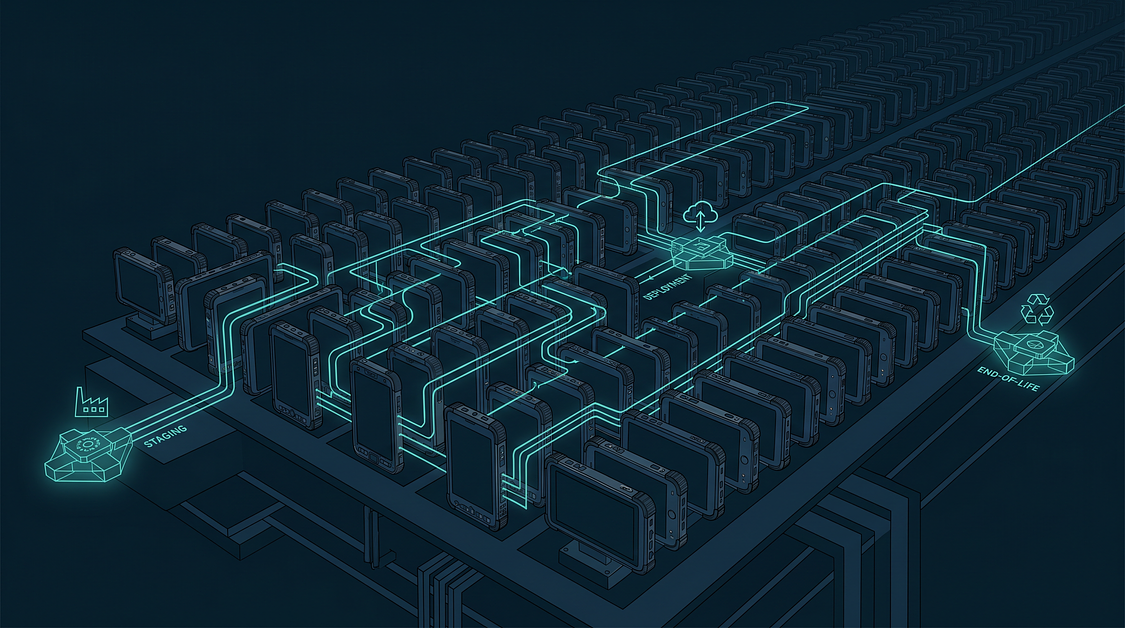
You manage a fleet of rugged enterprise devices across distributed Canadian operations. You already know the procurement-staging-support-refresh cycle consumes disproportionate IT bandwidth. You already know capital costs are unpredictable. You are here because you want to understand exactly what PiiComm’s Device as a Service program includes before you make a decision.
This post explains precisely how the per-device monthly cost model works, what Canadian delivery and swap logistics look like in practice, and how the program adapts to the specific needs of transportation and logistics, retail, and healthcare organizations.
PiiComm manages 500,000+ devices across thousands of Canadian locations. This is not a theoretical DaaS offering built on slide decks and service-level agreements. The staging facilities, spare device pools, and logistics networks that would support your program already exist at national scale. You are not a pilot customer.
Here is exactly how it works—from the monthly cost structure through to what happens when a scanner breaks at 2 a.m. in a warehouse in Calgary.
The per-device monthly cost model—how PiiComm prices DaaS
A PiiComm DaaS subscription bundles five distinct cost categories into a single monthly per-device fee: hardware procurement, pre-deployment staging and configuration, ongoing lifecycle management including repairs and spare device management, MDM administration, and certified secure decommissioning at end of life. There is no separate line item for any of these—they are the fee.
When organizations buy devices outright, the true cost is never the purchase price. It is the purchase price plus the 6–12 hours of IT time per 100 devices for staging and configuration, plus the MDM licence fees, plus the repair management overhead, plus the secure disposal cost at end of life.
Most CFOs have never seen these costs aggregated—because they sit across four or five different budget lines. A DaaS fee makes the real cost visible for the first time. And it is almost always lower than the sum of the hidden parts.
What the monthly fee includes—and what it replaces
PiiComm’s DaaS model includes all five service pillars—Strategic Sourcing, Staging & Deployment, Lifecycle Management, MDM as a Service (MDMaaS), and Secure Decommissioning—under a single monthly subscription.
Here is what that replaces:
What you currently pay for separately:
- Device purchase orders (capital budget)
- Staging labour or third-party configuration fees
- MDM platform licences and administration time
- Break-fix repair management and shipping
- Data erasure services and disposal certification at end of life
What the DaaS fee covers:
- All hardware procurement through Premier OEM partnerships
- Pre-deployment staging with your MDM profile, apps, and security policies
- Ongoing MDM administration and configuration updates
- Repair management and spare device logistics
- NIST 800-88 certified data erasure with chain-of-custody documentation
The two columns collapse into one line item. That is the financial simplicity the model delivers.
CapEx to OpEx—why the shift matters beyond accounting
The accounting treatment is straightforward: DaaS converts unpredictable capital expenditure into predictable operating expenditure. But the operational implications go further.
When devices sit on a capital budget, every refresh requires an approval cycle. The IT Director knows the fleet needs replacing. The CFO knows the capital budget is already allocated elsewhere. The result is deferral—replace the worst 20% this quarter, defer the rest.
DaaS removes refresh from the capital approval queue entirely. The monthly fee includes device currency as a contractual obligation, not a discretionary budget request.
The shift also eliminates depreciation schedule management. No more tracking which devices are fully depreciated versus which still carry book value. No more stranded assets when a device model reaches end of support before it is fully written off.
For organizations operating on thin margins—retail at 1–3% net, transportation and logistics with tight per-shipment economics—the predictability alone changes how the finance team plans the year.
What happens when a device breaks—Canadian swap logistics and spare pool management
It is Sunday night in a distribution centre outside Mississauga. A Zebra TC53 handheld drops from a conveyor belt and the screen cracks. The shift supervisor opens a ticket through PiiComm’s service desk—staffed 24/7 in Canada, in English or French.
Here is what happens next.
The ticket triggers PiiComm’s spare pool management process. A replacement device—already staged with the client’s MDM profile, applications, Wi-Fi credentials, and security policies—ships from a Canadian facility. The replacement that arrives is not a blank device that needs IT setup. It is a ready-to-scan, ready-to-work unit.
The difference between a DaaS provider with Canadian-based spare pools and one without is measured in hours of frontline worker downtime. For a T&L operation managing 6,500+ mission-critical devices with downtime tolerance of an hour or less, this distinction is the difference between a minor disruption and a missed delivery window.
Pre-configured spares vs. break-fix replacements
The traditional break-fix model works like this: device breaks, IT submits a warranty claim or repair ticket, a blank replacement ships from the manufacturer or repair depot, IT receives the device, configures it with MDM enrolment and apps, then ships it to the site. Elapsed time: three to seven business days minimum.
PiiComm’s spare pool approach works differently. PiiComm technicians stage spare devices in Canadian facilities with the client’s complete configuration—MDM enrolment, enterprise applications, network credentials, security policies—before any device fails. When a failure occurs, the swap is a logistics operation, not an IT project.
In practice, we see organizations cut device replacement timelines from days to hours. For frontline workers in healthcare, retail, or logistics, that difference translates directly to productivity recovered.
The 24/7 bilingual service desk—who answers the call
PiiComm’s service desk operates around the clock, staffed by Canadian-based personnel who provide support in both English and French.
For organizations with operations in Quebec—which includes virtually every national transportation carrier, retail chain, and multi-site healthcare network—bilingual service delivery is not a convenience. Quebec’s language laws require that workers access support services in French. PiiComm satisfies this requirement natively. US-based providers offering “translation services” or “French-language support during business hours” do not meet the standard.
When that Sunday night call comes in from a warehouse outside Montreal, the supervisor does not wait until Monday morning for someone who speaks their language.
Refresh cycles and fleet currency—how DaaS keeps devices current
The most expensive device in any fleet is the one that should have been replaced two years ago. It breaks more often, runs slower, cannot support current OS versions, and creates security vulnerabilities. DaaS eliminates fleet drift by building refresh into the subscription.
At the end of the DaaS contract term, devices are securely decommissioned and replaced, maintaining fleet currency without the buyer managing refresh cycles.
In practice, fleet refresh is where most in-house device management programs fail. The IT Director knows the devices need replacing. The CFO knows the budget is not there for a bulk purchase. The result is a rolling compromise—replace the worst 20% this quarter, defer the rest.
Within 18 months, the fleet is a patchwork of three device models running two different OS versions, and the MDM team is maintaining three separate configuration profiles. Every support ticket becomes a diagnostic exercise: which device, which OS, which configuration?
DaaS makes this problem structurally impossible because refresh is a contractual obligation, not a discretionary budget request.
End-of-life responsibility—secure decommissioning built in
PiiComm’s DaaS includes certified secure decommissioning with full chain-of-custody documentation. This is not an add-on service—it is part of the subscription.
Devices are wiped to NIST 800-88 standards, with documentation that proves it. For healthcare organizations subject to PHIPA (Personal Health Information Protection Act) in Ontario, or any Canadian organization subject to PIPEDA, this directly addresses compliance obligations around data at rest on decommissioned devices.
The alternative—managing end-of-life internally—means tracking which devices have been returned, verifying data erasure was performed correctly, maintaining audit documentation, and arranging responsible disposal. Most organizations do this inconsistently, if at all. We have walked into client sites and found drawers full of old devices with corporate data still intact.
DaaS removes that risk entirely. The device that arrives pre-configured at the start of its lifecycle leaves with certified data erasure at the end. The chain of custody is documented from deployment to destruction.
That addresses the financial model and the operational mechanics. But DaaS does not land the same way in every industry—the specific value depends on the operational constraints you are working within.
Fleet CapEx predictability for transportation and logistics
A national T&L operator running 6,500 rugged devices across Canada knows two things about their fleet budget: it will be wrong, and it will be wrong in the expensive direction. Devices that were budgeted for a four-year lifecycle fail at 30 months in a -20°C truck cab. DaaS absorbs that variance.
The device failure rate in transportation and logistics is not a smooth curve—it spikes in winter. Condensation from temperature cycling (cold truck to warm warehouse) is the number one killer of rugged handhelds. A scanner that lives in a delivery vehicle experiences dozens of these temperature swings per day during a Canadian January.
PiiComm’s DaaS program with Canadian-based spare pools absorbs these seasonal spikes without the client needing to maintain their own buffer inventory. You are not buying 15% extra devices to sit idle in a closet for nine months of the year. That buffer exists in PiiComm’s staging facilities, pre-configured with your MDM profile, ready to ship when the winter failure spike hits.
For a $1.6B national T&L firm managing over 6,500 mission-critical devices, PiiComm built a program around a simple requirement: device downtime tolerance of an hour or less. That tolerance drove everything—the spare pool sizing, the geographic distribution of staged devices, the service desk escalation protocols. DaaS is not a generic subscription layered on top of T&L operations. It is shaped by those operations.
Rugged device expertise—Zebra, Honeywell, and the devices T&L actually uses
PiiComm holds Premier partnerships with Zebra Technologies and Honeywell—the two dominant rugged device OEMs in Canadian transportation and logistics. This is not a generic IT provider offering DaaS on consumer-grade hardware.
The devices that run T&L operations—Zebra TC-series handhelds, Honeywell CT-series scanners, vehicle-mounted computers bolted to forklift dashboards—require specific expertise. They run Android Enterprise with OEMConfig profiles. They connect to warehouse management systems and transportation management systems through proprietary APIs. They need barcode scanning configurations tuned for specific label types and scanning distances.
When PiiComm stages a Zebra TC53 for a T&L client, the technician configuring that device has done it thousands of times. They know which firmware version resolves the Bluetooth dropout issue with certain wireless headsets. They know which scanning profile works best for damaged shipping labels in low light. That operational knowledge is baked into the DaaS program.
Seasonal flex capacity for retail operations
A retailer that buys enough devices for holiday peak is overspending for 10 months of the year. A retailer that buys for average demand is understaffed at the point-of-sale during the only quarter that matters. DaaS breaks this trade-off.
Retail net margins typically run 1–3%. At those margins, an unplanned $400,000 device refresh can consume an entire quarter’s profit from a mid-sized retail chain. The CFO’s job is to prevent that kind of variance. DaaS converts the variance into a predictable monthly line item.
But the flex capacity question in retail is not just about device count—it is about pre-configured devices. Shipping 200 blank tablets to 40 store locations two weeks before Black Friday and expecting store managers to set them up is a recipe for chaos. Store managers are not IT technicians. They have a hundred other things demanding their attention during the pre-holiday rush.
PiiComm stages those devices in Canadian facilities with the retailer’s POS software, MDM profile, and Wi-Fi credentials pre-loaded. They arrive ready to scan. The store manager takes them out of the box and puts them on the sales floor. That is the difference between “we have a DaaS program” and “we have a DaaS program that actually works for retail.”
DaaS allows scaling up during peak seasons and reducing afterward without penalties. When January arrives and transaction volumes drop, the excess devices return to PiiComm. You are not carrying the depreciation on hardware you only needed for 12 weeks.
Budget-cycle alignment for healthcare organizations
A regional health authority in Ontario needs to replace 800 clinical tablets. The capital request enters the queue behind an MRI upgrade, an HVAC replacement, and a parking structure repair. The tablets—which clinicians use for medication administration, patient identification, and charting—wait. DaaS removes the capital request from the queue entirely.
Healthcare organizations in Canada operate within rigid budget cycles, often aligned with provincial fiscal years or hospital foundation funding cycles. Large CapEx device purchases are difficult to approve because they compete against clinical equipment and infrastructure projects that carry more visible urgency.
DaaS converts these purchases into predictable monthly OpEx that aligns with operational budgets rather than capital budgets. The approval pathway is different. The threshold requirements are different. The timeline is different.
In Canadian healthcare, the budget-cycle constraint is compounded by procurement frameworks. Ontario’s Broader Public Sector (BPS) Directive governs how hospitals and health authorities purchase goods and services. A DaaS subscription structured as a managed service contract can navigate BPS procurement differently than a hardware purchase order—often with shorter approval timelines and different threshold requirements.
This is a structural advantage that most US-based DaaS providers do not understand because they have never navigated Canadian public-sector procurement.
PIPEDA, PHIPA, and device data at every stage
For healthcare organizations, compliance is not a checkbox at the end of a procurement process. It is a requirement that governs every stage of the device lifecycle—including stages that most IT teams do not think about until something goes wrong.
A clinical tablet that stores patient health information is subject to PIPEDA federally and PHIPA in Ontario. Those obligations do not end when the device is working. They extend through repairs (where does a broken device go while it is being fixed?), through spare device swaps (how is the data handled when a device transfers between users?), and through decommissioning (how is the data erased when the device reaches end of life?).
PiiComm’s DaaS program maintains compliance at every stage. Devices are staged and repaired in Canadian facilities by Canadian technicians. Spare device swaps follow documented chain-of-custody protocols. End-of-life decommissioning includes NIST 800-88 certified data erasure with documentation that proves it.
For a PHIPA-covered organization, this is not a “nice to have.” It is directly responsive to the regulatory requirement that custodians of personal health information maintain reasonable safeguards throughout the information lifecycle. A DaaS provider operating from US infrastructure introduces jurisdictional complexity that increases the organization’s compliance burden.
The AIM portal—real-time fleet visibility across every device
A DaaS program without fleet visibility is a black box you pay monthly to not understand. PiiComm’s AIM (Asset Intelligence Manager) portal provides real-time analytics on every device in the fleet—location, health status, lifecycle position, and cost allocation—accessible to both financial and IT stakeholders.
The most common complaint from organizations that have tried DaaS with other providers is not cost—it is visibility. They traded one problem (unpredictable CapEx) for another (not knowing what they are paying for or what state their fleet is in).
AIM exists specifically to prevent this. When a CFO asks “what are we spending per device in the Vancouver distribution centre versus the Montreal warehouse?” AIM answers that question in real time, not in a quarterly report delivered six weeks late.
For the IT Director, AIM surfaces device health metrics, battery degradation trends, and lifecycle position across the fleet. You can see which devices are approaching end of support, which locations have higher-than-average failure rates, and where the spare pool inventory sits at any given moment.
The visibility is not a reporting layer added after the fact. It is integrated into how PiiComm manages the program. When our team sees a pattern—a specific device model failing at higher rates in a specific environment—we surface that to you before it becomes a fleet-wide problem.
Canadian delivery infrastructure—why geography matters for DaaS
Device as a Service is not a software product you download. It is a physical operation—devices are staged, shipped, swapped, repaired, and decommissioned. Every one of those steps happens faster, more securely, and more predictably when it happens in Canada, for Canadian organizations, by a Canadian team.
PiiComm operates its own Canadian staging and deployment facilities, a 24/7 bilingual (English/French) service desk staffed in Canada, in-house certified technicians, and Canadian-hosted data infrastructure. No core operational function is outsourced or offshored.
Cross-border device shipments are not just slow—they are unpredictable. A pallet of 200 Zebra scanners shipped from a US staging facility to a Canadian distribution centre can be held at customs for 48 hours for documentation review.
When those devices are needed for a Monday morning warehouse go-live, that delay is not an inconvenience—it is a project failure. PiiComm stages devices in Canada. The shipment is domestic. The delivery timeline is a commitment, not an estimate.
The same logic applies to spare device logistics. When a scanner fails at 2 a.m. in Calgary, the replacement ships from Canadian inventory. No customs brokerage. No cross-border paperwork. No uncertainty about whether “next-day delivery” actually means next day.
Data sovereignty and the compliance advantage
Canadian organizations subject to PIPEDA, PHIPA, or Quebec Law 25 face specific obligations around where personal and health information is stored and processed. A DaaS provider with Canadian-hosted data infrastructure and Canadian-staffed operations provides a structurally simpler compliance posture than one operating from US infrastructure.
This is not an abstract legal concern. It is a procurement advantage. When your legal and compliance teams review a DaaS vendor proposal, a Canadian provider with Canadian data infrastructure reduces the review burden. There are fewer jurisdictional questions to answer, fewer cross-border data flow assessments to complete, fewer risk factors to document.
For Quebec healthcare organizations, PiiComm’s bilingual service capability and Canadian infrastructure address Law 25 requirements directly. For Ontario hospitals, the PHIPA chain-of-custody requirements are satisfied by a provider that handles every device touchpoint within Canada.
The compliance conversation becomes simpler when you can point to a single country of operation for every stage of the device lifecycle.
How PiiComm’s DaaS program compares to buying devices outright
DaaS is not universally superior to buying devices. It is superior for organizations that manage fleets of mobile devices across multiple locations, need predictable costs, lack the IT bandwidth for lifecycle management, and want to stop treating device procurement as a capital project.
Here is how the two approaches compare across six dimensions:
| Dimension | DaaS (PiiComm) | Outright purchase |
|---|---|---|
| Upfront cost | None—monthly per-device fee only | Full hardware cost at time of purchase |
| Monthly cost | Predictable fee includes all services | Unpredictable—repairs, MDM, support billed separately |
| Refresh management | Contractual—built into subscription | Discretionary—competes for capital budget |
| Spare device availability | Pre-configured spares in Canadian facilities | Self-managed buffer inventory or wait for warranty replacement |
| Compliance/decommissioning | NIST 800-88 certified erasure with chain-of-custody documentation included | Self-managed—often inconsistent or undocumented |
| IT bandwidth required | Minimal—PiiComm handles staging, MDM, repairs, logistics | Significant—every device touchpoint requires internal resources |
The organizations that benefit least from DaaS are the ones with fewer than 50 devices, all in one location, with a dedicated IT person who has the bandwidth to manage staging, MDM, repairs, and decommissioning. That describes very few of PiiComm’s target clients.
The organizations that benefit most are the ones where the IT Director’s team is spending 30% of their time on device logistics instead of strategic projects—and the CFO is approving emergency capital requests every quarter because devices keep failing outside the replacement schedule.
Getting started—what a DaaS scoping conversation looks like
A DaaS scoping conversation with PiiComm takes 30–45 minutes and requires no preparation beyond knowing your approximate device count, the types of devices your workforce uses, and how many locations you operate across. PiiComm handles the rest—from needs assessment through to a detailed proposal with per-device monthly pricing.
The conversation typically covers:
- Current fleet inventory and device types (rugged handhelds, tablets, vehicle-mounted computers, smartphones)
- Geographic distribution of locations and workforce
- Current MDM platform, if any
- Seasonal volume patterns or planned growth
- Contract term preferences
- Specific compliance requirements (PHIPA, Quebec Law 25, federal security classifications)
From that conversation, PiiComm’s team develops a scoping document that outlines the proposed program structure, the per-device monthly pricing, the spare pool sizing, and the implementation timeline.
There is no obligation, no pressure, and no requirement to have your current state perfectly documented before the call. Most organizations discover during the scoping conversation that their “500-device fleet” is actually running three different device models across two OS versions with two MDM configurations. That is useful information. It shapes the program design.
Request a DaaS scoping conversation with a PiiComm mobility specialist →
If you want to understand your current device and telecom spend before the scoping call, ClearSight TEMs AI can surface that data within minutes of uploading your carrier invoices—$99/month, no commitment, bilingual output.
Frequently asked questions about PiiComm’s Device as a Service program
What is included in PiiComm’s per-device monthly DaaS fee?
The fee bundles all five service pillars: Strategic Sourcing, Staging & Deployment, Lifecycle Management, MDM as a Service, and Secure Decommissioning. MDM administration and end-of-life data erasure are included—not add-ons. There are no hidden line items for staging, repairs, spare device management, or certified decommissioning.
Can PiiComm scale device counts up or down for seasonal demand?
Yes. DaaS allows scaling up during peak seasons (retail holiday, T&L volume surges) and reducing afterward without penalties. Scaled devices arrive pre-configured with your MDM profile, apps, and security policies—ready to deploy immediately, not requiring IT setup at the destination.
What happens to devices at the end of the DaaS contract term?
Devices are securely decommissioned using NIST 800-88 certified data erasure, with full chain-of-custody documentation provided. Fleet refresh to current-generation hardware is automatic. The client manages none of this—it is a contractual obligation within the subscription.
Does PiiComm’s DaaS program support rugged enterprise devices, not just smartphones?
PiiComm’s heritage is in rugged, industrial-grade devices. We hold Premier partnerships with Zebra Technologies and Honeywell and manage Zebra TC-series and Honeywell CT-series handhelds, vehicle-mounted computers, RFID systems, and rugged tablets across Canadian operations daily. This is not a smartphone DaaS program.
Where are PiiComm’s staging facilities and spare device pools located?
All staging, spare pool management, and device logistics are Canadian-based. PiiComm operates its own Canadian facilities with in-house certified technicians. Standard deployments ship domestically with no cross-border logistics. Delivery timelines are predictable.
How does PiiComm’s DaaS program help with PIPEDA and PHIPA compliance?
Compliance is built into the program at every lifecycle stage. Devices are staged and repaired in Canadian facilities, MDM administration uses Canadian-hosted infrastructure, and end-of-life decommissioning includes NIST 800-88 certified data erasure with chain-of-custody documentation. This is not a separate compliance add-on.
What is the minimum fleet size for PiiComm’s DaaS program?
DaaS is designed for organizations managing 250+ devices across multiple locations. Smaller fleets may be better served by engaging individual service pillars (Strategic Sourcing, Lifecycle Management, MDMaaS) rather than the full DaaS bundle. A scoping conversation can determine the right fit.
How long does it take to deploy a PiiComm DaaS program from contract signature?
Deployment timelines depend on fleet size and complexity, but PiiComm’s in-house staging capability—versus outsourcing to a third party—compresses the timeline significantly. A typical mid-sized deployment (500–1,000 devices) moves from contract to first shipment in four to six weeks.
The question behind the question
Most organizations that reach this point in evaluating DaaS are not really asking “should we subscribe to devices instead of buying them?” They already know the answer to that question.
The real question is whether the provider can actually deliver what the model promises. Whether the spare pool management exists at a scale that matters when winter hits and failure rates spike. Whether the Canadian staging facilities are real or just a line in a slide deck. Whether the bilingual service desk is staffed by people who can actually help, or whether it is a checkbox on a compliance form.
PiiComm manages 500,000+ devices across thousands of Canadian locations. The infrastructure is not theoretical. The operational experience is not borrowed from a US parent company. The scoping conversation is not a sales pitch—it is an operational assessment conducted by people who have staged thousands of devices and navigated every procurement framework you are dealing with.