A CFO at a multi-site Ontario hospital corporation asks their IT director for a cost-per-department breakdown of wireless spend ahead of budget season. Three weeks later, they receive a partial spreadsheet covering two of seven billing accounts, with a note that the other five are “still being reconciled.”
This is the moment most Canadian health systems realize they need more than a spreadsheet—they need a telecom expense management (TEM) provider. But the evaluation guides they find online are written for US health systems navigating HIPAA and AT&T contracts, or for generic enterprise buyers who do not face PHIPA obligations, bilingual service requirements, or the particular complexity of Bell, Rogers, and Telus enterprise billing.
The gap is real. Industry data indicates that 80% of telecom invoices contain billing inaccuracies. For a Canadian health system managing dozens of carrier accounts across hospitals, clinics, long-term care, and community programs, even a fraction of that error rate represents hundreds of thousands of dollars in recoverable spend—money that could fund clinical positions or equipment.
What follows are eight criteria that matter most when evaluating a TEM provider for Canadian healthcare, drawn from what procurement leaders, CFOs, and IT directors at health systems actually prioritize—not generic checklists.
Why generic TEM evaluation criteria fall short for health systems
A 400-bed hospital and a 400-person logistics company might have similar wireless line counts. But the hospital’s lines include EMS tablet SIMs, home-care worker iPhones, remote-patient-monitoring devices, on-call physician routing, and secure clinical messaging—each with different usage patterns, compliance requirements, and clinical-continuity stakes. A TEM provider that treats all lines the same will miss the distinctions that matter.
Healthcare wireless environments create complexity that generic enterprise TEM frameworks do not anticipate. Consider the scale: Alberta Health Services publicly disclosed approximately 7,900 cell phones and mobile devices in daily use across Home Care, community care, mental health, and EMS alone—with frequent inappropriate-use and roaming charges. That is one provincial health authority’s subset of devices. Multiply across departments and affiliated sites, and the inventory management challenge becomes clear.
The cost-recovery opportunity is equally significant. While no Canadian public benchmark exists, US healthcare TEM benchmarks report 25–35% telecom cost reduction in healthcare engagements. Those are US figures—but they indicate the scale of recoverable spend when clinical and administrative lines are properly segmented and optimized.
Here is what most TEM evaluation guides miss entirely: in healthcare, a “zero-use line” is not always waste. An on-call physician’s backup device may show zero data usage for 29 days and then carry a critical clinical communication on day 30. A TEM provider that flags it for disconnection without understanding clinical workflows creates a patient-safety risk, not a cost saving.
This is why healthcare TEM requires clinical-aware change management—something most enterprise TEM platforms do not offer.
Canadian carrier invoice parsing and multi-account consolidation
A regional health authority in Ontario might have 40+ billing account numbers (BANs) across Bell Mobility, Rogers Wireless, and Telus—some inherited from pre-merger hospital corporations, some created for specific programs like community paramedicine or mobile mammography. Each BAN has its own rate structure, contract terms, and billing cycle. Without a TEM provider that can ingest and normalize all of them, the CFO is making budget decisions on incomplete data.
Canadian carrier billing complexity is a structural challenge, not a minor inconvenience. The Commission for Complaints for Telecom-television Services (CCTS) reported that 46% of all issues raised in 2024–25 were billing-related—the highest proportion in five years. While CCTS data covers consumer and small-business complaints (enterprise accounts are excluded from its mandate), the billing-quality issues it reflects are systemic and surface in enterprise invoices as well.
Provincial sales-tax disaggregation adds a layer of complexity unique to Canada. A $50 plan costs $52.50 in Alberta but $57.49 in Quebec. For health systems operating facilities in Ontario and Quebec—or even across Ontario municipalities with different HST treatment—tax allocation errors compound across thousands of lines.
The forensic value of TEM is in the line-level detail, not the summary page. Carrier invoices for large health systems often contain legacy rate codes from contracts negotiated years ago by a predecessor organization. A TEM provider that simply reads the current invoice total misses the fact that the health system is still paying for a pooled-data plan designed for BlackBerry devices that were decommissioned in 2018.
What to ask a TEM provider about carrier integration
During vendor evaluation, pose these questions directly:
- “Which Canadian carriers can you ingest invoices from directly—Bell, Rogers, Telus, SaskTel, regional carriers?”
- “Can you normalize billing data across BANs with different rate structures and contract vintages?”
- “How do you handle mid-cycle plan changes and prorated charges?”
- “What is your process when carrier invoice formats change—do you absorb the adaptation or charge for it?”
The answers will separate providers with genuine Canadian carrier depth from those who bolt Canadian capability onto a US-built platform.
Line inventory management and zombie-line detection
A nurse leaves a contract position at a community hospital. HR processes the departure. IT eventually receives a ticket to recover the device. But nobody notifies the carrier to deactivate the line—because no automated workflow connects HR offboarding to carrier account management. The line bills for four, six, sometimes twelve months before anyone notices.
In healthcare, where agency nurses, locum physicians, and rotating residents create constant staff flux, this is not an exception—it is the default.
The financial exposure is substantial. Industry benchmarks put zombie services at 15–27% of total telecom spend. For a health system spending $3M annually on wireless, that is $450K–$810K paying for lines nobody is using. Healthcare’s turnover dynamics likely push Canadian health systems toward the higher end of this range.
The publicly available Canadian data points are limited, but revealing. Alberta Health Services disclosed $825,000 in cell phone bills over $500 over an 18-month period across hundreds of devices. This represents a single health authority’s partial disclosure, not a comprehensive audit—and it captures only the most visible overages, not the quiet $45/month lines billing indefinitely.
The most expensive zombie lines are not the obvious ones. It is the $45/month voice-only plan on a line assigned to a retired department head—a line that has been active for three years because the carrier account is managed by a different hospital within the corporation, and nobody cross-references the two inventories.
A credible TEM provider reconciles line inventory against HR records continuously, not annually.
How zombie-line detection should integrate with HR offboarding
The ideal workflow operates like this: an HR termination triggers a move/add/change/disconnect (MACD) request within 24–48 hours. The TEM provider validates the line against the device inventory, confirms no clinical dependency, and executes the disconnection with the carrier—all without IT intervention beyond exception approval.
When evaluating TEM providers, ask specifically:
- “What triggers a disconnection request—a manual ticket from IT, or an automated feed from our HRIS?”
- “What is your SLA for disconnection execution once triggered?”
- “How do you handle exception workflows for clinical lines that should not be disconnected automatically?”
The difference between a TEM provider that waits for IT to submit tickets and one that proactively surfaces disconnection candidates from HR data is the difference between recovering 5% of zombie spend and 25%.
PHIPA-compliant TEM operations and Canadian data residency
Line-level telecom data—which employee has which device, on which plan, at which facility—is not personal health information on its own. But the moment that inventory is cross-referenced with EMR access logs, MDM enrolment records, or secure-messaging platform user lists, it becomes metadata that can identify who accessed patient records, when, and from where.
That cross-reference is exactly what good TEM requires. Which means the TEM provider handling that data is functionally an agent or service provider under PHIPA.
The enforcement environment has materially changed. Effective January 1, 2024, the Information and Privacy Commissioner of Ontario may impose administrative monetary penalties under PHIPA, with maximum statutory fines of $200,000 for an individual and $1,000,000 for an organization. The first administrative monetary penalties were issued in August 2025.
A TEM provider that stores line-level data outside Canada, or cannot demonstrate role-based access controls and audit logging, creates a compliance exposure the CFO and privacy officer need to evaluate together.
Quebec’s penalty structure is even steeper. Quebec Law 25 penal sanctions reach the greater of $25 million CAD or 4% of worldwide turnover. For health systems with Quebec operations—or those serving Quebec patients through cross-provincial agreements—TEM provider compliance with Law 25 is not optional, and the penalties are material.
Here is the scenario that keeps privacy officers awake: during an IPC inquiry following a privacy breach, the first question is often “Can you produce a complete inventory of devices that had access to the affected records?” If the health system’s TEM data is hosted in a US data centre by a US-headquartered vendor, the privacy officer now has a second problem—explaining why PHI-adjacent metadata left the country.
Canadian data residency is not a nice-to-have. It is the difference between a straightforward response and a compounding investigation.
What “PHIPA-aware” means in a TEM context
There is a meaningful difference between a TEM provider that checks a “Canadian hosting” box and one that operationally understands PHIPA agent obligations.
A PHIPA-aware TEM provider will have:
- A data processing agreement (DPA) or written contract per PHIPA s.10 that explicitly addresses safeguard obligations
- AES-256 encryption at rest for all line-level data
- TLS 1.2+ encryption in transit
- Role-based access controls limiting data visibility by function
- Audit logging that can produce access records for IPC inquiry
- A documented breach-notification process with defined timelines
If a TEM vendor cannot produce these artifacts during evaluation, they are not PHIPA-ready—regardless of what their marketing materials claim.
Quebec Law 25 and the new HSS information act
For health systems with Quebec operations, the regulatory requirements extend further. Quebec Law 25 data portability provisions became effective September 22, 2024, with mandatory privacy officer designation (default = CEO) and privacy impact assessment requirements already in force.
The new Act respecting health and social services information adds sector-specific obligations that will affect how health information flows across provincial boundaries. Any TEM provider serving Quebec health entities must support Commission d’accès à l’information (CAI) compliance documentation in French, and must demonstrate that their platform’s data portability capabilities meet Law 25 requirements.
This creates a practical filter for evaluation: if a TEM provider cannot serve Quebec entities bilingually and under Law 25, they cannot serve a national health system. Ask about French-language platform interfaces, French-language reports, and French-language support interactions during evaluation—not as a courtesy check, but as a compliance requirement.
Clinical vs. administrative line separation in TEM reporting
When a CFO asks “What are we spending on wireless?”, the answer they actually need is segmented: clinical devices (EMS tablets, point-of-care scanners, home-care smartphones), IoT/M2M (remote patient monitoring SIMs, biomedical equipment connectivity), and administrative (corporate phones, executive devices). A TEM platform that reports a single aggregate number per carrier account is answering the wrong question.
IoT and M2M lines are the fastest-growing segment of carrier billing. Telus alone reported 3,144,000 M2M/IoT subscriptions and Bell reported 2,798,954 mobile-connected devices as of Q1 2024. In healthcare, these include RPM devices, mobile imaging, and connected biomedical equipment. If TEM reporting does not separate these from voice/data lines, the CFO cannot identify which cost growth is clinical (and justified) versus administrative (and optimizable).
The operational reality in most health systems is messier than any org chart suggests. A health system’s finance team allocated all wireless costs to “IT — General” in their GL for years. When a new CFO asked for cost-per-department reporting, the IT director had to manually map 2,400 lines to cost centres using a combination of carrier portal exports, an outdated spreadsheet, and institutional memory from one telecom analyst who had been in the role for eight years.
That analyst retired the following quarter. A TEM provider that maps lines to CIHI Canadian MIS Database functional centres from day one prevents this scenario.
Mapping TEM cost allocation to CIHI functional centres
Canadian hospital financial reporting follows the CIHI Canadian MIS Database chart-of-accounts structure. Ministry of Health audit readiness depends on costs being allocated to recognized functional centres—not to internally invented categories that make sense to IT but not to finance or provincial auditors.
A TEM provider built for Canadian healthcare should map line-level costs directly to CIHI functional centres: Nursing Inpatient Services, Ambulatory Care, Diagnostic and Therapeutic Services, Community Health Services, and so on. This is not a reporting convenience—it is the difference between TEM data that feeds directly into budget submissions and TEM data that requires manual translation every reporting cycle.
Most US-built TEM platforms accommodate US departmental structures optimized for HIPAA and Medicare cost reporting. They do not natively support CIHI functional centres, which means Canadian health systems using these platforms absorb a hidden translation cost every month.
When the evaluation criteria are weighted for Canadian healthcare—PHIPA-aware data handling, bilingual service, direct Canadian carrier integration, clinical-context awareness, and CIHI-aligned cost allocation—the shortlist narrows considerably. The next question is how health systems can use carrier contract renewals as leverage, and why that leverage depends entirely on having the usage data to back it up.
Carrier contract optimization and procurement leverage
A three-year Bell Mobility contract is expiring for a 600-bed hospital corporation. The carrier account manager presents a renewal offer with a modest discount on the current rate structure. The procurement manager has no usage data to challenge it—no visibility into how many lines are on plans that exceed their actual usage, no benchmark against what peer health systems pay for similar volumes, and no leverage to negotiate from.
They sign the renewal. This cycle repeats every three years, and every cycle leaves money on the table.
The Canadian carrier pricing environment is more fluid than it has been in years. Q1 2026 saw significant price competition among carriers, with flanker brands offering plans as low as $25/month—a dynamic that creates both opportunity and disruption for enterprise contract negotiations. Health systems with consolidated usage data and independent benchmarking can capitalize on this; those without it will accept whatever their carrier rep proposes.
The most effective carrier negotiations happen when the health system can present the carrier with their own data: “Here are 340 lines on 6GB plans that have never exceeded 2GB. Here are 87 lines with zero usage for six consecutive months. Here is what we are paying per line versus what comparable health systems pay.”
That data comes from TEM—not from the carrier’s own portal, which has no incentive to surface it.
Working with GPO telecom programs alongside TEM
Canadian healthcare procurement teams often assume their group purchasing organization handles wireless expense management. It does not—at least, not in the way TEM does.
HealthPRO Canada serves 1,300+ member healthcare facilities. Mohawk Medbuy manages $3+ billion of spend under contract. Both offer carrier rate aggregation programs that can deliver meaningful discounts on base pricing.
But GPO programs negotiate rates. They do not provide ongoing line-level invoice audit, MACD orchestration, or PHIPA-aware inventory management. They do not reconcile your line inventory against your HR records. They do not flag the 87 zero-use lines that are eroding the rate savings they negotiated.
TEM and GPO programs are complementary, not substitutes. A capable TEM provider should work alongside your GPO contract terms—ensuring those negotiated rates are actually applied correctly and that your usage data is current for the next GPO renewal cycle.
Bilingual service and multi-provincial coverage
A health system operating in Quebec—or serving Quebec patients through cross-border agreements—is not choosing bilingual TEM service as a courtesy. Quebec Law 25, the new Act respecting health and social services information, and the Charter of the French Language create legal obligations that extend to service providers.
A TEM provider that cannot deliver French-language platform interfaces, reports, and support is not a viable option for these organizations.
Quebec Law 25 data portability provisions became effective September 22, 2024, with mandatory privacy officer designation and PIA requirements already in force. Quebec health entities evaluating TEM providers must ensure the provider can support CAI compliance documentation in French, and that the platform’s data portability capabilities meet Law 25 requirements.
National health-system procurement teams often discover the bilingual gap late in the evaluation process—after they have already shortlisted three vendors and begun demos. One vendor’s platform is English-only. Another offers machine-translated French that the Quebec privacy officer rejects. The evaluation restarts.
Asking about bilingual capability in the RFP—not as a “nice to have” but as a mandatory requirement—saves months. If a TEM provider cannot serve Quebec entities bilingually and under Law 25, they cannot serve a national health system.
What a strong healthcare TEM program actually looks like
After evaluating dozens of health-system TEM engagements, a pattern emerges in the programs that deliver sustained value versus those that produce a one-time audit report and then stagnate. The difference is not the software—it is the operational depth behind it.
A mature healthcare TEM program maintains a single source of truth linking carrier-billed line → SIM/IMEI → assigned employee (HR feed) → cost centre/facility → MDM enrolment → contract end-date. It runs continuous audit—catching billing errors within one billing cycle, not during an annual reconciliation. It triggers MACD orchestration from HR offboarding within 24–48 hours, not whenever IT gets around to submitting a ticket.
Clinical-aware change windows matter. A credible healthcare TEM provider knows that disconnecting a line at 6:45 AM during nursing shift handoff can break code-team paging chains. No disconnects during nursing shift change or critical-care monitoring uplinks—this is not a feature you configure in software; it is a process discipline that comes from actually managing healthcare devices.
The program produces procurement-grade benchmarking usable in carrier renewal negotiations. It maintains privacy-officer-ready inventory for IPC or CAI inquiries. And it tracks healthcare-specific KPIs: cost per adjusted patient day, cost per licensed bed, cost per FTE—not just aggregate spend by carrier.
| Capability | In-house manual TEM | SaaS-only TEM platform | Managed TEM service |
|---|---|---|---|
| Audit recovery rate | 5–10% of errors caught | 15–25% (depends on staff capacity) | 25–35% (continuous, automated) |
| MACD turnaround | Days to weeks | Platform-ready, IT executes | 24–48 hours, vendor executes |
| PHIPA readiness | Varies by internal controls | Depends on hosting location | Canadian data residency, DPA in place |
| Bilingual capability | Depends on staff | Rarely native | Built into service delivery |
| Canadian carrier integration | Manual invoice download | Varies by platform | Direct ingestion, all major carriers |
| Scalability for M&A | Knowledge loss risk | Requires IT capacity | Vendor absorbs integration |
Questions to ask a TEM provider during evaluation
During vendor demos and RFP scoring, these questions separate providers with genuine healthcare operational depth from those marketing to the sector:
For the CFO:
- “What is your average cost recovery as a percentage of annual wireless spend for healthcare clients?”
- “Can you produce cost-per-licensed-bed and cost-per-adjusted-patient-day reporting?”
- “How do you handle cost allocation to CIHI functional centres?”
For the IT Director:
- “What triggers a MACD request—a manual ticket from our IT team, or an automated feed from our HRIS?”
- “What is your SLA for disconnection execution once triggered?”
- “How do you handle exception workflows for clinical lines that should not be disconnected automatically?”
- “Which Canadian carriers can you ingest invoices from directly?”
For the Procurement Manager:
- “Where is our data stored—which province, which data centre?”
- “Who are your sub-processors, and where are they located?”
- “Can you provide a DPA or written contract that addresses PHIPA agent obligations?”
- “Do you offer French-language platform interfaces, reports, and support?”
The answers will tell you more than any feature comparison matrix.
How PiiComm’s ClearSight TEMs AI addresses healthcare TEM criteria
Most TEM providers recognized by Gartner—Tangoe, Calero, Sakon, brightfin, Cass—are US-headquartered with global platforms designed for US carrier environments. They serve Canadian enterprise accounts, but their Canadian carrier integration, data residency posture, and bilingual capabilities vary significantly.
Canadian-origin options like Upland Cimpl (now part of US-based Upland Software) and Adaptis Mobile offer closer alignment. Adaptis supports Bell, Rogers, Telus, and SaskTel integration, and is credible for carrier MACD and invoice management—though it does not connect TEM insights to device lifecycle, staging, MDM, or decommissioning.
PiiComm occupies a distinct position. It is Canada’s largest pure-play managed mobility services (MMS) provider, and ClearSight TEMs AI is the only Canadian-built agentic AI telecom expense management platform—priced at $99/month per billing account, with bilingual output, Canadian carrier invoice parsing, and secure Canadian hosting.
The healthcare context matters here. PiiComm manages 500,000+ devices across thousands of locations, including modernizing patient care at a major Canadian research hospital with durable, scan-ready mobile computers for clinical teams. That fleet-scale operational experience informs how ClearSight was built—not as a generic enterprise tool adapted for healthcare, but as a platform shaped by the realities of clinical environments.
ClearSight TEMs AI capabilities for healthcare organizations
ClearSight addresses the specific criteria established in the preceding sections:
Canadian carrier integration: The platform parses 100% of invoice data from Bell, Rogers, Telus, and other Canadian carriers. It normalizes billing data across BANs with different rate structures and contract vintages—the exact capability needed when a health system has inherited carrier accounts from pre-merger hospital corporations.
Automated anomaly detection: AI agents detect billing anomalies, zero-use lines, usage spikes, unexpected fees, and contract mismatches within minutes of invoice upload. For health systems where IT is already stretched by cybersecurity and EHR workload, this eliminates the manual audit burden without adding headcount.
Cost allocation exports: ClearSight generates departmental chargeback exports compatible with QuickBooks, NetSuite, and other accounting systems. For finance teams trying to map wireless costs to CIHI functional centres, this removes the monthly translation exercise.
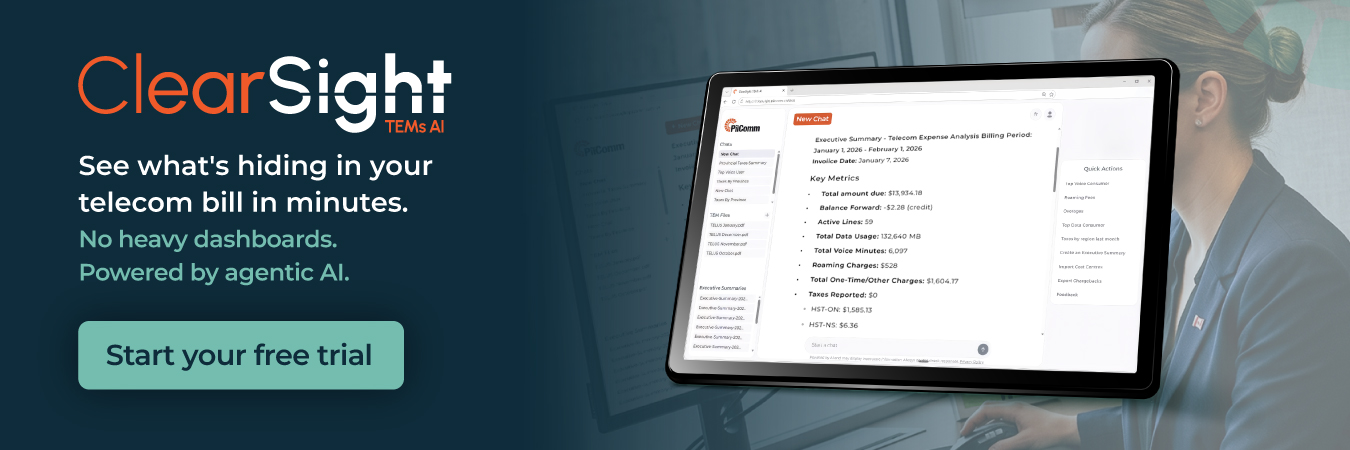
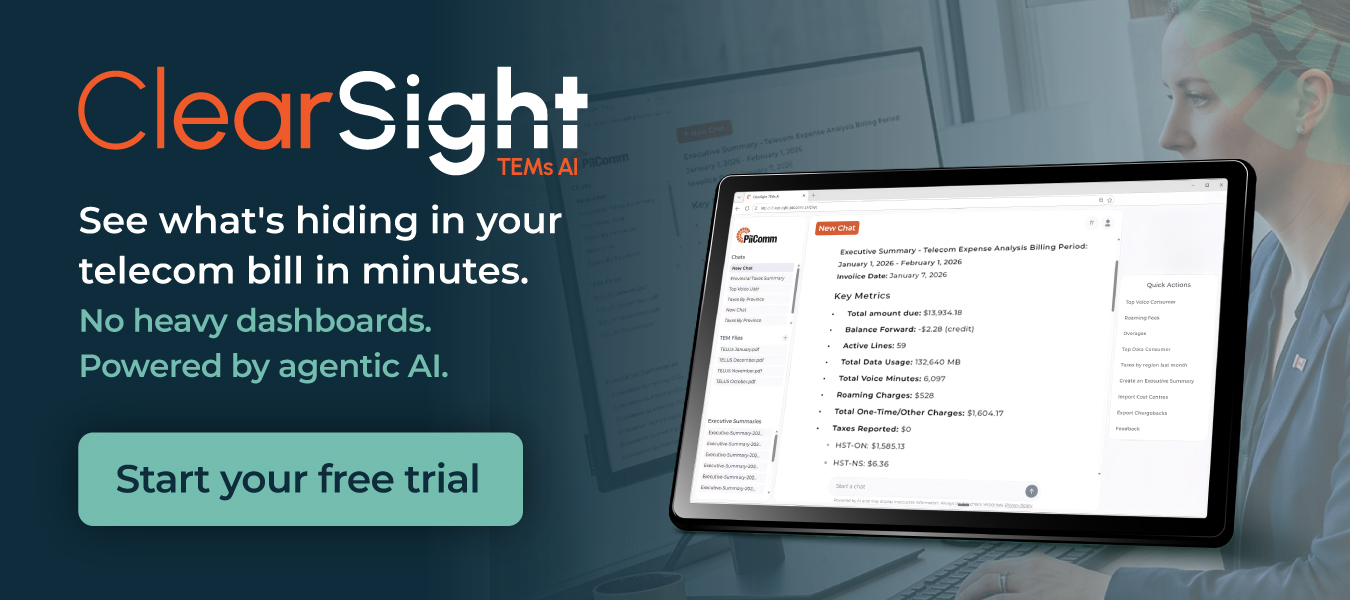
Conversational AI interface: Users ask plain-language questions about their wireless spend—”Which lines had zero usage last month?” “Why did our bill spike this month?”—and receive instant, specific answers. The privacy officer preparing for an IPC inquiry can get a device inventory in minutes, not weeks.
Canadian data residency: The platform operates in isolated tenant environments with secure Canadian hosting. No cross-border data transfer concerns. Role-based access controls and audit logging support PHIPA agent obligations.
Bilingual output: French-language reporting and analysis are built in—not machine-translated as an afterthought.
Talk to a PiiComm mobility expert about healthcare TEM →
Where ClearSight fits within broader managed mobility services
ClearSight serves as both a standalone TEM tool and an entry point into PiiComm’s five integrated service pillars: Strategic Sourcing, Staging & Deployment, Lifecycle Management, MDM as a Service (MDMaaS), and Secure Decommissioning.
The first ClearSight analysis for a healthcare client almost always surfaces problems beyond billing. Lines billed to cost centres that no longer exist in the organization’s current GL structure—remnants of departmental reorganizations that were updated in finance systems but never reflected in carrier accounts. Devices on expired warranties where repair-or-replace decisions need usage data to inform them. Lines attached to devices that should have been retired through certified secure decommissioning months ago.
For health systems that discover through TEM audit that their problems extend beyond billing—into device lifecycle, MDM gaps, or decommissioning compliance—the path forward does not require a new vendor relationship. PiiComm’s 24/7 bilingual Canadian service desk and managed mobility services for healthcare provide the operational depth to address what the TEM audit reveals.
Building a TEM business case for your health system
The challenge with building a TEM business case in Canadian healthcare is that the most compelling data is US-sourced. No Canadian public benchmark exists for hospital-specific wireless spend, unused-line rates, or TEM ROI. CIHI does not publish a telecom line item. Statistics Canada does not isolate healthcare-sector wireless spend.
This data gap is itself an argument for TEM: the organization does not know what it is wasting because it has never had the tools to measure it.
US healthcare TEM benchmarks provide directional guidance. Pixel Health reports 15–20% annual wireless cost reduction in healthcare engagements; Socium IT reports 25–35%. For a Canadian health system spending $3M annually on wireless, even the conservative end represents $450K in recoverable spend—equivalent to several nursing FTEs.
Manual invoice processing carries hidden labour costs as well. Industry benchmarks indicate 18.5 minutes per invoice with a 23% error rate. Multiply by dozens of BANs processed monthly, and the hidden labour cost of manual TEM becomes a line item that finance can quantify.
The most effective healthcare TEM business cases do not lead with cost savings. They lead with risk: “We cannot produce a complete device inventory for the IPC if asked today. We cannot confirm that all lines associated with departed staff have been deactivated. We cannot verify that our carrier contracts reflect our actual usage.”
The CFO who frames TEM as risk mitigation—not just cost reduction—gets board approval faster.
Translating US TEM benchmarks for Canadian health-system budgets
When extrapolating from US benchmarks, apply conservative adjustments. Canadian carrier pricing structures differ from US markets—fewer carriers, different competitive dynamics, different enterprise rate structures. Provincial tax variations add complexity that US benchmarks do not account for.
A defensible approach: apply the low end of US ranges (15% recovery) to your annual wireless spend, then discount by 20% for Canadian market differences. If that conservative estimate still produces a six-figure recovery opportunity, the business case stands on its own.
The most common reaction from a healthcare CFO seeing their first ClearSight anomaly report is not about the dollar amount—it is about the number of lines they did not know existed. That visibility alone often justifies the engagement, before any cost recovery materializes.
Upload your first carrier invoice to ClearSight TEMs AI and see what it finds →
At $99/month per BAN, the platform pays for itself if it catches a single zombie line per billing account.
Frequently asked questions about telecom expense management in healthcare
What should a Canadian healthcare organization ask a TEM provider about data residency?
Ask specifically: “Where is our data stored? Which province? Who are your sub-processors?” Under PHIPA, a TEM provider handling line-level data cross-referenced with clinical systems is functionally an agent. Canadian data residency—ideally in Ontario or Quebec—is the conservative and defensible position. Avoid providers who cannot name their data-centre location.
How much can a Canadian health system expect to save with managed TEM?
US healthcare TEM benchmarks report 15–35% annual wireless cost reduction. No equivalent Canadian public benchmark exists—which is itself a sign of the data gap TEM closes. For a health system spending $2–5M annually on wireless, even the conservative end represents $300K–$750K in recoverable spend. Start with a scoping audit to establish your baseline.
What is the difference between a TEM platform and a managed TEM service?
A TEM platform gives your team dashboards and reports—your staff still does the work. A managed TEM service handles invoice ingestion, audit, anomaly detection, MACD execution, and carrier negotiation support on your behalf. For health systems where IT is already stretched by cybersecurity and EHR workload, managed service is typically the higher-value model.
Can a TEM provider work alongside our existing GPO telecom program?
Yes—and they should. GPO programs like HealthPRO Canada and Mohawk Medbuy negotiate carrier rates at volume. TEM ensures those negotiated rates are actually applied correctly, that unused lines are not eroding the savings, and that your usage data is current for the next GPO renewal cycle. The two functions are complementary.
How quickly should a TEM provider deactivate a line when an employee leaves?
Within 24–48 hours of HR offboarding confirmation, with SLA-backed turnaround. In healthcare, where agency nurses and locum physicians rotate frequently, even a one-week delay per departure compounds into dozens of orphaned lines per quarter. Ask the provider: “What triggers disconnection—a manual ticket or an automated HR feed?”
Does a TEM provider need to be PHIPA-compliant?
If the TEM provider’s data can identify which employee used which device to access patient records—even indirectly through cross-reference with MDM or EMR logs—they are handling PHI-adjacent information. Under PHIPA, this likely makes them an agent bound by written contract with administrative, technical, and physical safeguard obligations. Treat TEM vendor selection as a privacy-office decision.
What healthcare-specific KPIs should a TEM program track?
Beyond cost per line and total spend by carrier, healthcare TEM should track cost per adjusted patient day, cost per licensed bed, and wireless cost per clinical FTE. These align with how hospital finance teams report to their boards and Ministries of Health. If a TEM provider only reports aggregate spend by carrier account, they are not serving healthcare.
How long does it take to implement a TEM program for a multi-site health system?
For a multi-site health system with 20–50+ carrier billing accounts, expect 60–120 days for full implementation—including invoice ingestion, line inventory reconciliation against HR and MDM records, cost-centre mapping, and user training. A lightweight entry point like ClearSight TEMs AI can deliver initial invoice analysis within days of upload, providing scoping intelligence while full implementation proceeds.
The evaluation framework matters less than the decision it leads to. Every month a health system operates without TEM visibility, zombie lines compound, billing errors go undetected, and the data needed for the next carrier renewal grows staler.
Total employee compensation in Canadian hospitals reached $50.7 billion in 2023–2024—a 13.0% year-over-year increase. With compensation consuming the majority of hospital budgets, non-compensation cost optimization is one of the few levers CFOs can pull without affecting staffing levels.
Telecom expense management will not transform a health system’s financial position. But the dollars it recovers are dollars that can fund a clinical position, replace aging equipment, or simply demonstrate to the board that the finance team is governing every category of spend—not just the ones that are easy to see.