Most Canadian enterprises don’t have a wireless expense management problem—they have a wireless expense visibility problem. The invoices get paid, but nobody can tell you whether the 1,200 lines on last month’s Bell and TELUS bills match the 1,200 devices actually in use. That gap between what you’re billed and what you’re deploying is where Canadian enterprises lose 15–30% of their wireless spend annually. This post breaks down what wireless expense management actually involves in the Canadian context, where the money leaks, and what a practical recovery path looks like.
The gap between your carrier invoice and your actual fleet
A Director of IT pulls up a Bellenterprise invoice and counts 1,400 lines. They check their MDM console and see 1,280 enrolled devices. Those 120 lines are costing $6,000 a month and nobody knows what they’re for.
That’s the problem wireless expense management exists to solve.
When we onboard a new fleet for lifecycle management, one of the first things we do is pull carrier invoices and reconcile them against the MDM inventory. Nine times out of ten, the line counts don’t match. The gap is typically 8–15% of the fleet—lines billing for devices sitting in a drawer, assigned to former employees, or provisioned for a project that ended two years ago.
This isn’t a minor data hygiene issue. It’s real money disappearing into carrier accounts every month because no automated workflow connects device lifecycle events to line management.
The scale of the problem is visible even at the carrier level. In Bell’s Q1 2024 earnings, the company removed approximately 106,000 “very low to non-revenue generating business market subscribers” from its subscriber count. These were lines that had been billing but producing minimal activity—zombie services that enterprises were paying for until Bell decided to clean up its own books.
If your carrier is finding dead lines in your fleet, you’ve already lost the money.
Despite the obvious financial impact, most organisations don’t have a formal approach to managing this. Industry estimates suggest only 20–30% of large Canadian enterprises use a dedicated TEM approach, dropping to 5–10% for mid-market companies. The rest rely on accounts payable to pay invoices unaudited, or ask an already-stretched IT team to spot-check charges when finance escalates a budget variance.
What wireless expense management actually covers
Wireless expense management isn’t a single activity—it’s five interconnected disciplines that only deliver value when they work together.
Invoice processing means ingesting every line item from every carrier, parsing the charge taxonomy, and validating that each charge matches a contracted rate. Inventory management tracks which lines are assigned to which devices, which devices are assigned to which employees, and what status each line should have. Contract tracking monitors terms, renewal windows, and rate commitments across your carrier agreements. Usage optimisation compares actual consumption against plan entitlements to identify overages, underutilisation, and plan mismatches. Dispute resolution documents billing errors, files disputes with carriers, and tracks credits through to confirmation.
The critical insight: these functions create value through their connections. Invoice processing without inventory management catches overcharges but misses zombie lines. Contract tracking without usage optimisation tells you when renewals happen but not whether your current plans still make sense. Most organisations attempt one or two of these disciplines in isolation. The savings compound when all five operate as a continuous system.
WEM vs. TEM—where the wireless-specific complexity lives
Wireless expense management is a specialised subset of telecom expense management, and the distinction matters more than taxonomy might suggest.
Wireline TEM deals with infrastructure that stays in one place. A data circuit is provisioned once and bills the same amount monthly until you change it. The audit is mostly about confirming contracted rates and catching duplicate charges.
Wireless carries fundamentally different complexity. Device proliferation means your fleet changes constantly—new hires, terminations, device upgrades, broken devices, lost devices. BYOD introduces stipend tracking and partial reimbursement models. Data overages spike unpredictably based on application behaviour, WiFi availability, and user habits. Roaming charges appear when employees cross borders. Plan pooling creates shared entitlements that make per-user cost allocation difficult.
Most importantly, wireless lines are tied to individual employees who move, travel, and leave the company. A wireline circuit doesn’t quit without notice. A wireless line does—and when that employee’s laptop gets reclaimed but their wireless plan doesn’t get cancelled, you’ve created a zombie line that bills until someone notices.
This is what makes wireless the hardest telecom category to manage, and why organisations that have their wireline costs under control can still be bleeding money on wireless.
Why Canadian wireless fleets are harder to manage than global peers
If you’ve read a US-based guide to wireless expense management and thought “this doesn’t quite apply to us,” you’re right. The Canadian market has structural characteristics that make enterprise wireless spend harder to control.
Start with baseline costs. The ISED 2024 Price Comparison Study found Canada had the highest wireless price among G7 countries plus Australia at the 5GB service level—$63.80 versus $45.50 in the US and $22.50 in Australia. Higher per-line costs mean every inefficiency costs more in absolute dollars. A 20% optimisation in Canada recovers more per line than the same percentage in a market with competitive pricing.
Add market concentration. Bell, Rogers, and TELUS collectively hold approximately 90% of wireless revenue, creating a negotiating environment where enterprises have limited leverage to play carriers against each other. The flanker brands—Koodo, Fido, Virgin—are owned by the same three companies, and their enterprise offerings are minimal.
The most common mistake we see is an IT team negotiating a “national rate” with one carrier and assuming the pricing is uniform across provinces. It isn’t. Interprovincial price variation runs 26–50%. Your Saskatchewan lines are almost certainly cheaper than your Ontario lines on the same plan—and if you’re not benchmarking by province, your “national rate” is hiding significant overpayment in your highest-cost regions.
Interprovincial pricing and tax variation
Take a $50/month base plan and apply it across a distributed Canadian fleet.
In Alberta, with GST only at 5%, the final cost is $52.50. In Ontario, with HST at 13%, that same plan costs $56.50. In Quebec, with GST plus QST at 14.975%, you’re paying $57.49.
Across 1,000 lines, the difference between Alberta and Quebec pricing on the same base plan is nearly $5,000 a month—$60,000 a year in tax variance alone, before accounting for any carrier pricing differences by region.
This creates a practical problem for departmental chargebacks. If you’re allocating wireless costs by headcount without adjusting for provincial tax treatment, your Ontario and Quebec operations are subsidising your Alberta costs. Finance will eventually notice the variance, but without province-level disaggregation in your wireless expense data, there’s no way to explain it.
Most TEM platforms built for the US market treat taxes as a single line item. Canadian wireless expense management requires provincial tax parsing as a baseline capability—not an edge case.
The enterprise regulatory protection gap
The CRTC Wireless Code sounds like it should protect your enterprise wireless accounts. It doesn’t.
The Code’s protections—overage caps, contract clarity requirements, trial periods, unlocking rules—apply only to individuals and businesses with fewer than 100 employees. Enterprises above that threshold operate in a regulatory gap with no formal complaint channel, no overage caps, and no mandated contract transparency.
Most IT leaders we talk to don’t know this. They assume the protections they’ve seen in consumer advertising apply to their enterprise accounts.
They don’t.
Without regulatory backstop, proactive wireless expense management is the only safety net. The carrier isn’t required to cap your data overages at $50. They aren’t required to let you exit a contract early without penalty if your business needs change. And when billing errors occur, the CCTS—the Commission for Complaints for Telecom-television Services—primarily serves consumers and small businesses, not enterprises.
This reframes the entire approach. Consumer wireless management can afford to be reactive because the Wireless Code limits downside exposure. Enterprise wireless management must be proactive because nothing else limits your exposure.
Four wireless cost leakage patterns hiding in Canadian carrier invoices
After 15 years of auditing Canadian enterprise wireless invoices, the same patterns show up in nearly every fleet. The amounts vary, but the categories don’t.
Before diving into each one, here’s what you’re looking for:
- Unused lines and zombie services
- Billing errors on complex carrier invoices
- Data overages and roaming charges
- Contract renewal overpayment
These four categories account for the majority of recoverable wireless spend in most Canadian fleets.
The scale is significant. The CCTS accepted a record 23,647 complaints in 2024–25, up 17% year-over-year, with billing as the number-one issue. Enterprise billing errors are underrepresented in these numbers because enterprises above 100 employees have no formal complaint channel—but if consumers and small businesses are experiencing billing problems at this rate, enterprise accounts with far more complexity are almost certainly seeing similar patterns.
Canadian enterprises waste an estimated 15–30% of their wireless spend annually. Most of it hides in these four categories.
We had a retail client with 2,400 mobile lines across Canada. The initial invoice audit found 310 lines—nearly 13% of the fleet—generating zero usage for three consecutive months. Some were assigned to seasonal workers who hadn’t returned. Others were spares in a drawer. That’s $130,000 a year in carrier charges for devices nobody was using.
Unused lines and zombie services
This is the most immediately actionable leakage category, and the root cause is almost always a process gap rather than negligence.
When an employee leaves, HR processes the termination. IT reclaims the laptop. The employee returns their badge. But the wireless line falls through the cracks because no automated workflow triggers a cancellation request to the carrier.
The MDM may show the device as unenrolled. The HR system shows the employee as terminated. But the carrier has no visibility into either system—so the line keeps billing.
In theory, carriers cancel lines when you ask. In practice, we regularly find lines still billing three to six months after disconnection requests. The request gets lost in carrier queue management, or the wrong line gets cancelled, or the cancellation processes but the final bill includes a month of prorated charges that nobody disputes because the line is already off the active radar.
Zombie lines are endemic because they’re invisible. They don’t generate usage that triggers alerts. They don’t cause operational problems. They just quietly bill, month after month, until someone reconciles invoice line counts against actual device inventory.
Billing errors on Canadian carrier invoices
Carrier invoices for enterprise accounts are not simple documents. A fleet of 1,500 lines across multiple rate plans, with provincial tax variation, pooled data allocations, device instalment charges, and mid-cycle plan changes generates an invoice that can run to hundreds of pages.
Errors in that complexity are a systemic characteristic, not a criticism of specific carriers. The billing systems are doing their best with enormous transaction volumes. But complexity creates error rates, and without line-by-line audit capability, those errors accumulate.
The patterns we see most frequently: charges continuing after a line cancellation was supposedly processed, rate increases applied without the contracted notice period, credits promised during plan changes that never appeared, surcharges applied to lines that should be exempt under contract terms.
A $15/month error sounds trivial. Across 500 lines over 12 months, it compounds to $90,000. Most enterprises wouldn’t notice because nobody audits at the line-item level—they compare total spend to budget and investigate only when the variance is large enough to trigger a finance escalation.
The economic reality is straightforward: the carriers have sophisticated billing systems and dedicated revenue assurance teams. You probably don’t. That asymmetry means billing errors net in the carrier’s favour, not yours, unless you have a systematic approach to catching them.
The remaining two leakage patterns—data overages and contract renewal overpayment—represent equally significant recovery opportunities, and they’re particularly relevant for Canadian fleets navigating the current carrier pricing environment.
Data overages and roaming charges
A warehouse worker’s Zebra scanner loses WiFi connectivity for three hours during a shift. The device falls back to cellular and burns through 2GB of data syncing inventory updates. Nobody notices because the overage shows up as a single line item buried in page 47 of next month’s invoice.
This pattern is particularly common in fleets with rugged devices and field workers. The devices are designed to maintain connectivity—that’s the point—but when WiFi drops and cellular takes over, the cost model changes completely. A driver crossing into the US for a border run, a technician roaming between sites with inconsistent WiFi coverage, a retail associate using a tablet in a back room with poor signal—these generate charges that hide in invoice noise because nobody has defined what “normal” looks like for each device type.
The operational challenge is that overages and roaming aren’t errors in the traditional sense. The charges are legitimate. The device did use that data. But without usage baselines by device type and role, there’s no way to distinguish a $150 overage caused by a legitimate operational need from one caused by a misconfigured device falling back to cellular when it shouldn’t.
Contract renewal overpayment
Canadian carrier contracts include evergreen clauses with 60–90 day notice windows. Most enterprises miss these windows because nobody’s tracking them.
The consequence: your contract auto-renews at the rates you negotiated two or three years ago, even when the market has shifted significantly in your favour.
The shift has been dramatic. The cost of a 10GB plan dropped 47% between 2020 and 2024—from $69.42 to $28.03. Enterprises that auto-renewed contracts negotiated in 2022 or 2023 are locking in rates that no longer reflect the current competitive reality.
The 2026 carrier environment—flanker brands at $25/month, aggressive enterprise retention offers, the CRTC’s ban on switching fees—creates the most favourable enterprise negotiation window in a decade. But you only capture that value if you know when your renewal windows open and you enter them with current usage data and competitive benchmarks.
Auto-renewal isn’t a passive administrative process. It’s an active decision to pay 15–25% more than you could negotiate today.
How AI is changing wireless expense management
The reason most mid-market companies buy TEM software and stop using it within 18 months isn’t that the software doesn’t work. It’s that maintaining carrier rate libraries, configuring rules for every charge type, and interpreting the output requires a dedicated analyst most organisations don’t have.
The dirty secret of the TEM software market is that most mid-market implementations fail—not because the platform can’t surface savings, but because the ongoing maintenance burden exceeds the ongoing savings. The platform surfaces obvious wins in month one: the 50 unused lines, the auto-renewed contract. But sustained value requires sustained configuration, and without a dedicated TEM analyst, the platform becomes an expensive invoice archive.
Organizations implementing comprehensive TEM achieve first-year cost reductions of 10–35%, with ROI multiples of 5:1 to 10:1 within 12 months. The opportunity is real. The challenge is building an approach that captures it without requiring headcount most mid-market organisations can’t justify.
This is where AI changes the economics.
AI-driven TEM platforms reduce per-invoice analysis time from 18.5 minutes to under 10 seconds while detecting anomalies at 99% accuracy versus 60–70% for manual review. The difference isn’t marginal—it’s the difference between actually auditing your invoices every month and paying them unreviewed.
From rule-based platforms to conversational invoice analysis
Traditional TEM platforms ask: “Did any line exceed the threshold I configured?”
AI-driven TEM asks: “Is there anything unusual about this invoice compared to the last 12 months?”—and asks it across every line, every charge type, every carrier, simultaneously.
The shift isn’t just speed. It’s the elimination of the configuration barrier that kills most TEM implementations.
Rule-based systems require someone to define what “unusual” means for every scenario. You need thresholds for data overages, roaming charges, rate changes, surcharge additions. You need carrier-specific rate libraries that stay current as plans change. You need someone monitoring the rules and adjusting them as your fleet evolves.
AI-driven analysis learns baseline patterns from your own invoice history. It doesn’t need you to define that a $47 charge on a line that’s averaged $35 for the past year is worth investigating—it surfaces the anomaly because the pattern changed.
The conversational interface eliminates another barrier. Instead of exporting reports and building pivot tables, you ask: “Which lines had zero usage last quarter?” or “Show me all lines where the per-GB rate exceeds my contract terms.” The system answers in language, not spreadsheets.
For organisations that could never justify a dedicated TEM analyst, this changes what’s operationally feasible.
What Canadian privacy rules mean for your wireless expense management platform
Call detail records include who your employees called, when, for how long, and from what location. Usage data shows where devices connected to cellular networks throughout the day. That’s personal information under PIPEDA—and how your wireless expense management platform handles it matters.
Most WEM buying conversations focus on savings. Almost none start with “Where will our employee call detail records be stored?”
But in Canada, that question determines compliance posture.
We’ve had clients come to us after discovering that their US-based TEM platform was routing Canadian employee call detail records through a data centre in Virginia. Under PIPEDA, that’s a cross-border transfer of personal information that requires documented consent. Under Quebec’s Law 25, it triggers a mandatory privacy impact assessment for out-of-province data transfers.
The TEM vendor didn’t flag any of this—because they didn’t know Canadian privacy law required it.
Quebec adds another layer. Bill 96 requires French-language output from commercial systems generating contracts or reports, with penalties ranging from $3,000 to $30,000 per day per violation, doubled for second offences. If your TEM platform generates reports consumed by Quebec employees or operations, bilingual capability isn’t a nice-to-have—it’s a compliance requirement with daily compounding penalties for violations.
This creates practical evaluation criteria most organisations don’t consider until legal raises a flag during procurement:
Where is the data hosted? If outside Canada, what consent documentation exists for cross-border transfer?
Does the platform support French-language output for Quebec operations?
Can you demonstrate data residency and handling practices for audit purposes?
A US-hosted TEM platform can still be legally operated in Canada with proper consent and documentation. But most organisations don’t have that documentation—because nobody told them they needed it.
A practical starting point for wireless spend visibility
You don’t need to overhaul your entire telecom governance model in one quarter. Start with one action: reconcile your current carrier invoices against your actual device inventory.
Pull three months of invoices from each carrier. Export your MDM device inventory. Compare the line counts.
If you have 800 lines in MDM and 870 lines on the invoices, those 70 lines are either devices you don’t know about or lines you’re paying for that shouldn’t exist. The gap is typically 8–15% of the fleet—and it’s pure cost recovery.
That reconciliation exercise is exactly what AI-powered tools now handle in minutes instead of days. The patterns that took a manual analyst hours to find—zero-use lines, billing anomalies, rate mismatches—surface immediately when you feed an invoice through a parser trained on Canadian carrier formats.
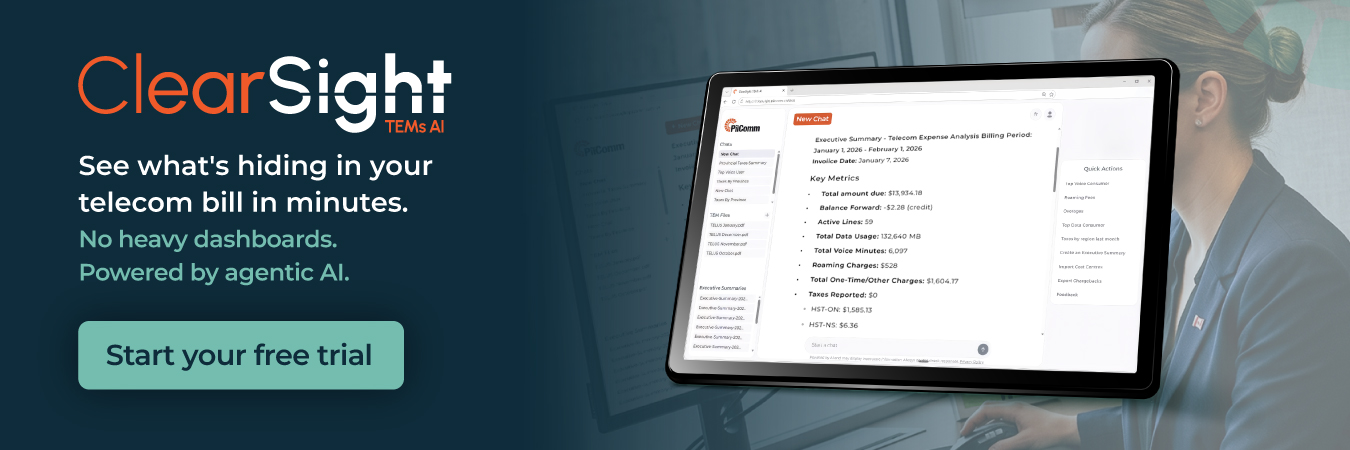
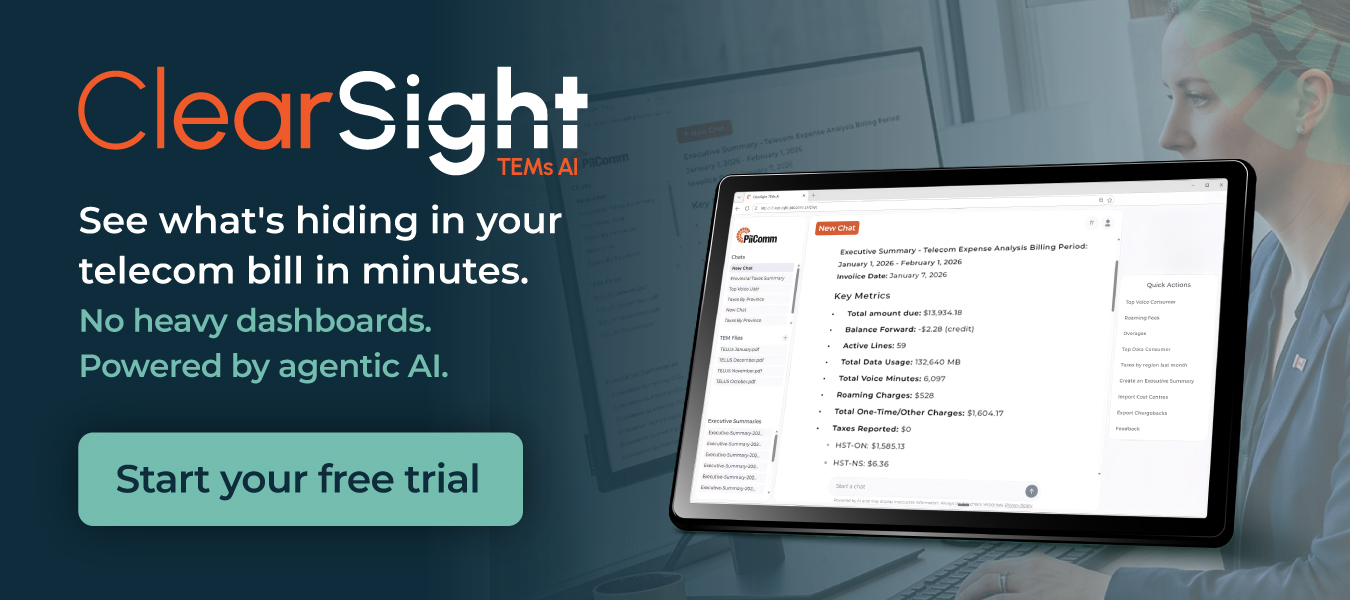
ClearSight TEMs AI was built specifically for this use case. Upload a Bell, Rogers, or TELUS invoice and get an AI-powered analysis in minutes—anomaly detection, zero-use line identification, per-line cost breakdowns, and departmental chargeback exports compatible with QuickBooks and NetSuite. Bilingual output. Canadian data hosting. $99/month per billing account, so mid-market organisations can start without a six-figure platform commitment.
The invoice data ClearSight captures also provides the scoping intelligence you need if wireless expense management reveals a broader operational gap. If your reconciliation shows a 12% line-to-device mismatch, the problem isn’t just billing—it’s that device lifecycle events and line management aren’t connected. Closing that loop requires integration between TEM visibility and lifecycle management that tracks every device from deployment through decommissioning.
That’s where managed mobility services that cover the full device lifecycle create compound value—not just finding zombie lines, but eliminating the process gap that creates them.
Frequently asked questions about wireless expense management
What is wireless expense management?
Wireless expense management (WEM) is the discipline of managing costs, inventory, contracts, and usage for an organisation’s mobile and wireless devices. It’s distinct from broader telecom expense management because wireless carries unique complexity—device proliferation, data overages, roaming, and the fact that lines are tied to employees who move, travel, and leave.
How is wireless expense management different from telecom expense management?
WEM is a specialised subset of TEM focused exclusively on wireless services. The distinction matters because wireless lines are tied to individual employees and physical devices, creating lifecycle management challenges that wireline services—which stay in one place and bill consistently—simply don’t have.
How much can wireless expense management save a Canadian enterprise?
First-time wireless audits typically recover 10–35% of annual wireless spend, with the Canadian market trending toward the higher end due to concentrated carrier pricing. Higher per-line costs mean optimisation recovers more absolute dollars than the same percentage in more competitive markets.
Does the CRTC Wireless Code protect enterprise wireless customers?
No. The Wireless Code’s protections—overage caps, contract clarity requirements, trial periods—apply only to individuals and businesses with fewer than 100 employees. Enterprises above that threshold operate without regulatory overage caps or trial period protections.
What types of billing errors are most common on Canadian wireless invoices?
The CCTS reports billing as the number-one complaint category, with unexpected charges, unauthorised price increases, and failure to apply promised credits as the top issues. Enterprise errors are underrepresented because the CCTS primarily serves consumers and small businesses—enterprises above 100 employees have no formal complaint channel.
What Canadian privacy laws affect wireless expense management platform selection?
PIPEDA governs employee telecom data collection nationally. Quebec’s Law 25 requires privacy impact assessments for out-of-province data transfers, and Bill 96 requires French-language output for Quebec operations—making data residency and bilingual capability non-negotiable evaluation criteria.
Can AI replace manual wireless invoice auditing?
AI-driven platforms reduce per-invoice analysis time from 18.5 minutes to under 10 seconds at 99% anomaly detection accuracy—making monthly invoice auditing feasible for organisations that could never justify a dedicated TEM analyst. The difference isn’t incremental improvement; it’s a category change in what’s operationally possible.
Closing the gap
The gap between what your carriers bill and what your fleet actually uses didn’t appear overnight, and it won’t close overnight. But it also won’t close by itself.
Every month you pay invoices without reconciling them against your device inventory, the gap widens. Every contract renewal window you miss, the gap compounds. Every zombie line that bills for a device in a drawer represents money that could have funded the visibility tools that would have caught it.
The Canadian market makes this harder than it needs to be—concentrated carriers, interprovincial pricing variation, an enterprise regulatory gap, and TEM platforms built for a US market that doesn’t share our compliance requirements. But the Canadian market also means the recovery opportunity is larger per line than it would be anywhere else in the G7.
Start with the reconciliation. Count your lines. Count your devices. Find the gap.
What you do after that determines whether next year’s wireless spend looks like this year’s—or whether you finally see what you’ve been paying for.