You ask your IT director a simple question: How many active wireless lines do we have across all stores?
Two weeks later, you get a spreadsheet. It was built from three different carrier portals, cross-referenced against an MDM export that hasn’t been reconciled since Q2, and annotated with notes like “possibly closed location — need to verify.” Nobody in the room trusts it. You’re a CFO responsible for a line item that runs into six figures annually, and you can’t get a reliable answer to the most basic inventory question.
This is the moment that triggers TEM evaluation. Not a vendor pitch. Not a conference presentation about AI-powered analytics. The moment someone in finance realizes the organization is flying blind on wireless spend.
When organizations finally subject their wireless costs to systematic analysis, the gap between what they’re paying and what they should be paying is consistently significant — first-time wireless audits in Canada typically recover 10–35% of annual spend. For a retailer spending $500,000 annually on wireless across a store network, that’s $50,000–$175,000 in recoverable waste, often surfaced in the first month.
This post isn’t about whether you need telecom expense management. If you’re reading this, you’ve already made that determination. It’s about what to look for in a platform so you don’t trade one set of problems for another.
Why multi-location retail is uniquely exposed to wireless spend waste
Retail wireless fleets are structurally harder to manage than any other vertical’s. That’s not an opinion — it’s a function of how retail operations work.
The combination of high location count, seasonal staffing, and distributed store-level accountability creates a perfect environment for cost leakage to go undetected. A manufacturing plant might have 500 devices in one location with a dedicated IT presence. A retailer with the same device count has those 500 devices spread across 50 stores, each with a manager whose primary job is selling product — not tracking wireless inventory.
Consider the scale of Canadian retail operations. Canadian retail trade generated $865.2 billion in operating revenue in 2024, with major chains operating networks that span from hundreds to thousands of locations — Loblaw operates more than 2,400 stores, Canadian Tire approximately 1,700, Dollarama over 1,600. Each location has its own wireless footprint: mPOS devices, handheld scanners, tablets for inventory management, back-office equipment. Multiply that by location count and you understand why nobody can answer the “how many lines do we have” question.
The billing complexity compounds from there. When a retailer with 400 stores runs three carriers across different regions — Bell in Ontario, TELUS in the West, Rogers in Quebec — each carrier uses a different billing account number (BAN) structure, a different portal, and a different format for usage exports. There is no native way to compare per-store costs across carriers. The finance team ends up maintaining three separate spreadsheets and hoping the totals make sense.
And while your team is reconciling invoices manually, billing accuracy is declining. The CCTS 2024-25 Annual Report recorded billing issues at a five-year high, representing 46% of all telecom complaints — a 16% year-over-year increase. For individual consumers, the CRTC Wireless Code provides some protection. Enterprise retailers with more than 100 employees fall outside those protections entirely.
The seasonal staffing problem nobody budgets for
Retail employment skews young and part-time — 27.5% of workers are ages 15–24 and 35.5% work part-time, according to Statistics Canada labour force data. That workforce composition implies enormous device and line churn that carrier billing systems never auto-flag.
Here’s what actually happens: Retailers hire seasonal staff in November for holiday peak, activate wireless lines for mPOS devices and handheld scanners, and those lines routinely remain active through March — sometimes longer. The seasonal worker is gone by January. The line keeps billing.
One Canadian enterprise discovered they were paying for 47 wireless lines at a location that had closed 11 months earlier. Nobody noticed because the invoices were processed by AP as a recurring charge. The monthly amount wasn’t large enough to trigger a variance flag, and nobody had cross-referenced the carrier invoices against the store closure schedule.
That pattern — small, persistent leakage across many locations — is the signature of retail wireless waste. It’s not dramatic fraud. It’s quiet accumulation.
Centralized cost visibility across every store and carrier
Most TEM providers will show you a dashboard. The question is whether that dashboard can tell you what Store #247 in Laval is spending per line on data this month versus last month, broken down by carrier, with provincial tax applied correctly.
That level of granularity is the first evaluation criterion because without it, nothing else works. You can’t detect billing errors if you can’t see line-level detail. You can’t identify zero-use lines if you can’t map lines to locations. You can’t allocate costs to cost centres if you can’t distinguish a Quebec line from an Alberta line.
The challenge is that Canadian carrier systems weren’t designed for this. Bell, Rogers, and TELUS each use proprietary BAN structures and non-comparable data exports. As of 2025, Bell is still migrating enterprise customers from “Corporate Self Serve” to “Bell Business Self Serve Centre,” creating a known transition gap for multi-line accounts. A TEM platform that simply ingests whatever format the carrier provides will inherit those inconsistencies.
The real test of visibility is chargeback. When finance asks “what does each store cost us in wireless?” the answer needs to account for provincial tax differentials. A $50 plan costs $52.50 in Alberta versus $57.49 in Quebec after the combined GST/QST rate. Any platform that doesn’t handle provincial tax at the line level is creating more reconciliation work, not less.
What to ask a provider about multi-carrier consolidation
Three questions separate credible providers from marketing claims:
Can you ingest Bell, Rogers, and TELUS enterprise invoices natively — or do we need to map fields from a CSV export?
Do you parse French-formatted invoices from Quebec accounts without manual intervention?
Can you roll up costs by store, region, banner, and cost centre in a single view — with the correct provincial tax rates applied automatically?
If the answer to any of these involves “custom implementation” or “professional services engagement,” you’re looking at a platform that wasn’t built for Canadian retail.
Telecom billing error detection that works at retail scale
The often-quoted statistic that “80% of telecom invoices contain errors” comes from a 2005 Gartner study. It’s been repeated so often that it’s become industry folklore — but it’s two decades old and reflects a different era of carrier billing systems.
The contemporary reality is more nuanced but still significant. Pure IP analysis quantifies enterprise telecom overpayment at 3–15% of invoice value. That’s not 80%, but for a retailer spending $1 million annually on wireless, it’s $30,000–$150,000 in avoidable cost.
And billing accuracy is trending in the wrong direction. CCTS 2024-25 data shows complaints about regular monthly price increases spiked dramatically — TELUS-specific complaints rose 195% year-over-year, Rogers 76% on the same issue, and breach-of-contract complaints increased approximately 121% industry-wide. These aren’t consumer-only problems. Enterprise plans experience the same rate-plan creep and mid-contract adjustments — but without the Wireless Code’s protective caps.
The telecom billing errors that matter at retail scale aren’t the dramatic ones. They’re the quiet ones.
A $3.50 add-on that was supposed to be removed after a device swap, replicated across 200 lines, costs $8,400 per year. Rate-card mismatches after a plan migration that was supposed to save money. Post-cancellation billing on lines that were disconnected in the carrier portal but never confirmed. These errors compound silently because nobody has time to check 2,000 line items against rate cards every month.
Automated rule sets vs. manual spot checks
The distinction matters more than most buyers realize. A TEM platform that offers “billing audit” might mean a consultant reviews a sample of invoices quarterly. That’s better than nothing, but it misses most errors because the sample is too small and the review happens too late.
What you need is configurable automated rules that run against every invoice: rate-card mismatch detection, duplicate charge identification, tax applied to exempt accounts, post-cancellation billing flags. The rules should trigger alerts within days of invoice receipt — not weeks after the carrier’s 90-day dispute window has closed.
Ask providers how many billing errors they catch automatically versus through periodic manual review. The ratio tells you whether you’re buying a platform or buying a person’s time.

Zero-use and inactive line detection for store networks
A retailer closes a store in June. The lease ends, the fixtures are removed, the staff are redeployed or terminated. But the eight wireless lines associated with that location continue billing through the following April because nobody sent a disconnection request to the carrier, and the monthly charge was small enough to pass AP review without a flag.
This is the “zombie line” problem, and it’s acutely painful in retail because of store closures, renovations, and seasonal churn. Every store lifecycle event — opening, renovation, format change, closure — should trigger a corresponding wireless inventory reconciliation. In practice, it rarely does.
The gap between what’s enrolled in your MDM and what’s being billed by your carriers reveals the scale of the problem. Reconciliation methodologies consistently find an 8–15% gap between MDM-enrolled devices and carrier-billed lines as a typical Canadian enterprise pattern. Separately, research indicates approximately 15% of end-user devices sit in a “zombie state” consuming licences and data plans. For a 1,000-line retail fleet, that’s 80–150 lines you’re paying for with no corresponding active device.
But here’s the operational nuance that blunt zero-use policies miss: the dangerous inactive lines aren’t the ones at closed stores — those are at least theoretically discoverable. The dangerous ones are LTE failover lines at active stores that appear inactive because they only transmit data during a network outage.
A policy that disconnects every line with zero usage over 30 days will knock out your backup connectivity. Any credible TEM platform needs configurable usage thresholds and the ability to flag lines for human review before automated action. A line with zero data usage but periodic SMS authentication traffic is probably a security device. A line with zero usage of any kind at a closed location is waste.
Closed-store cleanup workflows
Evaluate whether a provider can trigger disconnection requests within 7–14 days of a store closure event and track the carrier’s response through to confirmation. That last part matters — carriers don’t always process disconnection requests on the first submission. A disconnection that was requested but not confirmed is a billing leak that will persist until someone notices.
The workflow should include verification that the carrier has acknowledged the request, confirmation that the final bill reflects the disconnection date, and credit recovery if the carrier billed beyond that date.
That systematic approach to store closures connects directly to the broader question of contract management — because the lines you’re disconnecting today were activated under terms you negotiated years ago, and understanding those terms determines what you should be paying until disconnection.
Carrier contract management and renewal intelligence
Most retailers renew their carrier master agreements every 24–36 months. The carrier comes to the table with a complete picture of usage, revenue, and contractual commitments. The retailer comes to the table with whatever their carrier rep told them last quarter.
That asymmetry defines the negotiation before it starts.
The most expensive moment in a retailer’s carrier relationship is the 90 days before contract renewal. If you don’t have a master agreement repository with renewal dates, committed minimum volumes, rate cards, and MACD windows — with automated alerts at 90, 60, and 30 days pre-renewal — you’re negotiating blind.
Carrier reps are incentivized on activations and average revenue per user growth, not on helping you find the cheapest plan. That’s not a criticism of any individual rep — it’s the structural reality of how enterprise account management works. The person across the table benefits when you buy more lines at higher rates. They don’t benefit when you right-size your fleet.
AOTMP research indicates that mobile TEM programmes generate an average of 9.4% in annual savings, but those savings are disproportionately concentrated in the renewal cycle. Having line-level usage data transforms the negotiation from “trust us, this is a good rate” to “here’s exactly what we use, here’s what we should be paying, and here’s what your competitor quoted.”
Questions to ask about rate benchmarking
Does the provider benchmark against carrier published business rate cards — not just your historic spend?
Can they reference CRTC weighted average retail revenue per GB data to contextualize what “competitive” actually means in the Canadian market?
Do they track committed minimum volumes against actual usage to identify over-commitment before renewal?
The last question matters more than most buyers realize. Carriers often structure enterprise agreements with minimum volume commitments that made sense when the contract was signed but no longer reflect operational reality. If you committed to 2,000 lines and you’re running 1,600, you’re paying for capacity you don’t use — and your carrier has no incentive to point that out.
Seasonal plan optimization — a retail-specific requirement
If a TEM provider doesn’t have a seasonal ramp-up/ramp-down playbook, they don’t understand retail.
The pattern repeats every year. A retailer activates 300 temporary mPOS lines for Black Friday through Boxing Day. The devices go to seasonal staff for checkout backup, pop-up locations, and extended floor coverage during peak traffic. The season ends. The staff leave. Nobody submits the plan change requests.
By March, those 300 lines are still on unlimited data plans at full rate. The carrier won’t flag it — those lines are revenue. The finance team won’t catch it because the invoices look consistent month-over-month. The waste compounds until someone asks why wireless spend is up 15% year-over-year despite flat store count.
Canadian mobile data usage per subscriber climbed 23.5% from Q1 to Q3 2025 — from 8.9 GB to 11.0 GB per month, according to the CRTC Communications Monitoring Report. Carriers respond to that trend by automatically migrating accounts to higher data tiers. For a retailer, that migration might make sense for permanent store devices but makes no sense for seasonal lines that will be inactive in six weeks.
A TEM platform should have pre-defined seasonal workflows: temporary plan activation ahead of peak, automatic reversion within 30 days of the seasonal window closing, and suspension/resume capability for lines that will be reactivated the following year. The alternative is paying full rate for lines that transmit zero data for eight months annually.
Canadian data residency and regulatory compliance
When a TEM platform ingests your carrier invoices, it holds employee names, phone numbers, usage patterns, and cost centre assignments. That’s personal information under PIPEDA. Where that data is stored, who can access it, and under what jurisdiction it falls are not abstract governance questions — they’re compliance obligations with real penalties.
For retailers operating in Quebec, the compliance burden is more specific. Quebec Law 25 carries penalties ranging from $5,000 to $25 million or 4% of worldwide turnover, with a private right of action that includes minimum $1,000 damages per individual affected. Separately, Bill 96 explicitly names cellular contracts as contracts of adhesion that must be presented in French first, with OQLF fines of $3,000–$30,000 per offence.
Here’s the compliance moment most US-headquartered TEM providers haven’t prepared for: A retailer with 200 stores in Quebec uploads carrier invoices to a US-hosted platform. Those invoices contain Quebec employee names and mobile numbers. Under Law 25, that’s a cross-border transfer of personal information outside Quebec — and it requires a Privacy Impact Assessment documenting that the receiving jurisdiction provides “adequate protection.”
Most US-based TEM providers have never been asked this question, let alone documented the answer. When your legal team asks where employee mobile data from Quebec stores is being stored, the vendor’s response will tell you everything you need to know about their readiness for Canadian retail.
Bilingual platform output is a compliance requirement, not a feature
Bill 96’s requirement that invoices, receipts, and ancillary documents be available in French applies to the outputs your TEM platform generates. If your chargeback reports, executive summaries, and cost allocation files are English-only, you’re creating compliance exposure for any Quebec operations that need to reference those documents.
The distinction matters: a platform that offers French translation as an add-on service is fundamentally different from one that produces bilingual outputs natively. The first creates a manual step and a lag. The second treats Quebec compliance as foundational architecture.
Buy Canadian procurement momentum
The Buy Canadian Procurement Policy Framework, effective December 16, 2025, and the Ontario Procurement Restriction Policy, effective November 20, 2025, directly affect any retailer that also serves government, broader public sector, or Crown corporation customers.
But the impact extends beyond public-sector compliance. In the post-2025 trade tension environment, “Buy Canadian” has become commercially relevant for private-sector procurement decisions. A Canadian-domiciled TEM provider eliminates cross-border data transfer questions, aligns with emerging procurement preferences, and avoids the structural disadvantage that US-headquartered providers face in federal procurements above $25 million — a threshold dropping to $5 million by spring 2026.
For a retail procurement manager building a vendor shortlist, selecting a Canadian-owned TEM provider is both a compliance simplification and a procurement risk mitigation.
Carrier independence — why your TEM provider shouldn’t be your carrier
All three national carriers offer some form of managed mobility or account management service. These services are operationally integrated and convenient. They are also structurally incapable of recommending that you reduce the number of lines you buy from them or switch a portion of your fleet to a competitor’s plan.
No carrier publishes a named “retail vertical” TEM programme. All three sell via generic enterprise/SMB segmentation. TELUS offers Managed IQ as a cross-carrier portal claim — the most enterprise-focused incumbent offering — but it is part of TELUS Managed Mobility Services and structurally tied to the TELUS commercial relationship.
The tell is in the recommendations.
Ask your carrier rep to run a cost optimization analysis. Count how many of the recommendations involve reducing your line count or moving lines to a competitor. The answer will be zero — not because the rep is dishonest, but because the system they work within doesn’t generate those recommendations. An independent TEM platform has no revenue stake in how many lines you have or which carrier provides them.
For a multi-carrier retailer — and most national retailers run multiple carriers across regions for coverage and pricing reasons — carrier-affiliated TEM creates a structural blind spot. The Bell portal can’t tell you that TELUS offers a better rate in Alberta. The Rogers account manager won’t suggest consolidating onto Bell in Ontario. Independence isn’t a philosophical preference. It’s the only way to get recommendations that serve your interests rather than the carrier’s.
What good looks like — a practical TEM checklist for Canadian retailers
The evaluation criteria above aren’t designed to favour any single provider. They reflect the operational realities of managing wireless spend across Canadian retail locations. Use this checklist to score your current approach or your shortlist of providers.
| Capability | What to verify |
|---|---|
| Single line-level inventory | Mapped to store, banner, and cost centre — refreshed every billing cycle, not quarterly |
| Monthly variance detection | Flags any line with >10–15% month-over-month change automatically |
| Zero-use and low-use identification | Surfaces within 30 days of activation or status change, with configurable thresholds |
| Automated chargeback to GL | Provincial tax handling at the line level, bilingual output, export to QuickBooks/NetSuite |
| Closed-store cleanup workflow | Initiates disconnection within 7–14 days of closure, tracks carrier confirmation |
| Seasonal ramp-up/ramp-down playbook | Pre-defined plan changes, automatic reversion, suspension/resume for annual lines |
| Renewal intelligence | Rate benchmarking, committed volume tracking, 90/60/30-day alerts |
| Dispute resolution | Filed within the carrier’s 90-day window, credit recovery within 60 days |
| Canadian data residency | Isolated tenant environment, documented Law 25 compliance |
| Native Canadian carrier parsing | Bell, Rogers, and TELUS enterprise formats including French — no field mapping required |
The fastest way to evaluate a TEM provider is to hand them one month of your actual carrier invoices and ask for a sample analysis. If they can’t parse Bell, Rogers, and TELUS formats natively — if they ask you to map fields or reformat data — that tells you everything about how the ongoing relationship will work.
How ClearSight TEMs AI addresses these criteria for Canadian retailers
If you’ve been scoring providers against the criteria above, you’ve likely noticed that most established TEM platforms are US-headquartered, US-hosted, and built for AT&T and Verizon invoice formats — not Bell, Rogers, and TELUS.
That gap isn’t a marketing observation. It’s a structural reality of how the TEM industry developed, primarily serving US enterprise customers with US carrier relationships. Canadian retailers have been expected to adapt to platforms that weren’t built for their market.
ClearSight TEMs AI is PiiComm’s Canadian-built AI-powered telecom expense management platform, launched December 2025, priced at $99/month per billing account. It was purpose-built for Canadian carrier invoice formats with Canadian data residency and bilingual output as foundational architecture, not add-ons.
The capabilities map directly to the evaluation criteria:
- Native Canadian carrier parsing — Bell, Rogers, and TELUS enterprise invoice formats including French, extracted and structured by AI without manual field mapping
- Automated anomaly detection — billing errors, zero-use lines, usage spikes, and rate-card mismatches flagged within minutes of invoice upload
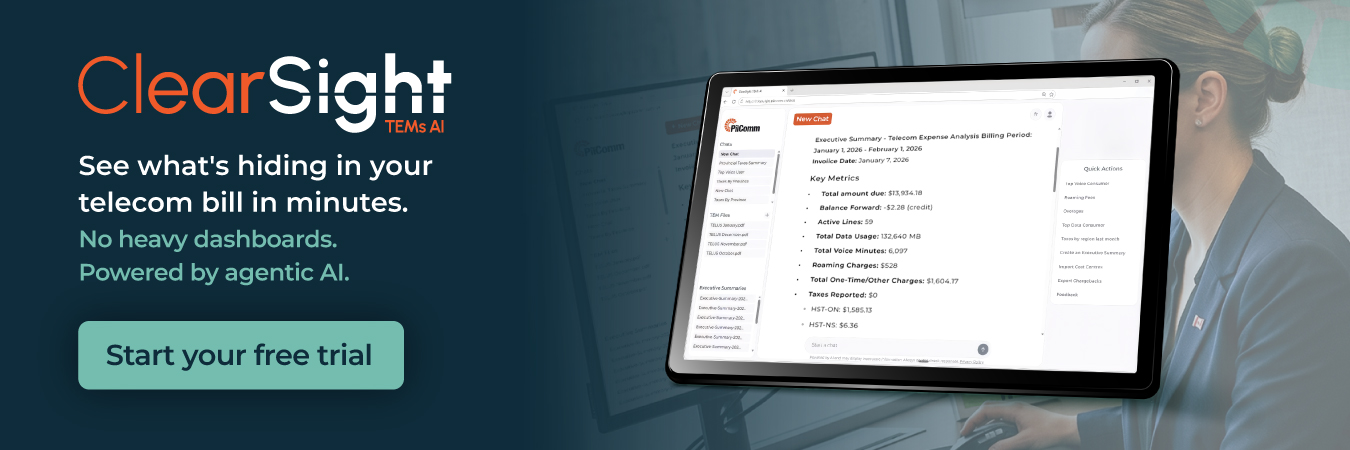
- Conversational AI interface — plain-language queries like “Why did Store #247’s bill spike this month?” answered instantly from your actual billing data
- Chargeback-ready exports — departmental cost allocation files compatible with QuickBooks and NetSuite, with provincial tax calculated at the line level
- Canadian data residency — isolated tenant environments with secure Canadian hosting, eliminating Law 25 cross-border transfer questions
- Bilingual output — English and French reports and summaries built in, not translated after the fact
The pricing model matters as much as the capabilities. Managed-service TEM providers typically charge 2–6% of monthly spend processed plus 25–50% gain-share on audit savings in year one. For a retailer spending $500,000 annually on wireless, that’s $10,000–$30,000 in platform fees plus half of whatever savings the audit finds.
ClearSight’s flat $99/month per billing account means total cost is predictable and the retailer keeps 100% of identified savings. For a CFO who has been waiting two weeks for a spreadsheet that nobody trusts, uploading invoices and getting per-store cost visibility within minutes isn’t incremental improvement — it’s a fundamentally different operating model.
Genuine alternatives to consider:
- Tangoe — The largest TEM by spend under management globally. Full managed-service model with deep capabilities. US-headquartered and US-hosted, with implementation timelines of 3–9 months.
- Calero/Cimpl — Quebec-founded, retains Canadian presence and bilingual capability. Now US-owned, raising questions about long-term data residency commitments.
- TELUS Managed IQ — Deep integration with TELUS billing systems, convenient for TELUS-primary accounts. Structural carrier affiliation limits cross-carrier optimization.
- In-house spreadsheet reconciliation — Viable below approximately 500 lines with dedicated analyst capacity. Misses carrier dispute windows routinely and creates key-person dependency.
The choice depends on your organization’s scale, complexity, and internal capacity. For retailers above 500 lines who need Canadian data residency, bilingual capability, and native carrier parsing without a six-month implementation — and who want to keep 100% of identified savings — ClearSight addresses those requirements at a price point that makes evaluation risk-free.
From TEM to full lifecycle visibility
The fleet metadata ClearSight captures — device inventory, carrier contracts, spending trends — provides the scoping intelligence needed for broader managed mobility solutions for retail if the organization decides to expand the relationship.
That progression is natural, not forced. Once you have accurate visibility into what you’re paying for wireless, the next question is often about what you’re paying for devices — and whether ongoing lifecycle management across all store locations could reduce the operational burden on a stretched IT team.
TEM is often the entry point because the pain is visible in every invoice. But the data it generates feeds decisions across the entire mobility lifecycle.
Not sure if TEM is the right starting point? Talk to a PiiComm mobility expert about your retail wireless environment.
Questions to ask any TEM provider before you sign
These questions separate serious providers from marketing claims. Copy them into your RFP or vendor evaluation scorecard.
- Where is our invoice and employee data stored, and in what jurisdiction?
- Can you produce bilingual (English/French) outputs and ingest French-formatted carrier invoices?
- How do you reconcile MDM-enrolled devices against carrier-billed lines?
- What percentage of historic spend have you recovered for clients of our size and industry?
- What is included in the base price and what is gain-share?
- Do you parse Bell, Rogers, and TELUS enterprise invoices natively, or do we need to map fields?
- How do you detect rate-plan creep and unauthorized add-ons?
- Can you support chargeback structures across cost centres, banners, and provinces?
- What is your SLA on dispute filing within carrier billing windows (typically 90–180 days)?
- How do you handle Quebec operations — Law 25 Privacy Impact Assessment requirements?
The answers to questions 1, 2, 6, and 10 will eliminate most US-headquartered platforms from consideration for any retailer with Quebec operations. That’s not bias — it’s compliance reality.
Frequently asked questions about telecom expense management in Canadian retail
What should a telecom expense management platform cost for a Canadian retail organization?
Pricing models vary significantly. SaaS platforms like ClearSight TEMs AI charge a flat $99/month per billing account. Managed-service providers typically charge 2–6% of monthly spend plus 25–50% gain-share on audit savings. For a retail CFO, the critical comparison is total cost of ownership over 24 months — including implementation time and internal effort required.
How quickly should a TEM platform deliver actionable results?
SaaS-based AI platforms can deliver first insights within minutes of invoice upload. Full managed-service implementations typically require 3–9 months for onboarding. For retail organizations approaching a carrier renewal window, time-to-value is a critical differentiator — a platform that takes six months to implement may miss the negotiation window entirely.
Can a TEM platform handle multiple Canadian carriers in a single view?
No Canadian carrier provides a consolidated view across competitors — each portal only shows their own services. A credible TEM platform must parse Bell, Rogers, and TELUS enterprise invoice formats natively and consolidate them into a single line-level inventory mapped to your store and cost-centre structure. Ask providers to demonstrate this with your actual invoices.
Does a TEM provider need Canadian data residency to serve Canadian retailers?
For retailers operating in Quebec, yes — Law 25 requires a Privacy Impact Assessment for any transfer of personal information outside the province. Carrier invoices contain employee names, phone numbers, and usage patterns — all personal information under PIPEDA and Law 25. Canadian data residency eliminates this compliance friction entirely.
What is the difference between carrier-provided account management and an independent TEM platform?
Carrier account management is operationally convenient but structurally conflicted — recommendations will never include reducing your line count or switching lines to a competitor. An independent TEM platform has no revenue stake in your carrier mix and can recommend the most cost-effective configuration regardless of which carrier benefits.
How do I know if my organization has inactive or “zombie” wireless lines?
If you cannot produce a single report showing every active wireless line mapped to a specific device, store, and employee — updated within the last 30 days — you almost certainly have inactive lines. Canadian enterprise reconciliations typically find an 8–15% gap between MDM-enrolled devices and carrier-billed lines. For a 1,000-line retail fleet, that’s 80–150 lines you’re paying for with no corresponding device.
What Quebec-specific requirements should a TEM platform meet for retail?
At minimum: bilingual (English/French) platform outputs, native parsing of French-formatted carrier invoices, Canadian data residency to avoid Law 25 PIA requirements, and documentation demonstrating compliance with Bill 96’s contract-of-adhesion requirements. Most US-headquartered TEM platforms were not designed for these requirements.
What ROI should a Canadian retailer expect from a TEM platform?
First-time Canadian wireless audits recover 10–35% of annual spend, with the initial audit often paying for the multi-year TEM investment within 3–9 months. Ongoing savings typically stabilize at 7–10% annually as the obvious waste is eliminated and the platform shifts to proactive optimization and renewal intelligence.
The spreadsheet that takes two weeks to build and nobody trusts isn’t a technology problem. It’s a symptom of an industry that expected Canadian retailers to adapt to platforms built for different carriers, different compliance requirements, and different operational realities.
The evaluation criteria in this post aren’t theoretical. They’re the questions that surface when a retailer tries to answer basic questions about their wireless spend and discovers that their current tools — or their current providers — can’t deliver the answers.
What changes when you have those answers is more than cost reduction. It’s the ability to walk into a carrier renewal with the same quality of data the carrier has. It’s the ability to close a store and know the wireless lines will be disconnected within two weeks, not eleven months. It’s the ability to answer the CFO’s question about active line count in minutes, not weeks.
That’s what a TEM platform should deliver. The question is whether yours does.