Telecom expense management software gives IT and finance teams automated visibility into what their organisation is actually paying for wireless, voice, and data services—and whether those charges are correct. For most Canadian enterprises, the answer is “they’re not.” The gap between what carriers bill and what organisations should be paying runs 15–30% of total telecom spend, and without a TEM platform parsing those invoices, the errors compound month after month without anyone noticing.
TEM software replaces the spreadsheet you stopped trusting
If your telecom expense management practice is a spreadsheet that someone updates when they remember, you don’t have expense management—you have a payment process.
The distinction matters. A payment process ensures invoices get paid on time. Expense management ensures you’re paying for what you actually use, at the rates you actually negotiated, without charges that shouldn’t be there. These are not the same thing, and the gap between them is where Canadian enterprises lose millions of dollars annually.
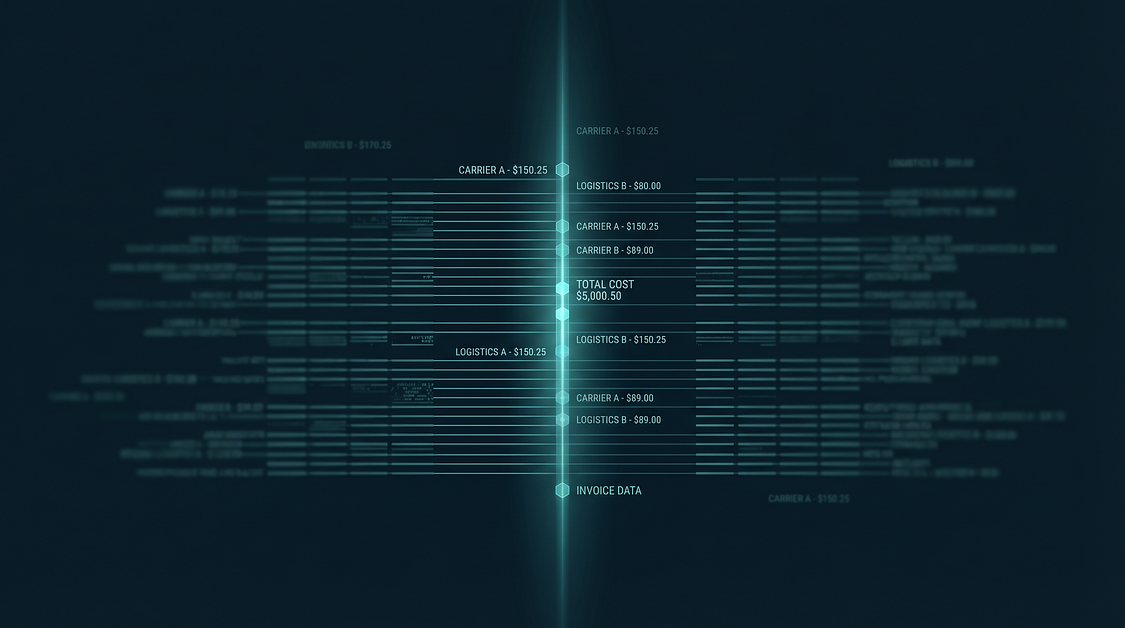
Telecom expense management software closes that gap by doing what no human with a spreadsheet can: ingesting carrier invoices at line-item level, extracting every charge and fee, categorising them against your contract terms, detecting anomalies and billing errors, and producing reporting you can actually act on.
Most Canadian organisations haven’t made this shift. Industry benchmarks suggest only 20–30% of large Canadian enterprises use a dedicated TEM approach, and that figure drops to 5–10% for mid-market companies. The majority are paying invoices blind—which is why first-time audits consistently surface significant recoverable spend.
The performance difference isn’t incremental. According to Socium IT audit data, AI-driven TEM platforms reduce per-invoice analysis time from 18.5 minutes to 8 seconds while achieving 99% anomaly detection versus 60–70% for manual review. That’s not an efficiency improvement—it’s the difference between auditing invoices and not auditing them at all.
Here’s what we see constantly: a mid-market IT team downloads the PDF invoices from Bell and TELUS every month, enters the totals into a spreadsheet, and sends it to finance. Nobody reviews the line items. Nobody compares this month’s charges to last month’s. The invoice gets paid because it looks roughly like last month’s invoice—and “roughly” is hiding $50,000 a year in errors and unused lines.
Five core functions inside a TEM platform
Every TEM platform, regardless of vendor, organises around five operational problems.
Invoice processing automates the extraction of charges from carrier bills—though in Canada, this means handling materially different formats from Bell, Rogers, and TELUS, none of which structure their enterprise invoices the same way.
Inventory management maintains an accurate record of every active line, device, and service—and flags discrepancies between what you think you have and what you’re being billed for.
Contract tracking monitors rate plans, commitment terms, and renewal dates against actual charges—accounting for interprovincial rate variation that makes “the same plan” cost different amounts in different provinces.
Usage optimisation identifies patterns like consistently underused data plans, lines with zero usage, or employees on legacy plans that cost more than current offerings.
Dispute resolution manages the process of raising billing discrepancies with carriers and tracking credits owed—a process that, without documentation, tends to disappear into carrier call centres.
For a complete treatment of each function and how they apply in the Canadian context, see our practitioner’s guide to telecom expense management in Canada.
The cost leakage TEM software is designed to catch
A retail client with 2,400 mobile lines came to us for lifecycle management. The first thing we did was pull their carrier invoices and compare them against their MDM inventory. We found 310 lines—13% of the fleet—generating zero usage for three consecutive months. That’s $130,000 a year in charges for devices nobody was using.
This isn’t an outlier. It’s the norm.
Billing complaints in Canada have reached record highs. The CCTS logged over 23,000 complaints in 2024–25, up 17% year-over-year, with billing as the number-one issue. But here’s the part that matters for enterprise IT leaders: the CCTS primarily serves consumers and small businesses. Enterprises with more than 100 employees have no formal ombudsman channel. Your billing errors go uncounted and unresolved unless you catch them yourself.
The scale of dormant-line charges across the Canadian market is staggering. Bell’s Q1 2024 financial disclosure revealed that the carrier removed approximately 106,000 “very low to non-revenue generating business market subscribers” in a single subscriber adjustment. If one carrier alone had over 100,000 dormant business lines on its books, the aggregate across all carriers represents hundreds of millions of dollars in charges for services nobody is using.
The root cause of zombie lines isn’t technology—it’s process. When an employee leaves, HR processes the termination and IT reclaims the laptop. But the wireless line? That falls through the cracks. No automated workflow triggers a cancellation request, and the carrier keeps billing until someone notices. We routinely find lines still billing three to six months after disconnection requests were submitted.
Billing errors, zombie lines, and overage charges
Three categories account for the majority of recoverable telecom spend in every fleet we’ve examined.
Billing errors include wrong rate codes applied to lines, promotional credits that expired without notice, charges for services never ordered, and rate increases that weren’t communicated. These aren’t malicious—they’re the inevitable result of complex billing systems processing millions of accounts. But they only get corrected if someone catches them.
Zombie lines are lines that remain active and billing but generate zero usage. They accumulate when employees leave, devices break, or seasonal workers finish their contracts. Without a systematic reconciliation between your device inventory and your carrier bills, these lines persist indefinitely.
Data overages hit hardest when field workers are on legacy plans with low data caps, when devices fall back to cellular when WiFi drops, or when employees travel without understanding roaming implications. A single warehouse scanner connected to an old shared data pool can generate hundreds of dollars in unexpected charges in a month.
The pattern across all three categories is the same: the charges are legitimate in the sense that the carrier believes they’re billing correctly. The problem is that what’s being billed no longer matches what the organisation actually needs or uses.
This is exactly the kind of pattern that’s invisible in a spreadsheet but immediately visible the moment you feed an invoice through a TEM platform that compares this month’s charges against last month’s—and against your actual device inventory.
The question isn’t whether your organisation has leakage in these categories. The question is whether you’re equipped to find it before it compounds into next quarter’s budget variance conversation with your CFO—and whether a TEM platform designed for US carriers can actually parse the invoices your Canadian operations generate.
Why Canadian enterprises need TEM software built for Canadian carriers
A Bell enterprise invoice from Ontario looks nothing like a TELUS enterprise invoice from Alberta, and neither one looks like a Vidéotron invoice from Quebec. Any TEM platform that treats Canadian carrier billing as a minor variation of US billing is going to miss the charges that matter most.
This isn’t a theoretical concern. We’ve had clients discover that their US-based TEM platform was routing Canadian employee call detail records through a data centre in Virginia. Under PIPEDA, that’s a cross-border transfer of personal information that requires documented consent and adequate protection. Under Quebec’s Law 25, it triggers a mandatory privacy impact assessment. The TEM vendor didn’t flag any of this—because they didn’t know Canadian privacy law required it.
The operational differences compound from there. Canadian wireless pricing remains among the highest in the developed world, which means the absolute dollar value of optimisation is larger per line than in more competitive markets. The ISED 2024 Price Comparison Study found Canada had the highest wireless price among G7 countries plus Australia at the 5GB service level—$63.80 versus $45.50 in the US and $22.50 in Australia.
Higher baseline costs mean higher absolute savings from optimisation. A 20% reduction on a $50/line Canadian plan recovers more per line than the same percentage on a $30/line plan in a more competitive market. But capturing that value requires a TEM platform that actually understands how Canadian carriers structure their invoices.
Provincial tax treatment and interprovincial rate variation
A $50/month plan costs $52.50 all-in in Alberta, $56.50 in Ontario, and $57.49 in Quebec. Across a fleet of 1,000 lines distributed nationally, those differences add up—and they make your departmental chargebacks wrong if your TEM platform treats Canada as a single tax jurisdiction.
The problem isn’t just HST versus GST versus GST+QST. It’s that most US-built TEM platforms don’t disaggregate provincial taxes at all. They see a Canadian invoice, apply a single tax assumption, and produce chargeback files that misallocate costs to every cost centre with employees outside the assumed province.
We’ve seen procurement teams spend three months evaluating a US-based TEM platform only to discover during pilot that it couldn’t handle Quebec’s combined GST+QST treatment correctly. The chargeback files were wrong by 10% for every Quebec cost centre. That’s a discovery you want to make in the first conversation, not the third month.
Bilingual output and Quebec compliance under Bill 96
If your TEM platform generates audit reports or chargeback files for Quebec operations, those outputs must be available in French. This isn’t a preference—it’s a legal requirement under Bill 96.
Penalties run $3,000 to $30,000 per day per violation, doubled for second offences. Most US-based TEM platforms produce English-only output. If your organisation has Quebec operations, bilingual capability isn’t a nice-to-have feature—it’s a vendor evaluation criterion that should surface in your first conversation.
How AI is changing what TEM software can actually do
Traditional TEM platforms ask: “Did any line exceed the overage threshold I configured?” AI-driven platforms ask: “Is there anything unusual about this invoice compared to the previous 12 months?”—and they ask that question across every line, every charge type, every carrier, simultaneously.
The difference matters because traditional TEM requires you to know what you’re looking for before you find it. You configure rules for the error patterns you’ve seen before. But the billing errors that hurt most are the ones you’ve never encountered—the promotional credit that expired without notice, the rate code that changed mid-contract, the fee category that didn’t exist six months ago.
Organisations implementing comprehensive TEM achieve first-year cost reductions of 10–35%, with ROI multiples of 5:1 to 10:1 within 12 months. The savings are real. But they only materialise if the organisation actually uses the platform—and that’s where most implementations fail.
The dirty secret of the TEM software market is that most mid-market implementations stall within 18 months. The initial audit surfaces the obvious wins—the 50 unused lines, the contract that auto-renewed at the old rate. But ongoing value requires someone to maintain carrier rate libraries, update rule sets every time a carrier changes its invoice format, and interpret dashboards that weren’t designed for occasional users.
Without a dedicated TEM analyst, the platform becomes an expensive invoice archive. The spreadsheet returns. The auditing stops. The errors compound again.
This is why the emerging generation of TEM tools approaches the problem differently. Instead of requiring pre-configured rules for every carrier and charge type, AI-driven platforms parse invoices autonomously—identifying anomalies without being told what to look for, surfacing patterns across months of billing history, and presenting findings in plain language rather than dashboard widgets.
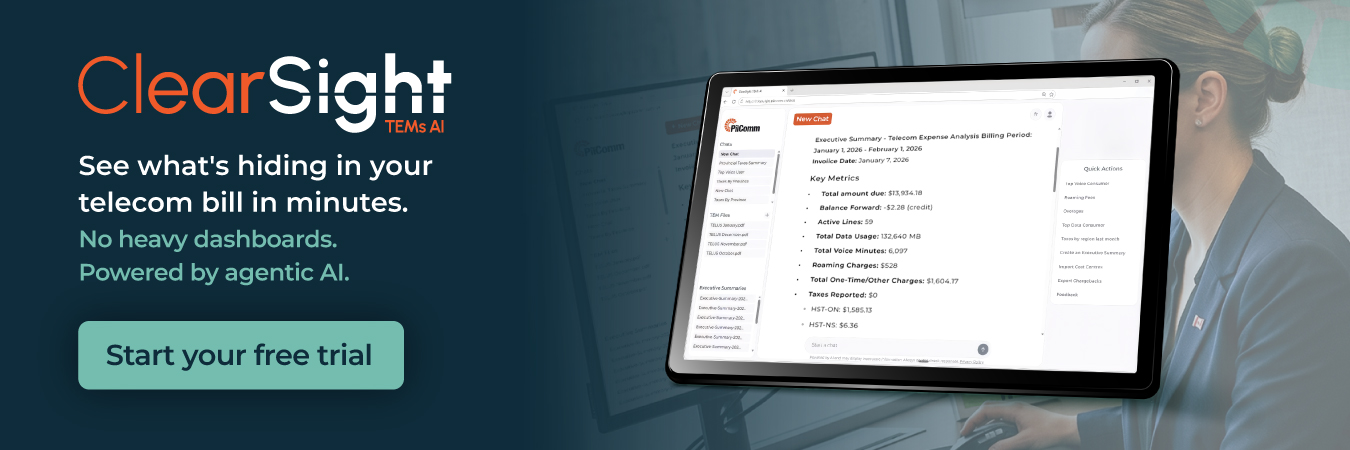
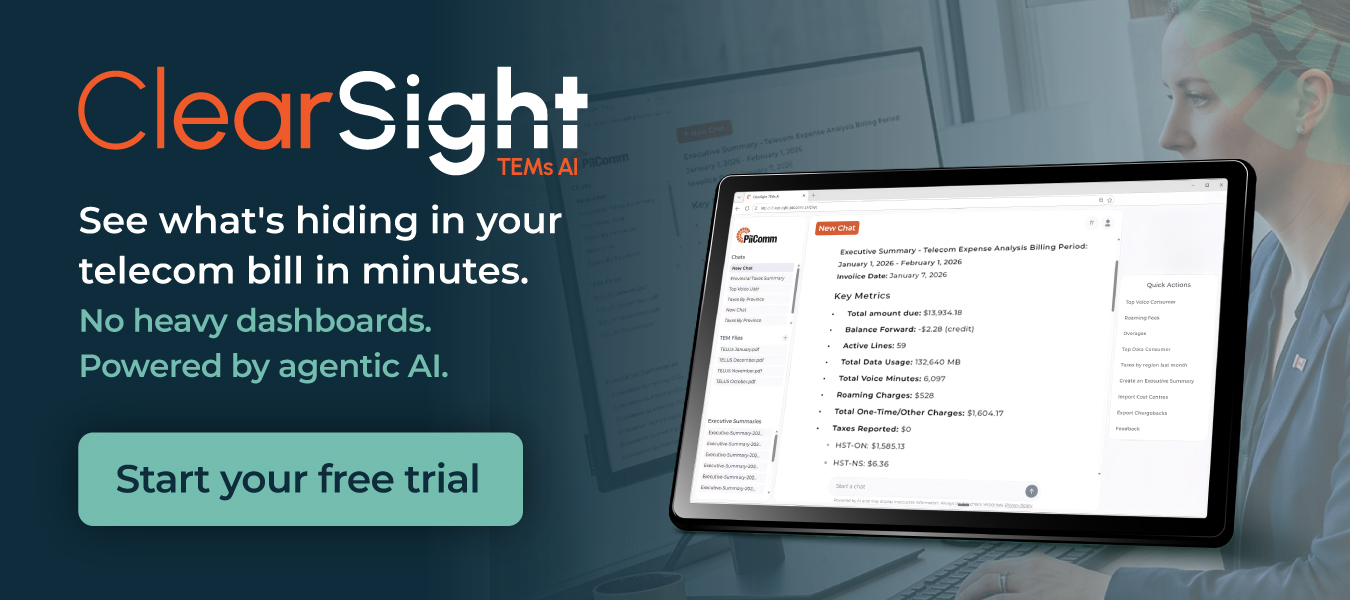
ClearSight TEMs AI is built specifically for this use case. It’s a Canadian-built platform designed for Bell, Rogers, and TELUS invoice formats, with bilingual output for Quebec compliance, Canadian data residency, and a $99/month price point designed for mid-market organisations that can’t justify a six-figure TEM platform but can’t afford to keep ignoring their telecom spend.
You upload an invoice. The platform’s AI agents parse every line item, compare it against your historical billing, flag anomalies and zero-use lines, and let you ask questions in plain language: “Why did our bill spike this month?” or “Which lines had zero usage for two consecutive months?” The answers come in minutes, not days—and they don’t require you to learn a new dashboard or configure detection rules.
See what ClearSight TEMs AI finds in your first invoice—book a 20-minute demo.
| Capability | Spreadsheets | Traditional TEM | AI-Driven TEM |
|---|---|---|---|
| Typical first-year savings | 0–5% (errors missed) | 10–20% (if maintained) | 15–35% (automated detection) |
| Per-invoice analysis time | 45+ minutes | 15–20 minutes | Under 1 minute |
| Canadian carrier parsing | Manual extraction | Varies by vendor | Native Bell/Rogers/TELUS support |
| Bilingual output | Depends on analyst | Rarely available | Built-in (EN/FR) |
What to evaluate before choosing a TEM platform for Canadian operations
Ask any TEM vendor you’re evaluating one question: “Can you parse a TELUS enterprise invoice and a Bell enterprise invoice in the same platform, and show me provincial tax breakdowns for Ontario, Quebec, and Alberta on the same dashboard?”
If they hesitate, they’re not built for Canadian operations.
Beyond that baseline, here’s what separates platforms that deliver ongoing value from platforms that become expensive archives:
- Canadian carrier format support. Bell, Rogers, and TELUS structure enterprise invoices differently. A platform built for AT&T and Verizon will struggle with line-item extraction, and extraction errors cascade through every downstream report.
- Provincial tax disaggregation. Your finance team needs chargeback files that correctly allocate GST, HST, and QST by province. If the platform treats Canada as a single tax jurisdiction, every cost-centre allocation is wrong.
- Bilingual reporting capability. If you have Quebec operations, French-language output is a legal requirement under Bill 96—not a feature request for later phases.
- Data residency and sovereignty. Employee call detail records are personal information under PIPEDA. Know where the platform hosts your data and whether that creates cross-border transfer obligations.
- Ongoing maintenance burden. Ask how often carrier rate libraries need updating, who does it, and what happens when a carrier changes its invoice format. If the answer requires a dedicated TEM analyst you don’t have, the platform will stall.
- Time to value. A platform that requires three months of implementation before surfacing your first insight is a platform that may never deliver ROI. Look for platforms that show value on the first invoice upload.
The vendor conversation should feel like a discovery process, not a sales pitch. If they can’t answer these questions with specifics—Canadian carrier names, provincial examples, hosted data locations—they’re selling a US platform with a Canadian footnote.
Talk to a mobility strategist about integrating TEM with your device lifecycle.
Frequently asked questions about telecom expense management
What is telecom expense management software used for?
TEM software automates invoice parsing, usage analysis, and anomaly detection across an organisation’s telecom services. It replaces manual spreadsheet review that typically misses 30–40% of billing errors, surfacing recoverable spend that would otherwise compound month after month unnoticed.
How much can TEM software save a Canadian enterprise?
First-time TEM implementations typically recover 10–35% of annual telecom spend, with Canadian recovery rates tending toward the higher end due to concentrated carrier pricing. For a mid-market fleet, that often translates to $50,000–$200,000 in first-year recoveries.
What types of telecom expenses does TEM software manage?
TEM covers wireless plans, voice services, data connectivity, roaming charges, and device-related service fees—essentially any recurring charge from a telecom carrier. More comprehensive platforms also track hardware assets and correlate billing data with device inventory.
Does TEM software work with Canadian telecom carriers?
Platform capability varies significantly. Most US-built TEM platforms struggle with Bell, Rogers, and TELUS enterprise invoice formats, provincial tax disaggregation, and bilingual output requirements. Evaluate Canadian carrier support explicitly before committing to a platform.
What is the difference between TEM software and managed TEM services?
TEM software provides the platform; managed TEM services add human expertise to operate it—including invoice auditing, carrier dispute resolution, and contract renegotiation on the client’s behalf. Many organisations start with software and add managed services when internal bandwidth becomes a constraint.
How does AI improve telecom expense management?
AI-driven TEM reduces analysis time from 18+ minutes per invoice to seconds and detects anomalies without pre-configured rules. This eliminates the configuration burden that causes most mid-market TEM implementations to stall within 18 months of launch.
What Canadian privacy laws affect TEM platform selection?
PIPEDA governs employee telecom data nationally. Quebec’s Law 25 requires privacy impact assessments for out-of-province data transfers. Bill 96 requires French-language output for Quebec operations. These make platform hosting location and language capability compliance decisions, not preferences.
The gap between what you’re paying for telecom services and what you should be paying isn’t a rounding error—it’s a budget line item large enough to fund projects you’ve been told there’s no money for. The question is whether you have the visibility to find it before your CFO asks why wireless costs spiked again this quarter.
For a deeper treatment of building a TEM practice in the Canadian context—from carrier contract structures to integration with device lifecycle management—see our practitioner’s guide to telecom expense management in Canada.