

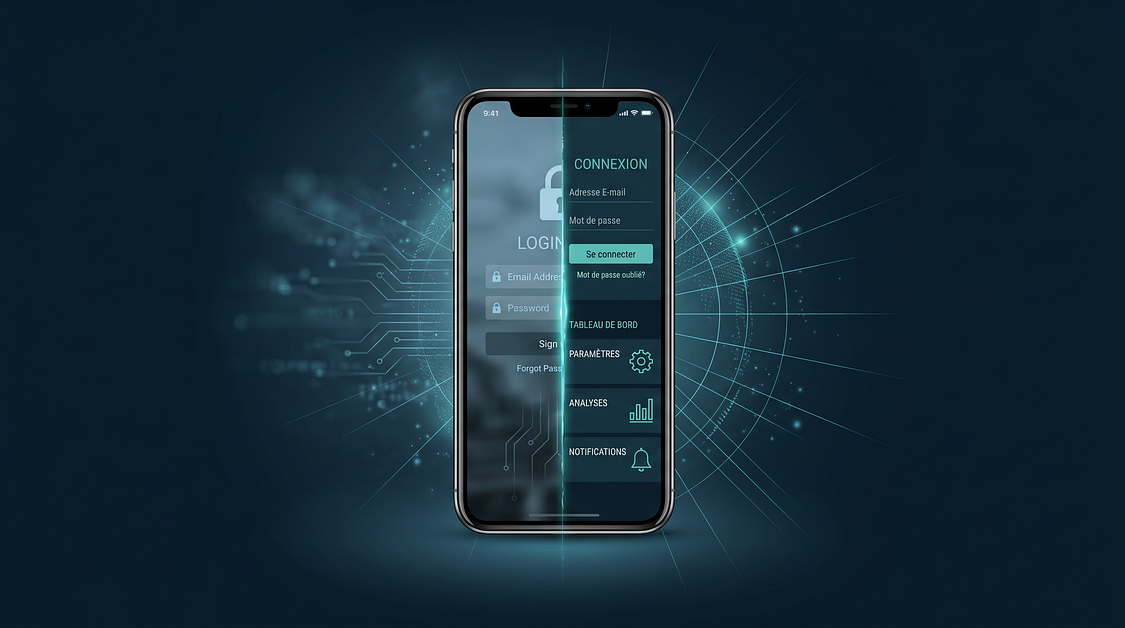
If your enterprise operates mobile devices in Quebec and those devices boot into English by default, display English-only MDM enrollment screens, or route support calls to an English-only service desk, you are already exposed to Bill 96 non-compliance. This isn’t a signage law that stops at the front door—it reaches every screen, notification, and support interaction your frontline workers touch. Here’s what operations leaders need to know to close the gap before an OQLF inspection finds it first.
Bill 96 reaches the device in your worker’s hand
A warehouse supervisor in Laval hands a newly hired picker a Zebra TC52 scanner. The device boots in English. The MDM enrollment screen is in English. The quick-start card in the box is in English. The worker’s first IT support call is answered in English.
Every one of those touchpoints is now a potential Bill 96 violation—and any of the worker’s colleagues can file an anonymous complaint with the Office québécois de la langue française (OQLF).
Bill 96 is not an abstract legal framework that lives in your legal department’s filing cabinet. It is an operational reality that touches every enterprise mobile device deployed in Quebec. The law strengthened French-language requirements across all workplace communications, and “workplace communications” includes the technology your employees use to do their jobs.
The OQLF is not a passive regulator waiting for egregious violations to cross its desk. In the most recent reporting period, over 10,000 complaints were filed and 9,813 inspections conducted. That’s not theoretical enforcement. Complaints are anonymous, inspections are unannounced, and the volume tells you the OQLF has both the capacity and the mandate to show up at your facility.
The financial exposure scales in a way that surprises most operations leaders when they first encounter it. Fines range from $3,000 to $30,000 per violation, with personal liability for corporate directors. Note the phrase “per violation”—not per incident. A fleet of 300 devices with English-default configurations is not one violation. It is potentially 300 violations, each carrying its own fine.
Here’s what actually happens: most national enterprises configure devices at a central staging facility and ship the same image to every province. That single English-default image becomes a compliance liability the moment it crosses into Quebec. The fix isn’t a sticker on the box—it’s a separate Quebec staging profile built into the deployment workflow from day one.
The enterprises that get caught aren’t usually the ones who ignored French entirely. They’re the ones who translated their signage and updated their HR documents but never thought to ask what language the scanner boots into.
Which device touchpoints Bill 96 actually covers
Bill 96 doesn’t just require French availability—it requires French predominance. The “markedly predominant” standard means French text must occupy at least twice the space of other languages on signage and digital displays. For enterprise mobile devices, this standard touches more surfaces than most operations leaders realise.
Device interface and default language settings
Employee-facing device interfaces must default to French. This isn’t about offering a language toggle buried three menus deep—it’s about what the device does out of the box when a Quebec worker powers it on for the first time.
The system locale, the home screen language, the settings menu, the notification language—all of it defaults to the language configured during staging. If staging happens in Ontario with an English-default image, that’s what arrives in Quebec.
MDM enrollment portals and on-screen notifications
The MDM enrollment experience is often the first thing a frontline worker sees when they power on a managed device. That enrollment screen—the one asking them to accept policies, enter credentials, or acknowledge terms—is a workplace communication.
So are the compliance notifications that pop up when a device falls out of policy. So are the push alerts from IT. So are the policy acknowledgement prompts. If they’re in English, they’re non-compliant for Quebec employees.
IT support and service desk interactions
Employees in Quebec have the right to communicate and receive communications in French in the workplace. That right doesn’t pause when they call the help desk because their scanner won’t pair with the Bluetooth printer.
A service desk that can’t take a call in French is creating a compliance liability for the employer—not for the service desk provider, but for you. Every support interaction with a Quebec employee that defaults to English is a potential complaint waiting to be filed.
Printed materials, quick-start guides, and training documentation
The physical materials that ship with a device matter too. Quick-start cards, safety inserts, regulatory compliance sheets, training guides—all of it falls under Bill 96’s requirements for workplace documentation.
This is the easiest gap to miss because most OEMs ship English-default documentation for the Canadian market. The French insert might be available on request, or buried on a website, or simply not included in the standard kit. If it’s not in the box when the device reaches your Quebec worker, you’ve created a compliance gap before the device even powers on.
The scope of enterprises subject to these requirements expanded under Bill 96. Previously, businesses needed 50 or more Quebec employees to trigger OQLF registration and potential francization audits. Bill 96 lowered that threshold to 25 employees. A single warehouse, distribution centre, or retail location in Quebec can put your entire enterprise in scope—and your devices are part of the audit surface.
The “markedly predominant” standard applied to device screens
The “markedly predominant” standard was written with storefront signage in mind—large windows, physical signs, printed materials where you can measure text size with a ruler. But the OQLF applies it to digital displays and on-screen communications too.
On a Zebra TC52’s 5-inch screen, “twice the space” is a design constraint, not just a language toggle.
A bilingual splash screen where the French text is the same font size as the English text does not meet the standard. A notification that displays English and French in equal-sized blocks does not meet the standard. The law requires French predominance, not French presence.
Here’s what actually happens in staging: when we configure devices for Quebec, the French locale is set as the system default, French is the primary language in the MDM profile, and any bilingual on-screen content is built with French-first layout. The English option exists—but it’s the secondary path, not the default.
This is a staging decision, not a translation decision. You can’t fix it after 500 devices are already in the field without a costly over-the-air push and potential workflow disruption while devices reboot and reconfigure. The workers who were scanning inventory all morning are now staring at a “configuring device” screen because someone in legal finally read the Bill 96 requirements.
The standard also applies to any custom applications deployed through your MDM. If your warehouse management app displays English-first menus, or your delivery tracking app shows English notifications, or your time-clock app presents an English login screen—each of those is a touchpoint where the “markedly predominant” requirement applies.
OQLF inspections and what triggers them for device fleets
An OQLF inspector doesn’t need a warrant to walk into your Quebec facility and examine the devices your workers are using. The inspection can be triggered by an anonymous complaint—from a current employee, a former employee, a contractor, or even a member of the public who noticed your delivery driver’s handheld displaying English menus at a customer site.
The inspector can examine device interfaces. They can request documentation about your device configuration and staging processes. They can review your IT support records to see what language support interactions occur in.
The complaint-driven enforcement model means your own workforce is the trigger. A disgruntled employee who was handed an English-default device has a free, anonymous channel to create a compliance event for your organisation. So does the temporary worker who couldn’t get French support from your help desk. So does the picker who noticed the English-only quick-start card in the box.
With over 10,000 complaints filed and 9,813 inspections conducted in the most recent reporting period, this is not a dormant regulatory body. The OQLF is resourced, active, and responsive to complaints.
Here’s what actually happens: the enterprises that get caught are almost never the ones with zero French capability. They’re the ones that translated their signage and HR documents but forgot about the 200 scanners on the warehouse floor—because nobody in legal thought to ask the IT team what language the MDM enrollment screen displays.
The devices slip through because they’re invisible to the compliance review. Legal audits the employee handbook. HR updates the offer letters. Facilities checks the signage. But mobile devices? Those live in IT’s domain, and IT wasn’t invited to the Bill 96 compliance meeting.
By the time an inspector asks to see a device, the gap has been baked into your fleet for months or years. And now you’re explaining why 300 devices in Laval boot into English while your legal team scrambles to calculate the per-device fine exposure.
That compliance gap becomes even more complicated when you factor in Quebec’s parallel privacy requirements—which brings us to the intersection of Bill 96 with Law 25.
How Bill 96 compliance intersects with Quebec Law 25 for mobile devices
Bill 96 is not Quebec’s only regulatory layer that touches enterprise mobile devices. Law 25—Quebec’s modernised privacy framework—requires a Privacy Impact Assessment (PIA) before deploying any technology that collects personal information. That includes MDM platforms.
If your MDM tracks device location, monitors app usage, logs compliance events, or enforces security policies, you’re collecting personal information about your Quebec employees. Law 25 says you need a PIA before that deployment goes live. If your MDM platform is hosted in the US, you’ve added a cross-border data transfer dimension to that PIA—another layer of documentation, another set of questions from your privacy officer.
An enterprise deploying devices in Quebec faces simultaneous language and privacy obligations that most national IT teams are not equipped to manage in parallel. Your legal team is working on the Bill 96 francization certificate while your privacy officer is asking about the MDM data flows, and nobody has told either of them that the same device deployment triggers both reviews.
The penalty scales are different, too. Bill 96 fines run $3,000 to $30,000 per violation. Law 25 administrative monetary penalties reach up to $10 million or 2% of worldwide revenue, whichever is higher. A device deployment that misses both creates compounding exposure—language fines calculated per device plus privacy penalties calculated at the enterprise level.
The practical implication: Quebec device deployments require a provider who understands both frameworks and can address them through the same operational model. Canadian staging, Canadian MDM administration, Canadian data residency. Not because it’s philosophically tidy, but because it closes both compliance gaps with one infrastructure decision.
Building a Bill 96–compliant device deployment workflow
Bill 96 compliance for enterprise mobile devices is a staging and deployment problem, not a translation problem. The fix lives in how devices are configured before they ship, how the MDM platform is administered, and whether the service desk can operate in French—not in a post-deployment language pack or a PDF translation of your user manual.
French-default device staging for Quebec locations
Quebec-bound devices need a separate staging profile. This isn’t a toggle you flip in your MDM console after the device ships—it’s a physical staging operation that happens before the device leaves the facility.
The French system locale must be set as the default. The keyboard layout defaults to French Canadian. The MDM enrollment profile is configured with French as the primary language. Any custom applications are deployed with French-first UI configurations. The documentation in the box is French, not English with a French insert buried underneath.
Here’s what actually happens when this isn’t built into the workflow: a national enterprise ships 200 devices to a new Quebec distribution centre using the same staging image they use everywhere else. Three months later, someone in legal discovers that every device boots into English. The remediation options are all bad—ship replacement devices (expensive), push an OTA reconfiguration (disruptive to operations), or hope nobody files a complaint (risky). None of those options would have been necessary if the Quebec staging profile existed from day one.
Bilingual MDM administration and enrollment
The MDM enrollment experience is often the first managed interaction a frontline worker has with their device. That enrollment screen—the policies, the terms, the credential prompts—must be in French for Quebec employees.
This requires MDM administrators who can configure French-language policies, not just translate the English ones after the fact. The difference matters. A policy that was written in English and translated reads differently than a policy that was authored in French by someone who understands the operational context. The compliance notifications, the security alerts, the policy acknowledgement prompts—all of it needs to be French-first for Quebec deployments.
If your bilingual MDM administration is handled by administrators who don’t speak French, you’re creating compliance artifacts that may not hold up to scrutiny. A machine-translated MDM policy is not the same as a policy configured by a bilingual administrator who understands both the language and the operational requirements.
French-language service desk as operational requirement
A Quebec warehouse worker who calls the help desk at 2 a.m. because their scanner won’t pair with the Bluetooth printer has the legal right to receive support in French. If your service desk can’t deliver that, you’re non-compliant every time the phone rings.
Here’s what actually happens at many national enterprises: Quebec support calls route to the same English-primary service desk that handles the rest of Canada. There’s a “press 2 for French” option that connects to a single bilingual agent—if that agent is on shift. If they’re not, the call goes to voicemail, or the caller gets transferred back to an English-speaking technician who tries to muddle through.
That’s not bilingual service delivery. That’s a compliance gap with a hold time.
A Bill 96–compliant service desk isn’t one that can eventually find someone who speaks French. It’s one where French-language support is operationally equivalent to English—same response times, same technical depth, same 24/7 availability.
Bill 96 compliance checklist for Quebec device deployments
Before shipping devices to Quebec locations, verify these staging and support requirements:
- French system locale set as device default (not just available as an option)
- MDM enrollment screens and compliance notifications configured in French
- French-language quick-start guides and documentation included in device packaging
- 24/7 French-language service desk support available for Quebec employees
- Custom applications deployed with French-first UI configuration
| Device touchpoint | Bill 96 requirement | Operational action |
|---|---|---|
| Device interface | French default language | Configure French locale during staging |
| MDM enrollment | French-language enrollment screens | Build French-first MDM profile |
| On-screen notifications | French predominance | Author notifications in French, not translate |
| IT service desk | French-language support | Staff bilingual technicians 24/7 |
| Printed materials | French documentation | Include French guides in device packaging |
| Custom applications | French-first UI | Deploy apps with French language configuration |
When your device partner can’t speak French, you own the compliance risk
Most managed mobility providers serving the Canadian market operate from US infrastructure with English-only service delivery. They can ship a device to Quebec—but they cannot stage it with a French-default configuration, administer the MDM enrollment in French, or staff a 24/7 French-language service desk.
That gap doesn’t create a compliance problem for the provider. It creates one for you.
Your contract with a US-based managed mobility provider doesn’t transfer your Bill 96 obligations to them. When an OQLF inspector asks why the 300 scanners in your Laval warehouse boot into English, “our vendor doesn’t support French staging” is not a defence. The fine lands on your books, not theirs. The director liability provisions apply to your executives, not theirs.
This is exactly the kind of compliance surface that becomes visible only when you start asking operational questions. Not “do you support French?” but “who configures the French-language MDM policies?” Not “can you ship to Quebec?” but “what language does the enrollment screen display when my worker in Trois-Rivières powers on the device for the first time?”
PiiComm stages devices for Quebec deployments at its own Canadian facilities with French-default configurations built into the staging profile. The 24/7 bilingual (English/French) service desk is staffed in Canada—not routed to a translation service or a single bilingual agent covering three time zones. MDM administration for Quebec clients is handled by bilingual MDM administrators who configure policies in French, not translate English policies after the fact.
This is what Bill 96 compliance looks like at the device level—and it requires a provider whose operations are built for it, not bolted on after a Canadian enterprise asks the right questions.
Frequently asked questions about Bill 96 and enterprise mobile devices in Quebec
Does Bill 96 apply to enterprise mobile devices like scanners and handhelds?
Yes. Bill 96 requires that employee-facing workplace communications—including device interfaces, on-screen notifications, and IT support—be available in French. Enterprise mobile devices used by Quebec employees fall within this scope, regardless of device type or industry.
What are the penalties for Bill 96 non-compliance on enterprise devices?
Fines range from $3,000 to $30,000 per violation, with personal liability for corporate directors. The “per violation” structure means a fleet of non-compliant devices can generate multiple fines—300 English-default devices could theoretically trigger 300 separate penalties.
Do I need to register with the OQLF if I have employees in Quebec?
Yes, if your enterprise employs 25 or more people in Quebec. Bill 96 lowered the previous threshold from 50 employees. Registration triggers potential francization audits that can include examination of workplace technology, including mobile devices.
What does “markedly predominant” mean for device screens?
French text must occupy at least twice the space of other languages on signage and digital displays. On a mobile device, this means French must be the default language and primary display—not equal-sized bilingual text. A 50/50 split does not meet the standard.
Does Bill 96 require my IT service desk to offer French support?
Yes. Quebec employees have the right to communicate and receive workplace communications in French, including IT support interactions. An English-only service desk—or one with limited French coverage—creates ongoing compliance exposure for the employer.
How does Bill 96 interact with Quebec Law 25 for mobile device deployments?
They create parallel obligations. Bill 96 requires French-language device configuration and support. Law 25 requires a Privacy Impact Assessment before deploying MDM technology that collects personal information. Both apply simultaneously, and penalties operate at different scales—per-device for Bill 96, enterprise-wide for Law 25.
Can an anonymous complaint trigger an OQLF inspection of our devices?
Yes. The OQLF investigates anonymous complaints, and inspectors can enter business premises without a warrant to examine compliance. With over 10,000 complaints filed in the most recent reporting period, the complaint-driven model means any employee—or former employee—can initiate an inspection of your device fleet.
The compliance gap nobody told IT about
Bill 96 compliance conversations usually happen in legal departments and HR offices. The signage gets updated. The employee handbook gets translated. The offer letters get reviewed.
But the devices? Those live in IT’s domain. And IT wasn’t invited to the francization meeting.
The gap persists because the people who understand the regulatory requirements don’t manage the device fleet, and the people who manage the device fleet weren’t told their staging decisions have compliance implications. By the time someone connects the dots, there are 300 English-default scanners in Laval and no good options for fixing them quickly.
The question isn’t whether Bill 96 applies to your mobile devices—it does. The question is whether your current provider can actually deliver French-default staging, French-language MDM administration, and 24/7 French service desk support. If the answer is no, you already know where the compliance liability lands.