You’re in the quarterly budget review, and someone asks why technology costs climbed 18% year-over-year. Nobody has a clear answer.
The carrier invoices run to hundreds of pages. SaaS subscriptions have multiplied across departments without central approval. The device fleet has grown by 200 lines since last fiscal—half of which may not even be in active use. Your finance team wants a breakdown by cost centre, and the best you can offer is a spreadsheet that hasn’t been reconciled since Q2.
This is the reality for most Canadian IT and finance leaders managing enterprise technology expenses. The tools exist to solve it, but the category itself is poorly understood, inconsistently defined, and complicated by Canadian market dynamics that don’t appear in any US-authored playbook.
This guide is written for Canadian IT directors, VPs of finance, and procurement leaders who suspect they’re overpaying but can’t quantify by how much. It covers what technology expense management actually means in 2026, where Canadian enterprises lose the most money, how Canadian regulatory and market realities create unique challenges, and how to build a practice that delivers sustained visibility—not just a one-time audit.
The stakes are substantial. Canadian enterprises waste an estimated 15–30% of their telecom spend annually—applied to the roughly $23–26 billion businesses spend on telecom services, that represents $3.5 billion to $6.9 billion in recoverable cost leakage every year. A mid-sized enterprise spending $500,000 annually on wireless is likely losing $75,000–$150,000 to billing errors, unused lines, and suboptimal rate plans.
But the term “technology expense management” gets used loosely—and that confusion costs real money.
Technology expense management is not just telecom expense management with a new name
If your TEM practice only covers wireless invoices, you’re managing about 40% of the technology spend that’s actually leaking.
The term “technology expense management” emerged as the scope of what enterprises need to manage expanded beyond phone lines and data plans. Today it encompasses SaaS subscriptions, cloud infrastructure, IoT connectivity, device lifecycle costs, and UCaaS platforms. The vendors who built their businesses on wireless invoice auditing have rebranded as “TEM” providers, but most of them are still running the same playbook they used a decade ago.
This matters because the fastest-growing cost categories aren’t the ones traditional TEM platforms were designed to handle. Canada’s IoT device market reached USD $5.25 billion in 2024 and is projected to hit $12.7 billion by 2030. Every new IoT connection adds a billable line that needs tracking—and most TEM platforms built for wireless invoice auditing aren’t designed to handle IoT billing models with their usage-based pricing and high line counts.
Meanwhile, the Canadian enterprise mobility management market reached USD $1.28 billion in 2024, growing at 23.5% CAGR through 2030. The device management market is expanding faster than the telecom market itself, which means device lifecycle costs—repairs, replacements, downtime, decommissioning—are an increasingly significant component of total technology expense. But almost no TEM vendor treats them as part of the same problem.
Here’s what actually happens: We onboarded a logistics company last year that had a TEM vendor handling their wireless invoices. Clean reports, decent savings. But nobody was tracking the 800 Zebra scanners deployed across their distribution centres—each one with a data plan, a lifecycle cost, and a replacement cycle. The wireless TEM practice was saving them $40,000 a year. The unmanaged device fleet was costing them three times that in premature replacements, idle spares, and over-provisioned data plans nobody had reviewed since deployment.
The five expense categories TEM should actually cover
A complete technology expense management practice addresses five interconnected cost categories:
- Wireless remains the largest single category for most enterprises—smartphones, tablets, rugged handhelds, and the voice and data plans attached to them. This is where traditional TEM started, and it’s still the highest-visibility line item.
- Wireline covers fixed voice services, internet circuits, MPLS, and SD-WAN—often managed by a different team than wireless and rarely reconciled against the same inventory.
- SaaS and cloud infrastructure includes per-seat software subscriptions, cloud compute and storage, and the shadow IT sprawl that accumulates when departments procure tools without central approval.
- IoT and M2M connectivity encompasses every sensor, tracker, and connected device with a cellular data plan—from fleet GPS units to warehouse temperature monitors.
- Device lifecycle costs covers the total cost of ownership beyond the purchase price: staging, deployment, repairs, spares inventory, downtime impact, and certified data erasure and secure device retirement at end-of-life.
If your current TEM practice only addresses the first category, you’re optimising a fraction of your exposure.
Where traditional telecom expense management stops short
The gap between legacy TEM and modern technology expense management isn’t just definitional—it’s operational.
Legacy TEM platforms were built for a specific workflow: ingest carrier invoices, match line items against contracts, flag rate plan mismatches, and generate optimisation recommendations. That workflow assumes the invoice is the source of truth and the contract is the benchmark.
The problem is that invoices only capture what carriers bill you for—not what your technology environment actually costs. A Zebra scanner’s $50/month data plan appears on the invoice. The $200 repair when a warehouse worker drops it, the $150 in lost productivity during the three days it takes to get a replacement, and the $75 in managing the full lifecycle of enterprise mobile devices through to decommissioning—those costs never touch a carrier invoice, but they’re technology expenses all the same.
Modern TEM requires integrating invoice data with device inventory, HR systems, asset management platforms, and procurement workflows. Most platforms that call themselves “TEM” don’t have those integrations, which means they’re still doing invoice auditing while calling it something broader.
The organisations getting real value from technology expense management are the ones that have recognised this gap—and are either building the integrations themselves or working with partners who treat the device and the line as a single cost object.
The Canadian technology expense landscape creates problems you won’t find in US guides
Picture this: you operate in Ontario, Alberta, and Quebec. Your carrier invoices arrive in three different formats, with three different tax treatments, and your Quebec operations require French-language contract documentation under Bill 96. Your US-headquartered TEM vendor’s platform produces English-only reports and processes data through a Virginia data centre.
You’ve just created a compliance problem you didn’t know you had.
Most technology expense management content is written for the US market, where a single carrier invoice format, uniform federal tax treatment, and English-only operations are reasonable assumptions. None of those assumptions hold in Canada—and the differences aren’t just annoying, they’re expensive.
Canada’s concentrated carrier market shapes everything. Bell, Rogers, and TELUS collectively hold approximately 90% of wireless revenue in Canada, which means enterprise buyers have limited competitive alternatives. In a market with more carrier competition, you can play vendors against each other. In Canada, proactive expense management is more critical precisely because switching costs are higher and alternative options are fewer.
The pricing gap compounds this. The ISED 2024 Price Comparison Study found Canada had the highest wireless price among G7 countries plus Australia at the 5GB service level—$63.80 versus $45.50 in the US. Higher baseline costs mean higher absolute savings from optimisation. A 20% reduction on Canadian wireless pricing recovers more per line than the same percentage in a cheaper market.
Here’s what catches every new client off guard: interprovincial pricing variation. We had a healthcare organisation with 1,200 lines across Ontario, Saskatchewan, and Quebec. Same carrier, same “national enterprise rate.” When we broke the billing down by province, Saskatchewan lines were costing 30% less than Ontario lines for identical plans—because the carrier’s regional pricing reflected local competition from SaskTel. The client had no idea because their invoice reporting was national, not provincial.
Interprovincial tax and pricing variation across Canadian telecom carriers
The tax treatment alone creates reconciliation headaches that US-based TEM platforms aren’t built to handle.
Ontario applies 13% HST. Alberta charges 5% GST only. Quebec applies 5% GST plus 9.975% QST. British Columbia adds 7% PST to the 5% GST. Each province’s treatment of specific telecom services varies further—some exempt certain data services, others don’t.
When your TEM platform generates a chargeback file for finance, it needs to disaggregate these tax treatments correctly by province. If it can’t, your departmental cost allocations are wrong, your budget forecasts are based on flawed data, and your CFO is working with numbers that don’t reconcile to the general ledger.
The pricing variation beyond taxes is equally significant. Carriers price differently by province based on regional competition, infrastructure costs, and historical rate structures. A “national enterprise agreement” typically establishes ceiling rates, not floor rates—and the actual per-line cost can vary 20–30% between provinces on the same contract.
National-level reporting hides this. If your TEM platform or internal process only produces aggregate national numbers, you can’t see which provincial operations are overpaying relative to their peers. The optimisation opportunities disappear into averages.
Bill 96, Law 25, and the bilingual compliance layer
Quebec’s language and privacy requirements aren’t theoretical compliance concerns—they carry real penalties and affect technology expense management platform selection directly.
Bill 96 requires that commercial contracts and business communications in Quebec be available in French. For TEM purposes, this means your platform needs to produce French-language reports, chargeback documentation, and user-facing outputs for any Quebec operations. If your US-based TEM vendor’s platform only produces English outputs, you’re creating a compliance gap every time you distribute a cost allocation report to a Quebec cost centre manager.
Law 25 (Quebec’s private-sector privacy law) requires organisations to conduct a privacy impact assessment before transferring personal information outside Quebec. TEM platforms process employee call detail records, usage data, and device location information—all of which constitute personal information under Law 25. If your TEM platform routes that data through infrastructure outside Quebec without a documented privacy impact assessment, you’re in violation.
The penalties aren’t abstract: $3,000 to $30,000 per day per violation for Law 25, with administrative monetary penalties reaching $10 million or 2% of worldwide turnover for serious breaches.
Most US-based TEM vendors don’t flag any of this because they don’t know Canadian privacy law requires it. The compliance burden falls entirely on the Canadian enterprise—which means platform selection is a compliance decision, not just a finance decision.
Five cost leakage patterns that show up in nearly every Canadian fleet
After auditing thousands of Canadian enterprise telecom accounts, the same five patterns account for the bulk of recoverable spend. The amounts vary by organisation, but the categories don’t.
The scale of the problem is documented in complaint data: the CCTS accepted a record 23,647 complaints in 2024–25, up 17% year-over-year, with billing-related complaints as the number-one issue. That number dramatically understates the enterprise problem because the CCTS primarily serves consumers and small businesses. Enterprises with 100+ employees have no formal ombudsman channel—they have to catch errors themselves.
The dormant line problem alone represents hundreds of millions in industry-wide waste. When Bell’s Q1 2024 subscriber adjustment removed approximately 106,000 “very low to non-revenue generating business market subscribers”, it revealed just how many lines carriers carry on their books that generate revenue but deliver zero value to the organisations paying for them. If one carrier alone had 106,000 dormant business lines, the aggregate across all three national carriers is staggering.
| Leakage category | Typical % of spend | Recoverability |
|---|---|---|
| Billing errors and incorrect charges | 2–5% | High—often recoverable with back-billing |
| Unused lines and zombie services | 5–15% | High—immediate cancellation savings |
| Data overages and roaming charges | 3–8% | Medium—requires plan restructuring |
| Contract renewal overpayment | 5–12% | Medium—requires renegotiation timing |
| Shadow IT and decentralised procurement | 3–10% | Variable—depends on governance changes |
The one that always surprises clients is the zombie line problem. We had a retail client with 2,400 mobile lines. Initial audit found 310 lines—nearly 13% of the fleet—generating zero usage for three consecutive months. Some were seasonal workers who never returned. Others were test devices provisioned years earlier and never decommissioned. That’s $130,000 a year in carrier charges for devices nobody was using.
Billing errors and incorrect charges
Carrier billing systems are complex, and complexity creates errors. The challenge is that most enterprises don’t audit line-by-line, so small per-line errors compound across large fleets.
Common billing errors include: lines billed at higher rate plans than contracted, features added without authorisation, one-time charges that recur monthly, and taxes applied incorrectly by province. Individually, these might be $5 or $15 per line per month. Across a 1,000-line fleet over 12 months, that’s $60,000–$180,000 in overcharges that never get caught because nobody’s looking at the line-item detail.
The carriers aren’t malicious—their billing systems are simply old, complex, and prone to configuration drift. But the burden of catching errors falls entirely on the enterprise. And most enterprises don’t have the staff or tools to audit 1,000 lines against contracted rates every billing cycle.
Unused lines and zombie services
Lines fall through the cracks for a specific, preventable reason: there’s no automated workflow between HR termination and carrier cancellation.
When an employee leaves, HR updates the HRIS. IT maybe recovers the laptop. But the wireless line? That requires someone to remember to submit a cancellation request to the carrier, track the request through fulfilment, and verify the line actually stops billing. In most organisations, nobody owns that workflow end-to-end.
The result is zombie lines—active carrier billing for employees who left months or years ago. Carriers have no incentive to flag these. A line generating $50/month in revenue with zero network usage is pure margin for the carrier.
In theory, carriers cancel lines when you ask. In practice, we regularly find lines still billing three to six months after disconnection requests. The carrier’s fulfilment backlog, the complexity of multi-line accounts, and the lack of confirmation workflows all contribute to lines that should be dead but keep billing.
Data overages, roaming charges, and contract renewal overpayment
These three categories share a common root cause: they’re all preventable with visibility and process, and all invisible without automated monitoring.
Data overages happen when rate plans don’t match actual usage patterns. An employee provisioned with a 2GB plan who consistently uses 4GB generates overage charges every month—often at rates three to five times the per-GB cost of a higher-tier plan. The fix is straightforward (right-size the plan), but identifying which lines need adjustment requires usage analysis that most organisations don’t perform.
Roaming charges spike unpredictably when employees travel without understanding their plan’s international coverage. A single two-week trip can generate $500–$1,000 in roaming charges that could have been avoided with a temporary travel add-on costing $50.
Contract renewal overpayment is the silent killer. When enterprise agreements auto-renew without renegotiation, organisations lock in pricing that’s 15–25% above current market rates. The Q1 2026 carrier price environment—driven by increased competition and CRTC’s ban on activation and switching fees—makes this particularly acute. Organisations that benchmark before renewal capture savings; those that auto-renew pay a premium for inertia.
Shadow IT and decentralised procurement
When departments order their own telecom services because centralised procurement is too slow, the enterprise loses volume leverage and visibility.
This isn’t a technology problem—it’s a governance problem. A regional sales manager who needs 20 new lines for a product launch can’t wait six weeks for IT procurement to process the request. So they call the carrier directly, set up an account under the department’s P-card, and get the lines activated in 48 hours.
The immediate problem is solved. But now the enterprise has a parallel telecom account that doesn’t appear in the central inventory, doesn’t benefit from enterprise contract pricing, and won’t be included in the next contract renegotiation. Multiply this across a dozen departments and you have significant spend that’s completely invisible to the TEM practice.
The solution isn’t to lock down procurement harder—it’s to make centralised procurement fast enough that departments don’t need to route around it. That’s an operational challenge, not a policy one.
These leakage patterns don’t exist in isolation. They compound. The organisation with zombie lines also has billing errors on those lines. The one with shadow IT also has suboptimal rate plans on the decentralised accounts. And none of it is visible without the kind of systematic analysis that most Canadian enterprises simply aren’t equipped to perform internally—which raises the question of how privacy regulations should shape the technology choices that could provide that visibility.
How Canadian privacy regulations shape technology expense management decisions
Most TEM buying conversations focus on cost savings and invoice automation. Almost none of them start with “Where will our employee call detail records be stored and processed?”
In Canada, that question determines whether your TEM practice creates a compliance liability.
TEM platforms ingest detailed data: which employees called whom, when, for how long. They track device locations, usage patterns, data consumption by application. For enterprises with field workers, that data paints a remarkably complete picture of employee movements and behaviours. Under Canadian privacy law, this is personal information—and it’s subject to rules that most US-based TEM vendors don’t know exist.
We’ve had clients come to us after discovering that their US-based TEM platform was routing Canadian employee call detail records through a data centre in Virginia. Under PIPEDA, that’s a cross-border transfer of personal information that requires documented consent and adequate protection. Under Quebec’s Law 25, it triggers a mandatory privacy impact assessment. The TEM platform vendor didn’t flag any of this—because they didn’t know Canadian privacy law required it.
The federal government’s direction is clear. Budget 2024 earmarked approximately $2 billion including $700 million for Canadian cloud data centres—a signal that where data resides is a growing priority for Canadian organisations at every level.
PIPEDA and cross-border data transfer obligations
The practical implication of PIPEDA for TEM platform selection is straightforward: if your platform routes Canadian employee data through US infrastructure, that data becomes subject to US jurisdiction.
US-based platforms fall under the US CLOUD Act, which compels American companies to produce data in their possession regardless of where that data is physically stored. A Canadian enterprise using a Virginia-hosted TEM platform has effectively made its employee call records accessible to US law enforcement requests—without any notification requirement to the Canadian organisation or its employees.
PIPEDA requires that cross-border transfers maintain an equivalent level of protection. Whether US jurisdiction meets that standard is a legal question your privacy officer will have opinions about. The simpler path is eliminating the question entirely by selecting a Canadian-hosted platform.
Why data sovereignty matters for telecom expense data
The argument for data sovereignty isn’t abstract nationalism—it’s operational risk management.
Call detail records reveal patterns: which employees communicate frequently, when they’re working, where they travel. Device location data shows employee movements across shifts. Usage analytics can identify behavioural anomalies. In aggregate, TEM data is surveillance-grade information about your workforce.
For organisations in healthcare, the exposure compounds. Employee mobile devices accessing patient information create a nexus between PIPEDA, PHIPA, and provincial health privacy frameworks. A TEM platform that processes that data outside Canadian jurisdiction creates audit vulnerabilities that procurement teams rarely anticipate.
The selection criteria should be binary: does this platform process and store Canadian employee data on Canadian infrastructure, or doesn’t it? Everything else is secondary.
What to look for in a technology expense management approach
Every TEM vendor will tell you they process invoices, optimise rate plans, and generate reports. Those are table stakes.
The capabilities that actually determine whether a TEM practice delivers sustained value are less obvious—and most of them relate to how well the platform or service handles Canadian-specific complexity.
The market reality is telling: only 20–30% of large Canadian enterprises use a dedicated TEM approach, dropping to 5–10% for mid-market companies. The vast majority of Canadian enterprises are still managing telecom expenses manually, which means most readers are selecting their first formal TEM approach rather than replacing an existing one. Getting the evaluation criteria right matters.
The question I always ask when evaluating a TEM approach for a client: “Can your platform parse a TELUS enterprise invoice and a Bell enterprise invoice in the same billing cycle, apply the correct provincial tax treatment to each, and produce a chargeback file that finance can import into NetSuite or QuickBooks without manual cleanup?” If the answer involves caveats about “custom configuration” or “professional services engagement,” that’s a signal the platform wasn’t built for the Canadian market.
| Approach | Invoice processing | Anomaly detection | Canadian carrier parsing | Bilingual output | Typical time to value |
|---|---|---|---|---|---|
| Manual spreadsheet review | 18–25 min/invoice | Human-dependent | N/A | N/A | Weeks to months |
| Traditional TEM software | Automated ingestion | Rule-based alerts | Often requires customisation | Rarely available | 60–90 days implementation |
| AI-powered TEM platform | Automated ingestion | Pattern recognition across full invoice | Native Canadian formats | Built-in where designed for Canada | Minutes to first insight |
Canadian telecom carrier invoice parsing and tax handling
This is the first filter. If a TEM platform can’t natively parse Bell, Rogers, and TELUS invoice formats with correct provincial tax disaggregation, everything downstream—chargebacks, anomaly detection, reporting—is compromised.
Canadian carrier invoices aren’t standardised. Each carrier structures line items differently, categorises surcharges under different taxonomies, and applies provincial taxes with different presentation formats. A platform built for US carriers and “adapted” for Canada typically requires manual mapping for every invoice type—which means ongoing maintenance as carriers change their formats.
Native Canadian parsing means the platform was built with Canadian invoice structures from the ground up. The difference shows in time-to-value: platforms requiring custom configuration take 60–90 days to implement. Platforms with native parsing can process your first invoice in minutes.
Bilingual reporting and Quebec compliance readiness
This is a binary capability that eliminates most US-based platforms from consideration.
Can the platform produce French-language reports for Quebec operations? Not machine-translated outputs—actual French-language reporting that meets Bill 96 requirements for commercial documentation?
For organisations with Quebec employees, this isn’t optional. Cost allocation reports distributed to Quebec cost centre managers need to be in French. If your TEM platform can’t produce them, you’re either creating compliance exposure or manually translating reports—neither of which is sustainable.
AI-powered anomaly detection versus manual invoice auditing
The practical distinction is capacity. Most enterprises don’t have staff to audit 1,000 lines against contracted rates every billing cycle. The technology needs to do the heavy lifting.
Manual invoice auditing takes 18–25 minutes per invoice for a trained analyst working through a spreadsheet. At that rate, a 50-invoice monthly billing cycle requires 15–20 hours of analyst time just to identify errors—before any remediation work begins. Most organisations don’t have that capacity, which is why errors compound month over month.
AI-powered platforms surface anomalies automatically: billing spikes, zero-usage lines, rate plan mismatches, unexpected charges. The analyst’s job shifts from finding problems to validating and acting on the problems the system identified. That’s the difference between a TEM practice that delivers sustained value and one that produces a single audit report and then stalls.
The expanding scope—IoT, device lifecycle, and SaaS in technology expense management
Your warehouse just deployed 300 IoT sensors for inventory tracking. Each one has a cellular data plan. Your logistics fleet added GPS trackers to 150 vehicles. Your field technicians are using a new SaaS-based work order app that charges per seat.
None of these costs show up on your traditional telecom invoice—but they’re all technology expenses that need management.
IoT device management is growing at 34.8% CAGR—the fastest segment in North American telecom. IoT line proliferation is the next wave of unmanaged technology expense. Organisations that don’t extend their TEM practice to cover IoT will face the same visibility gap they currently have with wireless.
We’re seeing this with manufacturing clients especially. They deploy IoT sensors for predictive maintenance, each with a low-cost data plan—maybe $5/month per sensor. Sounds trivial. But 500 sensors across three plants is $30,000 a year, and nobody’s tracking whether those lines are actually transmitting data or whether the rate plans match the actual usage pattern. It’s the zombie line problem all over again, just with smaller per-line costs and much larger line counts.
IoT connectivity costs and the line proliferation challenge
Traditional TEM platforms weren’t built for IoT billing models. IoT plans are often usage-based rather than fixed monthly, with high line counts and low per-line visibility. A platform designed to manage 500 smartphone lines doesn’t scale gracefully to 5,000 IoT connections.
The challenge compounds because IoT deployments often bypass IT procurement entirely. Operations teams deploy sensors. Logistics deploys trackers. Facilities deploys environmental monitors. Each group manages their own carrier relationship, and the aggregate spend never appears in a single view.
Extending TEM to IoT requires the same fundamentals: centralised inventory, usage monitoring, and anomaly detection. But the scale and billing models are different enough that platforms without IoT-specific capabilities struggle.
Device total cost of ownership beyond the purchase price
The purchase price of a Zebra scanner or a rugged tablet is typically less than half its total lifecycle cost. The rest accumulates in repairs, replacements, downtime, spare inventory, and certified data erasure and secure device retirement at end-of-life.
A $1,200 scanner that fails twice during its three-year deployment generates $400 in repair costs, $300 in lost productivity during downtime, and $75 in decommissioning costs. The total cost of ownership is $1,975—65% higher than the purchase price. Multiply that across a 500-device fleet and the untracked costs exceed the tracked ones.
Technology expense management that ignores device lifecycle costs is managing the wrong half of the problem. The organisations getting real value are the ones connecting their TEM practice to their device lifecycle management practice—treating the line and the device as a single cost object.
For organisations looking to simplify this entirely, converting unpredictable device CapEx into predictable monthly OpEx through subscription models bundles device, connectivity, and lifecycle costs into a single manageable expense.
Building a technology expense management practice that works in Canada
The organisations that get the most value from technology expense management don’t start with a platform purchase. They start with an audit—a single, comprehensive look at what they’re actually paying, what they’re actually using, and where the gaps are.
Every TEM engagement we’ve been involved in starts the same way: pull three months of carrier invoices, reconcile them against the device inventory, and compare billed lines to active users. That exercise alone—before any platform, any optimisation, any contract renegotiation—typically identifies 10–15% in immediate savings. It also produces the baseline data you need to evaluate whether a managed TEM service, a software platform, or an AI-driven tool is the right next step.
Start with a telecom expense audit, not a platform purchase
The audit-first approach works because it quantifies the opportunity before you commit to a solution.
Most enterprises don’t know what their actual waste rate is. They suspect they’re overpaying, but they can’t put a number on it. An initial audit produces that number—and the number determines whether a $50,000 annual TEM platform makes sense or whether a lighter-weight tool would deliver the same value.
The challenge is that most enterprises lack the internal resources or tools to perform this audit at fleet scale. Line-by-line invoice reconciliation against device inventory and HR records is exactly the kind of work that’s important but never urgent—which means it doesn’t happen.
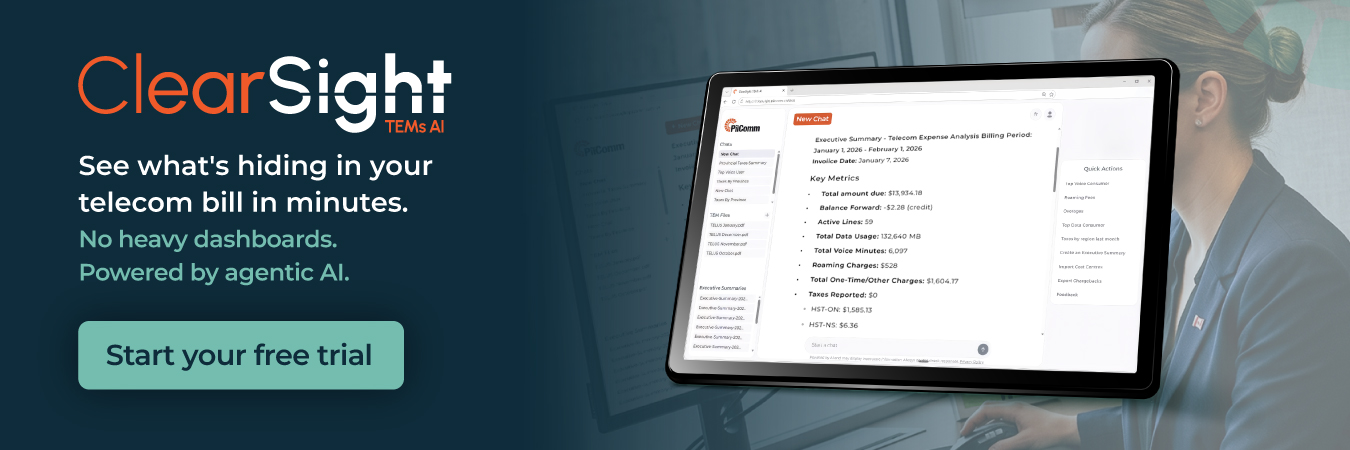
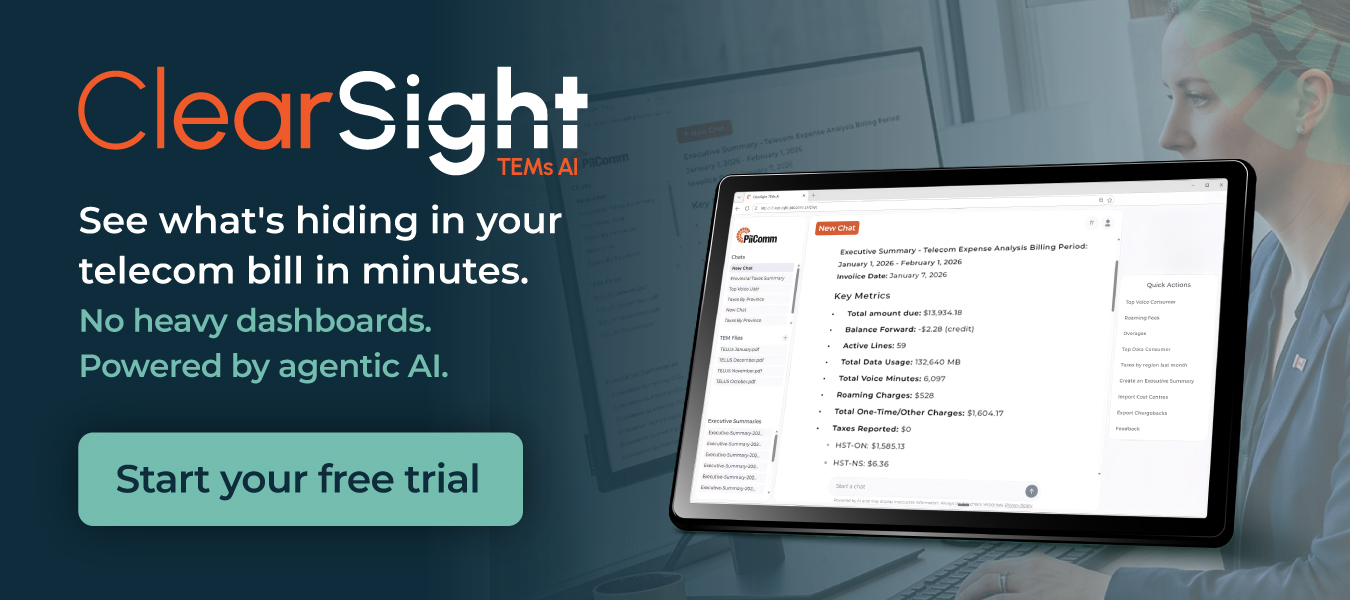
This is exactly the kind of pattern that’s invisible in a spreadsheet but obvious the moment you feed an invoice through an AI parser. AI-powered telecom expense analysis built for Canadian carrier invoices can surface anomalies, zero-use lines, and cost optimisation opportunities within minutes of invoice upload—providing the baseline data you need to decide what comes next, without a six-figure platform commitment.
Matching the TEM approach to your organisation’s scale and complexity
The right TEM approach depends on two variables: fleet size and internal capacity.
Organisations with under 500 lines may be well-served by AI-driven self-service tools. The anomaly detection and reporting capabilities of modern platforms can surface the major issues without dedicated analyst time. The key is choosing a tool built for Canadian carrier formats—not a US platform with Canadian invoices bolted on as an afterthought.
Organisations with 500–5,000 lines benefit from managed TEM services. At this scale, the complexity of carrier contracts, the volume of monthly invoices, and the ongoing work of acting on identified issues exceeds what most IT teams can absorb alongside their other responsibilities.
Organisations with 5,000+ lines typically need a combination of platform and managed services. The platform provides the visibility and automation; the managed service provides the expertise and execution capacity to turn insights into savings.
The key variable across all three tiers is internal capacity. If your IT team doesn’t have a dedicated telecom analyst, the platform alone won’t deliver sustained value. Someone has to act on the anomalies the system identifies, negotiate the rate plan changes, and follow through on the cancellation requests. Technology without operational capacity just produces reports that nobody reads.
Ready to see what your wireless spend actually looks like? Upload your first carrier invoice to ClearSight TEMs AI and get AI-powered analysis of your Canadian telecom expenses—with bilingual output and Canadian-hosted data processing—in minutes.
Want to discuss your broader technology expense management strategy? Talk to a managed mobility specialist about building a TEM practice that fits your organisation’s scale and complexity.
Frequently asked questions about technology expense management
What is technology expense management?
Technology expense management (TEM) is the discipline of tracking, auditing, and optimising all technology-related costs—including wireless, wireline, SaaS, cloud infrastructure, IoT connectivity, and device lifecycle expenses. For Canadian enterprises, TEM also requires handling interprovincial pricing variation and bilingual compliance requirements that US-focused platforms typically don’t address.
What is the difference between telecom expense management and technology expense management?
Telecom expense management focuses specifically on wireless and wireline carrier invoices—rate plan optimisation, billing audits, and contract management. Technology expense management encompasses telecom plus SaaS subscriptions, cloud infrastructure, IoT connectivity, and device lifecycle costs. Organisations managing only telecom invoices miss 40–60% of their total technology spend exposure.
How much can technology expense management save a Canadian enterprise?
Canadian TEM practitioners consistently find 15–30% waste in enterprise telecom spend during first-time audits. For an enterprise spending $500,000 annually on wireless, that’s $75,000–$150,000 in recoverable savings. AI-powered platforms typically deliver 33–40% reductions compared to 15–20% for manual review.
What are the biggest challenges in managing technology expenses?
The five most common challenges are: billing errors undetected without line-by-line auditing, unused lines accumulating when offboarding doesn’t trigger cancellations, decentralised procurement fragmenting volume leverage, interprovincial pricing variation hidden in national reporting, and lack of internal resources dedicated to ongoing expense management.
Does PIPEDA affect which TEM platform a Canadian enterprise can use?
Yes. TEM platforms process employee call detail records and usage data—personal information under PIPEDA. US-based platforms fall under the US CLOUD Act, which can compel disclosure of Canadian employee data. Canadian-hosted TEM platforms eliminate this jurisdictional ambiguity and simplify compliance documentation.
What should I look for in a technology expense management platform for Canadian operations?
Three non-negotiable capabilities: native parsing of Bell, Rogers, and TELUS enterprise invoice formats with correct provincial tax treatment; bilingual (English/French) reporting for Quebec compliance; and Canadian-hosted data infrastructure. Beyond those, evaluate AI-powered anomaly detection and integration with your accounting platform.
How does IoT affect technology expense management?
Every IoT device with cellular connectivity adds a billable line. With IoT device management growing at 34.8% CAGR, organisations deploying sensors and trackers at scale need to extend their TEM practice to cover these connections—or risk recreating the zombie line problem with thousands of low-visibility lines.
Are Canadian enterprises protected by the CRTC Wireless Code for telecom billing disputes?
Only partially. The CRTC Wireless Code provides billing protections but applies only to individuals and small businesses with 1–99 employees. Enterprises with 100+ employees are explicitly excluded, making proactive expense auditing the only protection against systematic overpayment.
The technology expense landscape keeps expanding. IoT connections multiply. SaaS subscriptions proliferate. Device fleets grow more complex. The organisations that treat expense management as a one-time audit will find themselves back in the same quarterly budget meeting a year from now, facing the same unanswerable questions about where the money went.
The ones that build a practice—with the right tools, the right processes, and visibility across the full scope of technology spend—will have answers. And they’ll have the budget headroom that comes from not leaking 15–30% of their spend to errors, zombie lines, and contracts nobody renegotiated.
The first step is always the same: find out what you’re actually paying for. Everything else follows from that.