You’re comparing three telecom expense management platforms, and they all claim the same thing—invoice automation, cost visibility, anomaly detection. The feature lists are nearly identical. But the moment you upload a TELUS enterprise invoice with interprovincial tax breakdowns and Quebec French-language requirements, two of the three platforms break.
The right telecom expense management solution for a Canadian enterprise isn’t the one with the longest feature list. It’s the one built to handle the billing complexity that Canadian carriers actually produce.
Most telecom expense management software wasn’t built for Canadian carrier invoices
The global TEM market lists 28 products on Gartner Peer Insights. Fewer than five can parse a Bell enterprise invoice and a TELUS enterprise invoice in the same platform without manual configuration.
This isn’t a minor inconvenience. It’s a structural mismatch that determines whether your telecom expense management software produces accurate output or expensive guesswork.
The TEM category was built in the United States, for American carriers, with American invoice structures. AT&T and Verizon produce standardised invoice formats because the US market evolved that way. Canadian carriers—operating in a concentrated market where three providers control over 90% of wireless revenue—developed their own formats, their own surcharge structures, and their own regional variations.
Most Canadian enterprises never get far enough into a TEM evaluation to discover this. They see a demo with sample data, the platform looks capable, and the disconnect only becomes visible after implementation—when the finance team asks why the departmental chargeback report doesn’t match the carrier invoice total.
Here’s what actually happens: we’ve had clients migrate from a US-based TEM platform and discover that the previous platform had been miscategorising TELUS surcharges for two years. Carrier-specific regulatory recovery fees were being lumped into a generic “taxes” bucket, which made provincial chargeback reporting inaccurate for every Quebec cost centre. Nobody noticed until they switched platforms and the numbers finally reconciled.
The adoption gap reflects this reality. Only 20–30% of large Canadian enterprises use a dedicated TEM approach—and that number drops to 5–10% for mid-market companies. Part of that gap is awareness. But a significant part is that organisations tried a platform, watched it produce unreliable output, and concluded that TEM doesn’t work for them.
It does work. But only if the platform was built for the invoices you’re actually processing.
How Bell, Rogers, and TELUS invoice formats differ at the enterprise level
Canadian carrier invoices aren’t interchangeable, and the differences matter more than most IT leaders realise until they’re debugging a chargeback discrepancy at quarter-end.
Bell enterprise invoices structure surcharges and regulatory fees differently than Rogers. TELUS uses its own categorisation for roaming charges that doesn’t map cleanly to either. Each carrier handles interprovincial usage differently—a critical distinction when you’re allocating costs across employees in Ontario, Quebec, Alberta, and British Columbia.
Then there’s the tax layer. A wireless line billed to an Ontario cost centre includes HST. The same plan billed to Quebec includes GST plus QST as separate line items. British Columbia applies GST plus PST. Alberta charges GST only.
A TEM platform that treats “taxes” as a single field—which most US-built platforms do—produces departmental chargebacks that are mathematically wrong. Your finance team either catches the error and spends hours manually correcting it, or they don’t catch it and your cost centre reporting drifts further from reality every month.
The platforms built for Canadian operations parse these distinctions natively. The platforms built for the US market require you to build custom rules, maintain carrier-specific configurations, and hope the next invoice format update doesn’t break everything.
Most organisations don’t have the analyst bandwidth to maintain that configuration. Which brings us to the second problem.
Three generations of telecom expense management—and where most Canadian enterprises are stuck
A mid-market retailer with 1,200 lines bought a TEM platform in 2022. Eighteen months later, nobody was using it.
The initial audit surfaced $180,000 in savings—genuine value. But maintaining the carrier rate libraries and rule configurations required a dedicated analyst they didn’t have budget for. The platform became an expensive invoice archive that nobody trusted enough to act on.
This pattern repeats across Canadian enterprises more often than vendors acknowledge. The problem isn’t the concept of telecom expense management. It’s that each generation of TEM solutions has carried assumptions about operational capacity that mid-market organisations can’t meet.
Spreadsheets and manual review—the ceiling nobody talks about
For fleets under 200 lines, spreadsheets work. Someone downloads the invoice, logs the totals, flags anything unusual, and moves on. The process takes a few hours per month, and the error rate is acceptable because the stakes are manageable.
The ceiling hits somewhere between 200 and 500 lines. At that scale, a single carrier invoice might run 80 to 150 pages. Line-level detail becomes impossible to review manually. Variance detection—noticing that Line 47 spiked by $300 this month—requires comparing thousands of data points across billing periods.
What actually happens: the person responsible for telecom expense review stops reviewing at the line level. They check the invoice total against last month, flag anything that looks dramatically different, and move on. Smaller anomalies—a $40 monthly charge on a line that should have been cancelled, a roaming fee that shouldn’t have been billed—slip through because nobody has time to find them.
Multiply that by 12 months, and you’ve accumulated thousands of dollars in cost leakage that nobody intended and nobody noticed.
Legacy TEM platforms and the configuration burden
Traditional telecom expense management software promised to solve the scale problem through automation. Upload your invoices, configure your carrier rate plans, define your cost allocation rules, and the platform handles the rest.
The promise was real. The operational burden was hidden.
Every quarter, carriers update their invoice formats. Every rate plan change requires a rule update in the TEM platform. Every new surcharge needs a mapping entry. Every organisational change—a new department, a cost centre restructure—requires configuration updates.
Without a dedicated TEM analyst maintaining the platform, accuracy drifts within six months. The reports start showing anomalies that aren’t anomalies, or missing anomalies that are real. Trust erodes. Usage drops. The platform becomes expensive shelfware.
First-year TEM implementations typically recover 10–35% of annual telecom spend, with ROI multiples of 5:1 to 10:1 within 12 months. Those numbers are real—but they assume ongoing platform maintenance that most mid-market IT teams can’t sustain alongside their other responsibilities.
The legacy TEM model works for enterprises with dedicated telecom analysts. For everyone else, it’s a tool that produces value for 12 to 18 months and then quietly fails.
AI-driven telecom expense analysis—what actually changed
The shift from rule-based detection to AI-driven analysis isn’t incremental. It’s categorically different.
Traditional TEM platforms require you to define what an anomaly looks like before they can find it. You configure thresholds: flag any line that exceeds $200 in data charges, alert on roaming over $50, trigger a review when the invoice total varies by more than 10% from the prior month. The platform enforces your rules.
AI-driven platforms learn what normal looks like from your data. They identify patterns you didn’t know to look for. They detect anomalies based on the behaviour of your specific fleet, not on generic thresholds that may or may not apply to your organisation.
The operational difference is stark. AI-driven TEM platforms reduce per-invoice analysis time from 18.5 minutes to 8 seconds while detecting anomalies at 99% accuracy—compared to 60–70% for manual review. More importantly, they do this without requiring ongoing rule configuration.
No carrier rate library maintenance. No threshold tuning. No quarterly updates when invoice formats change. The AI adapts to the data it receives.
This removes the operational burden that caused mid-market TEM implementations to fail. The platform doesn’t require a dedicated analyst to stay accurate. It requires someone to act on the insights it surfaces—which is a fundamentally different ask.
For Canadian IT leaders who tried TEM five years ago and abandoned it, the category has matured enough to warrant another look. But maturity alone doesn’t solve the Canadian-specific requirements that most platforms still ignore.
The question isn’t whether AI-powered TEM works. It’s whether the platform you’re evaluating can handle the specific complexity of Canadian carrier invoices, provincial tax disaggregation, and the regulatory requirements that will surface the moment your legal team reviews the procurement.
Five capabilities that separate effective telecom expense management solutions
Every TEM vendor will tell you they automate invoice processing and detect anomalies. The differences that matter are in the specifics—which carriers they can parse natively, how they handle provincial tax disaggregation, whether their anomaly detection requires pre-configured rules or learns autonomously.
When we evaluate a TEM platform for a client, the first test is always the same: upload a real Bell invoice and a real TELUS invoice from the same month and see if the platform produces accurate, comparable output. You’d be surprised how many platforms fail this basic test.
Here’s what to ask every vendor before you get to pricing.
Native Canadian carrier invoice parsing
“Native parsing” means the platform understands the invoice structure without manual configuration or CSV workarounds. It recognises where Bell puts roaming charges versus where TELUS categorises them. It distinguishes carrier regulatory recovery fees from government-mandated taxes. It handles format updates automatically when carriers change their invoice layouts.
The alternative—manual CSV import and custom field mapping—works until it doesn’t. The moment a carrier updates their format, your mappings break, and nobody notices until finance flags a chargeback discrepancy three months later.
Automated variance detection without pre-configured rules
Rule-based detection requires you to anticipate every anomaly type before the platform can find it. AI-driven detection identifies patterns from your fleet’s actual behaviour and flags deviations without pre-set thresholds.
The practical difference: rule-based systems catch the anomalies you thought to define. AI systems catch the anomalies you didn’t know to look for—like a line that’s been billing $47/month for 18 months with zero usage, because nobody configured a rule for “moderate charge, no activity.”
Provincial tax handling and departmental chargeback accuracy
Interprovincial wireless pricing varies by 26–50% depending on the province—Saskatchewan and Manitoba are cheapest due to regional competition, while Ontario and British Columbia run highest.
But beyond plan pricing, the tax layer creates chargeback complexity that US-built platforms ignore entirely. A line billed to Ontario includes HST at 13%. The same plan in Quebec includes GST at 5% plus QST at 9.975% as separate line items. British Columbia applies GST plus PST. Alberta charges GST only.
Any TEM platform producing departmental chargebacks must disaggregate provincial taxes automatically. If it doesn’t, your finance team is either correcting the output manually every month or allocating costs inaccurately across every cost centre with employees in multiple provinces.
Bilingual output for Quebec compliance
This isn’t a courtesy feature. Bill 96 imposes penalties of $3,000 to $30,000 per day per violation for organisations that fail to provide French-language workplace documentation to Quebec employees.
Any TEM platform generating audit reports, chargeback files, or executive summaries for Quebec operations must produce French-language output. Most US-based platforms produce English-only output, which creates a compliance gap your legal team will flag during procurement review—if not during the evaluation, then certainly after implementation when someone in Quebec receives an English-only expense report.
Canadian data residency and privacy compliance
Employee call detail records and device usage data constitute personal information under PIPEDA. When that data is processed through a US-hosted TEM platform, it becomes subject to US legal jurisdiction—meaning US authorities can compel disclosure even if the data belongs to Canadian employees.
For organisations subject to Quebec’s Law 25, cross-border data transfers trigger privacy impact assessment requirements. Canadian-hosted TEM infrastructure isn’t a preference—it’s the only way to maintain a clear compliance posture without conducting transfer impact assessments for every invoice upload.
What Canadian enterprises actually recover with TEM
The CCTS logged over 23,000 complaints in 2024–25—up 17% year-over-year—with billing as the number-one issue. But those numbers undercount enterprise problems because the ombudsman primarily serves consumers and small businesses. Enterprise billing errors are largely invisible in the complaint data, which means the problem is likely worse than the headline figure suggests.
Canadian enterprises waste an estimated 15–30% of their telecom spend annually. For a mid-market organisation spending $400,000 a year on wireless, that’s $60,000 to $120,000 in recoverable cost leakage—enough to fund the TEM investment many times over.
Zombie lines and the HR-to-carrier disconnect
The most common recovery we see in the first 90 days isn’t a billing error—it’s lines that should have been cancelled months ago.
When an employee leaves, HR processes the termination. IT reclaims the laptop. But the wireless line keeps billing because no automated workflow triggers a carrier cancellation request. In theory, carriers cancel lines when you ask. In practice, we regularly find lines still billing three to six months after disconnection requests were submitted.
Multiply that by 50 departures a year and you’ve got a six-figure leak that nobody intended and nobody noticed. This isn’t a technology problem—it’s a governance gap between HR systems, IT asset management, and carrier account management that TEM makes visible.
Contract renewal overpayment in a declining-price market
Canadian wireless prices have dropped dramatically over the past four years. The cost of a 10GB plan fell 47% between 2020 and 2024, from $69.42 to $28.03.
But enterprises that auto-renew contracts without renegotiating are locking in rates that don’t reflect the current competitive reality. The carriers aren’t going to call you to suggest a rate reduction.
TEM data is the leverage that makes renegotiation effective. When you can show a carrier exactly how your usage patterns compare to your contracted rates—and exactly what the competitive alternatives would cost—the conversation changes. Without that data, you’re negotiating blind.
How AI-powered TEM changes the evaluation for Canadian IT leaders
The reason most mid-market Canadian enterprises never adopted TEM wasn’t cost—it was operational overhead. The platforms required more maintenance than the savings justified.
AI changes that equation by eliminating the configuration burden that killed adoption.
But AI alone doesn’t solve the Canadian-specific requirements that surface the moment you upload a real carrier invoice. This is exactly the kind of pattern that’s invisible in a spreadsheet but obvious the moment you feed an invoice through an AI parser that was actually built for Canadian carrier formats.
We built ClearSight TEMs AI because we kept seeing the same pattern: mid-market clients who knew they were overpaying but couldn’t justify a $150,000 TEM platform or a dedicated analyst. They needed something they could upload an invoice into on Monday and get actionable answers from by Tuesday—without configuring a single rule.
ClearSight is priced at $99/month per billing account with Canadian hosting, bilingual output, and native Canadian carrier invoice parsing. It’s positioned as a zero-friction entry point—not a six-figure enterprise commitment.
Conversational invoice analysis versus dashboard-based reporting
Legacy TEM platforms work like traditional business intelligence tools. You configure dashboards, learn a reporting interface, and run queries that someone had to define in advance.
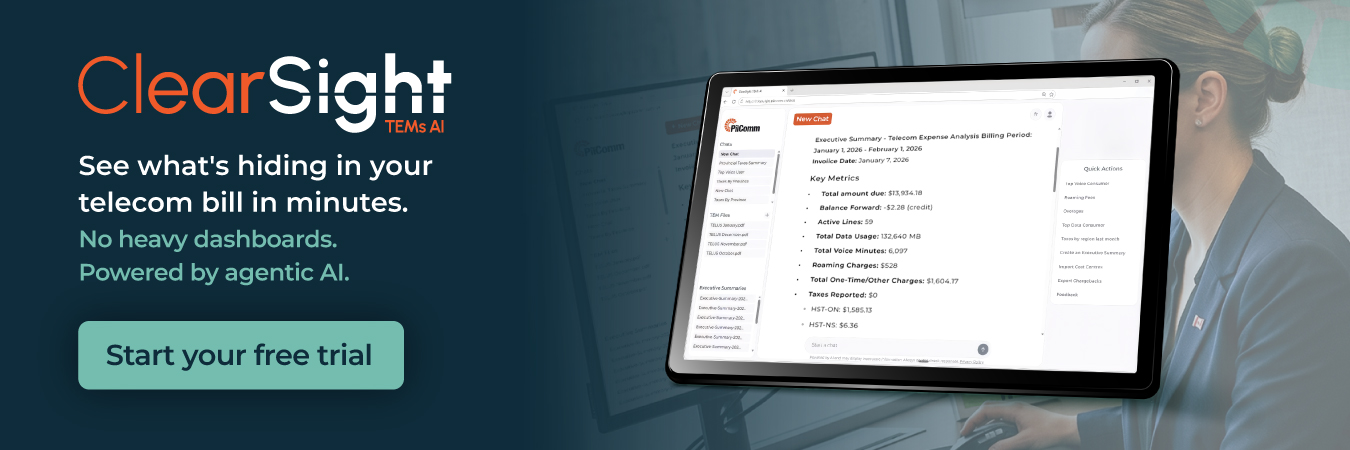
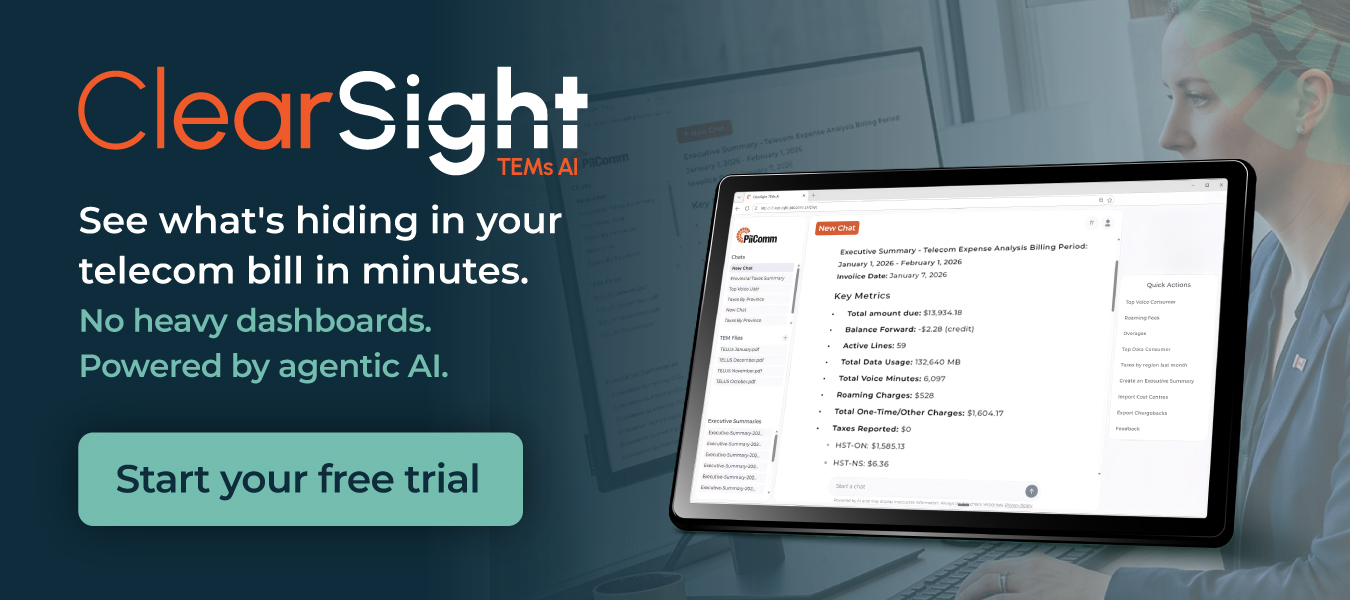
ClearSight works differently. You upload an invoice and ask questions in plain language: “Why did our bill spike this month?” or “Which lines had zero usage last quarter?” The AI parses the question, analyses the invoice data, and returns specific answers—not a dashboard you have to interpret.
The practical difference: your team doesn’t need TEM expertise to get TEM insights. The person uploading the invoice can ask the questions that matter to them without learning a new interface.
From invoice audit to fleet intelligence
The metadata captured through TEM analysis—device inventory, carrier contracts, usage patterns, spending trends—feeds decisions beyond cost optimisation.
When you know exactly which lines are active, which devices are generating usage, and how your carrier spending aligns with your device inventory, you have the scoping intelligence to make informed decisions about lifecycle management that tracks every device from deployment through decommissioning.
TEM data reveals the 8–15% gap that almost always exists between MDM device counts and carrier invoice line counts. That gap represents devices without active lines, lines without active devices, and the governance drift that accumulates when no single system tracks the full picture.
For organisations considering a Device as a Service model that converts unpredictable CapEx into a fixed monthly fee, TEM data provides the baseline: how many active lines, what the current spend looks like, and where the inefficiencies are that a DaaS model would absorb.
Ready to see what ClearSight finds in your first invoice? Book a 20-minute demo and upload a real carrier invoice—no configuration, no commitment.
Frequently asked questions about telecom expense management solutions
What is telecom expense management software?
TEM software automates the processing, auditing, and optimisation of an organisation’s telecom invoices across carriers and service types. According to Gartner Peer Insights, the category includes 28 products globally—though fewer than five handle Canadian carrier invoices natively without manual configuration.
How much can telecom expense management save a Canadian enterprise?
First-time implementations typically recover 10–35% of annual telecom spend, with ROI multiples of 5:1 to 10:1 within 12 months. For a mid-market organisation spending $400,000 annually on wireless, that’s $40,000 to $140,000 in first-year recovery—often enough to fund the TEM investment several times over.
What is the telecom expense management process?
TEM covers five interconnected functions: invoice processing, inventory management, contract tracking, usage optimisation, and dispute resolution. These aren’t one-time audits—they’re continuous processes applied every billing cycle to catch new anomalies, track inventory changes, and maintain accurate cost allocation.
How do I reduce telecom costs in a Canadian enterprise?
Start with an invoice-to-asset reconciliation—comparing carrier-billed lines against your actual device inventory. This typically reveals 8–15% of lines that can be cancelled immediately: zombie lines from employee departures, test devices that were never deactivated, and backup lines that nobody remembers provisioning.
Does the CRTC Wireless Code protect enterprise customers?
No. The Wireless Code’s billing protections—$50 domestic data overage caps, $100 international roaming caps—apply only to individuals and businesses with fewer than 100 employees. Larger enterprises operate without these regulatory safeguards, making proactive TEM their only systematic defence against billing errors.
What Canadian privacy laws affect TEM platform selection?
PIPEDA governs employee telecom data nationally. Quebec’s Law 25 requires privacy impact assessments for cross-provincial data transfers, and Bill 96 mandates French-language output for Quebec operations. US-hosted platforms create compliance complexity that Canadian-hosted alternatives avoid entirely.
How does AI change telecom expense management?
AI-driven platforms eliminate the rule-configuration burden that caused most mid-market implementations to fail. They parse invoices autonomously and detect anomalies without pre-set thresholds—reducing per-invoice analysis time from 18.5 minutes to 8 seconds while improving detection accuracy from 60–70% to 99%.
What should I look for in a TEM provider for Canadian operations?
Non-negotiable requirements are native Canadian carrier invoice parsing (Bell, Rogers, TELUS), bilingual English/French output, Canadian data residency, and automated provincial tax disaggregation. If a platform can’t demonstrate all four during evaluation, it wasn’t built for Canadian operations—regardless of what the feature list claims.
The evaluation has already started
Every month you spend without systematic telecom expense governance, the cost leakage compounds. Lines that should have been cancelled keep billing. Contract renewals lock in rates that don’t reflect current market pricing. Provincial chargebacks drift further from accuracy.
The platforms that couldn’t handle Canadian complexity five years ago still can’t handle it today. But the category has matured enough that the operational barriers—the configuration burden, the analyst requirement, the six-figure commitment—no longer apply to every option.
The question isn’t whether telecom expense management in the Canadian context produces value. It’s whether the platform you’re evaluating was built for the invoices you’re actually processing.