Search for telecom expense management in Canada and you’ll get two different kinds of results on the same page: software platforms that ingest carrier invoices, and managed services that run your mobility account for you. They solve overlapping problems with completely different commercial models, and most comparison pages don’t tell you which is which. The second thing worth knowing before you shortlist: expense visibility and device operations are separate disciplines, and the provider that’s strong at one is often silent on the other.
Here’s the short version:
- PiiComm: best for Canadian enterprises that want expense intelligence attached to a managed device fleet
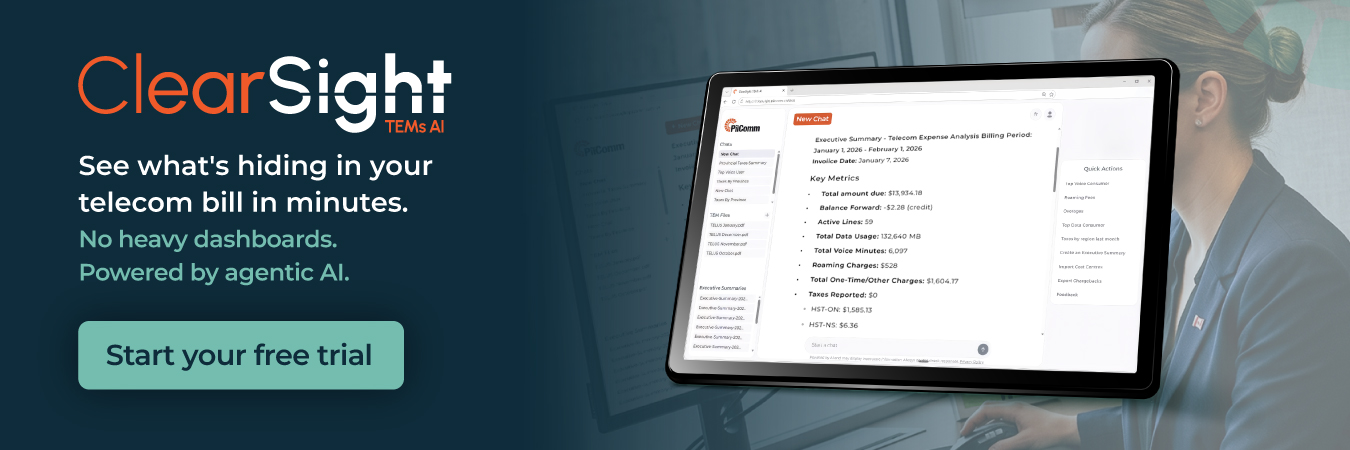
- ClearSight TEMs AI: best for teams that want AI-driven expense intelligence over an existing fleet
- Tangoe: best for global telecom, mobile and cloud expense at scale
- Rogers Business: best for organisations consolidating with an existing Canadian carrier account
- TELUS Business: best for TEM tied to Canadian carrier usage reporting
- Calero: best for unified telecom, mobility and SaaS expense in one view
- brightfin: best for teams already running ServiceNow
- Stratix: best for TEM inside a large US or cross-border managed mobility program
This list covers both telecom expense management (TEM) platforms and managed TEM services, because the search term genuinely returns both. Each entry is assessed on the terms that fit what it is. And expense management is not device operations: several entries here read invoices without ever touching a device, which is a fit question, not a flaw.
We’ve ordered these by who each one fits best.
How we evaluated these TEM providers and platforms
This list mixes software platforms with managed services, so the assessment method differs by entry type and is stated in each one.
Platforms were assessed on published capabilities and aggregated user reviews from G2 and Capterra as of 2026-08-25. Services were assessed on published service capabilities, public records, and named case studies as of the same date.
Here’s what we weighed:
- Expense scope. Whether the offer covers mobile only, or extends to fixed line, cloud, and SaaS spend.
- Carrier and invoice coverage. How many carriers the platform integrates with, and whether Canadian carriers are documented.
- Device logistics presence. Whether the provider also touches the physical device lifecycle: procurement, staging, repair, retirement.
- Canadian operations and French-language capability. Documented in-country presence and bilingual service.
- Integration depth. What the platform connects to: UEM, ServiceNow, finance systems, carrier portals.
- Reporting. What you can see, and whether custom reporting requires vendor work.
- Commercial model. How engagements are structured and what’s published.
One absence worth stating once rather than repeating: none of the eight publishes standard pricing for its TEM offer. Every commercial conversation here starts with a quote cycle.
Quick comparison
| Provider or platform | Type | Best for | Standout strength | Canadian operations |
|---|---|---|---|---|
| PiiComm | Managed service | Expense with device operations | In-house Canadian lifecycle execution | Yes: Plantagenet, Ontario |
| ClearSight TEMs AI | Platform | AI expense intelligence | Intelligence layer over fleet complexity | Yes: Plantagenet, Ontario |
| Tangoe | Both | Global expense at scale | $40 billion in technology spend managed | Not documented |
| Rogers Business | Managed service | Consolidating with a carrier | Carrier-native account management | Yes: Toronto, Ontario |
| TELUS Business | Managed service | Canadian carrier usage reporting | Near-real-time subscriber reporting | Yes: Vancouver, British Columbia |
| Calero | Both | Telecom, mobility and SaaS in one view | Embedded Power BI reporting | Not documented |
| brightfin | Both | ServiceNow-native expense | Built natively on ServiceNow | Not documented |
| Stratix | Managed service | TEM inside a mobility program | Three million devices under management | Referenced, function not specified |
Carriers, resellers and TEM: which one you actually need
“Telco services for business” covers three different purchases in Canada, and buyers regularly start shopping in the wrong category.
- Carriers — Bell, Rogers and TELUS, plus regional operators — sell the connectivity itself: lines, plans, data, and increasingly IoT. You need one regardless. What they do not do is tell you which of your lines are doing nothing.
- Resellers and channel partners sell carrier plans alongside hardware and sometimes basic administration. Useful for procurement leverage, rarely a source of expense visibility.
- Telecom expense management (TEM) providers and platforms sit on top of whichever carrier you use: validating invoices, tracking line and device inventory, allocating cost to departments, and surfacing the spend that should not be there.
If the problem is coverage or price per line, that is a carrier conversation. If the problem is that nobody can say how many active lines you are paying for, no carrier will solve it — that is TEM, and the list below is where to start.
The 8 best telecom expense management providers and platforms in Canada
We’ve ordered these by who each one fits best, not by a universal ranking.
1. PiiComm: best for Canadian enterprises that want expense intelligence attached to a managed device fleet
If your telecom spend problem is really a fleet problem — billing errors like lines for devices nobody can locate, plans provisioned for roles that changed, retired hardware still on the invoice, — then reading the invoice alone won’t fix it. PiiComm is Canada’s largest pure-play managed mobility services provider, and expense intelligence sits inside a relationship where its own team also sources, stages, repairs, and retires the devices.
Services
- ClearSight TEMs AI. AI-driven telecom expense intelligence across carrier billing for the managed fleet. Separately priced, not bundled into managed service contracts by default.
- Lifecycle Management. Break/fix and repair logistics, advance-exchange spare device programs, asset and SIM tracking, and help desk support.
- AIM portal. Asset Intelligence Manager providing fleet visibility, asset tracking, and analytics.
- Strategic Sourcing. Vendor-neutral device and accessory procurement across Zebra, Brady, and Samsung, with configuration standardisation across sites.
- Staging & Deployment. Devices imaged, configured, kitted, quality-checked, and shipped deployment-ready from PiiComm’s own Canadian facility.
- MDM as a Service (MDMaaS). Certified administration of SOTI MobiControl and 42Gears SureMDM covering policy, security, and OS update management.
Delivery model
- Headquartered in Plantagenet, Ontario, founded 2007, privately held.
- Staging, kitting, quality assurance, break/fix, and data destruction performed by PiiComm’s own certified technicians in its own Canadian facilities.
- Bilingual English and French service desk staffed in Canada.
- Canada-focused, with devices managed across thousands of North American locations.
Pros
- Expense intelligence is informed by running the devices, not just parsing invoices, because the same team holds the asset and SIM records.
- 500,000+ assets under management with named Canadian enterprise clients including Air Canada, Giant Tiger, KalTire, and Enterprise.
- Rugged and industrial device heritage backed by Zebra Premier Solution Partner status, the highest partner tier.
- Reverse logistics and depot processing happen at a Canadian facility, which keeps repair and retirement shipments out of USMCA and CBSA handling.
Proof points
- 500,000+ assets under management across thousands of North American locations.
- Zebra Premier Solution Partner; Brady and Samsung partnerships.
- Named public case study covering scanners and printers sourced, standardised, staged, and managed across hundreds of retail locations for a national retailer.
Engagement model
- Managed service contracts, per-device per-month, DaaS-bundled, and project-based engagements.
- ClearSight TEMs AI is priced separately per billing account.
- Confirm commercial terms directly with the provider.
Best for: Canadian enterprises with large distributed fleets that want expense visibility from the same team that stages, repairs, and retires the hardware.
2. ClearSight TEMs AI: best for teams that want AI-driven expense intelligence over an existing fleet
If you already have a device operations model you’re happy with and the gap is visibility into what the fleet costs and why, ClearSight TEMs AI is the narrower option. It’s an AI-driven intelligence layer over carrier billing and fleet complexity, sold as a distinct product rather than a bundled line inside a managed service.
Key features
- AI-driven expense intelligence. Analysis across carrier billing for the managed fleet.
- Fleet-aware context. Expense data read against asset and SIM records rather than invoices in isolation.
- Separate product line. Available on its own terms, not bundled into managed service contracts by default.
- Canadian delivery. Built and operated from PiiComm’s Canadian operation.
Pros
- Expense analysis sits alongside asset and SIM tracking, which is where most unexplained line charges resolve.
- Priced and scoped as its own product, so you can adopt it without restructuring an existing device operations arrangement.
- Delivered from a Canadian operation with a bilingual English and French service desk.
Ratings
- Not listed on G2 · Not listed on Capterra
Pricing
- Custom quote, priced per billing account.
- Verify current pricing with the vendor.
Best for: Canadian teams with an existing fleet arrangement that need expense intelligence as a discrete addition rather than a full service change.
3. Tangoe: best for global telecom, mobile and cloud expense at scale
If your problem is spend visibility across dozens of carriers in multiple countries, Tangoe is the scale leader in this set. It’s a technology expense platform with managed services attached, and it operates at a volume nobody else here matches.
Key features
- Tangoe One. Expense management across telecom, mobile, and cloud spend in one platform.
- Carrier integrations. Connects with hundreds of carriers.
- Managed mobility services. Ordering and logistics, help desk, repair and maintenance, buyback and recycling delivered as services alongside the platform.
- Ecosystem integrations. Connects to UEM platforms, SAP, and Apple.
- Device logistics. Physical device handling exists within the managed services offer, which is unusual for an expense-first vendor.
Pros
- Manages more than $40 billion in technology spend and more than 10 million technology assets globally, which the company states is five times more than its three closest competitors combined.
- Nearly half of the Fortune 500 rely on Tangoe.
- Covers telecom, mobile, and cloud in one platform rather than requiring separate tools per spend category.
- Managed services include device ordering, logistics, and buyback, so it isn’t invoice-only.
Cons
- Reviewers report platform-migration instability and gaps in reporting customisation, so ask about your migration path specifically.
- Customer-service responsiveness draws criticism in reviews, worth testing during a pilot.
- Custom reports require vendor SQL work, so factor turnaround into your reporting expectations.
- No documented Canadian office or French-language support, which matters if Quebec operations or bilingual obligations are in scope.
Ratings
- Not listed on G2 · Capterra: 3.4/5 (12 reviews)
Pricing
- Custom quote.
- Verify current pricing with the vendor.
Best for: Global enterprises whose primary problem is telecom, mobile, and cloud spend visibility across many countries and carriers.
4. Rogers Business: best for organisations consolidating TEM with an existing Canadian carrier account
If most of your wireless spend already sits on one Rogers account and you want management attached to it rather than layered on top, Rogers Business is worth a look. It’s a Canadian facilities-based carrier offering enterprise mobility management alongside business wireless service.
Services
- Enterprise Mobility Management (EMM). Management of applications and devices including smartphones, tablets, and laptops. Delivered on third-party platforms rather than a Rogers-built stack.
- Apple Business Manager. Zero-touch deployment and enrollment of corporate-owned Apple devices.
- Business wireless plans. Corporate wireless voice and data on the Rogers network.
- Advantage Mobility bundles. Bundled business mobile and internet services.
Delivery model
- Canadian facilities-based carrier headquartered in Toronto, Ontario.
- EMM is delivered on third-party platforms, not in-house managed administration.
- French-language business pages are published.
- Physical staging, kitting, depot repair, and secure decommissioning are not documented on primary Rogers pages.
Pros
- EMM management is documented across smartphones, tablets, laptops, desktops, servers, and wearables.
- Zero-touch Apple deployment is documented through Apple Business Manager.
- Bundling mobile and internet under one Canadian carrier account simplifies the commercial relationship.
Cons
- The platform is partner-delivered rather than in-house managed administration, so confirm who performs day-to-day policy and compliance work.
- Rugged handhelds and dock scanners are not documented, only smartphones, tablets, and similar device classes.
- Physical staging, depot repair, and secure decommissioning are not documented as part of the offer.
Proof points
- Enterprise Mobility Management documented on the Rogers Business wireless site covering multiple device types.
- Apple Business Manager program documented for corporate Apple device deployment.
- No analyst listing, published scale figure, or named Canadian case study is published for the managed mobility offer.
Engagement model
- Carrier account plus partner-delivered EMM platform, contracted through Rogers Business sales.
- Pricing is not publicly documented.
- Confirm commercial terms directly with the provider.
Best for: Canadian organisations with wireless spend concentrated on a Rogers account that want mobility management attached to that relationship.
5. TELUS Business: best for TEM tied to Canadian carrier usage reporting
If what you need most is near-real-time visibility into subscriber-level usage across a Canadian wireless base, TELUS Business is a strong fit. It’s a Canadian facilities-based carrier with a self-service portal built for exactly that reporting job.
(Disclosure: TELUS is a referral and co-marketing partner of PiiComm. It’s on this list on its merits, assessed on the same criteria as everyone else.)
Services
- TELUS IQ. Self-service portal for buying, deploying, and managing mobility services, with near-real-time subscriber usage reporting. Positioned for businesses with at least 50 wireless subscribers with TELUS.
- Usage reporting and expense visibility. Subscriber-level usage updated every 10 to 15 minutes with customizable data alerts, exportable to Excel.
- TELUS Enterprise Mobility Management (EMM). Software combining MDM, mobile application management, and mobile content management, operated by your team with advice from TELUS EMM specialists.
- Apple Business and Samsung Knox enrollment. Zero-touch enrollment of corporate-owned devices into an MDM before delivery. Add-on capabilities.
- Online catalogue procurement. Device ordering through the TELUS IQ portal.
Delivery model
- Canadian facilities-based carrier headquartered in Vancouver, British Columbia.
- Managed mobility is delivered through the TELUS IQ portal and EMM software.
- French-language business and mobility pages are published, including a French TELUS IQ page.
- A dedicated TELUS Concierge covers the first 45 days, followed by dedicated help desk agents.
Pros
- Subscriber usage reporting updates every 10 to 15 minutes and exports to Excel, which is the fastest published refresh cadence in this set.
- Documented French-language business and mobility pages support bilingual Canadian deployments.
- Integrated Apple and Samsung Knox enrollment enables zero-touch MDM enrollment before delivery.
- Access to TELUS EMM specialists for advisory work and custom mobility scoping.
Cons
- TELUS IQ is positioned for businesses with at least 50 wireless subscribers, so it may be more than a small fleet needs.
- Physical staging and depot repair are not documented as part of the offer, so pair it with a device operations provider if that’s in scope.
- The current managed-mobility delivery arrangement is not publicly documented, so ask directly who performs the service.
Proof points
- TELUS IQ usage reporting updated every 10 to 15 minutes.
- EMM offering documents MDM, mobile application management, and mobile content management capabilities.
- French-language TELUS IQ page published.
Engagement model
- Carrier account plus self-service portal, with advisory EMM specialists, contracted through TELUS Business sales.
- Pricing is not publicly documented.
- Confirm commercial terms directly with the provider.
Best for: Canadian organisations with a substantial TELUS wireless base that want usage-level expense reporting tied directly to the carrier relationship.
6. Calero: best for unified telecom, mobility and SaaS expense in one view
If your spend problem now includes SaaS subscriptions alongside telecom and mobility, Calero brings all three into a single technology expense view. It’s a platform with managed mobility services attached, and it’s built for enterprise-scale estates.
Key features
- Technology expense management. Telecom, mobility, and SaaS spend in one platform.
- Embedded Power BI. Reporting and analytics built into the platform rather than exported elsewhere.
- Managed mobility services. Lifecycle coverage including device procurement and retirement.
- Asset tracking and cost allocation. Inventory, benchmarking, and chargeback across the estate.
- Lifecycle coverage. Procurement through retirement handled inside the same relationship.
Pros
- Brings telecom, mobility, and SaaS expense into one pane, which removes the tool-per-category problem.
- 30+ years of experience in expense management.
- Managed mobility services include device procurement and retirement, so it isn’t a pure software play.
Cons
- Some reviewers describe the interface as confusing, worth walking through carefully during evaluation.
- Public review volume is thin, which limits how much independent user sentiment you can weigh.
- Enterprise-only orientation, so it may be more than a mid-sized estate needs.
- No documented Canadian presence or French-language support, which matters for Quebec operations.
Ratings
- Not listed on G2 · Not listed on Capterra
Pricing
- Custom quote.
- Verify current pricing with the vendor.
Best for: Large enterprises consolidating telecom, mobility, and SaaS spend into one platform with managed lifecycle services attached.
7. brightfin: best for teams already running ServiceNow
If ServiceNow is already your system of record and you’d rather not add another console, brightfin is the option built for that. It’s the only mobile and telecom solution built natively on the ServiceNow platform, and it’s also available as standalone software.
Key features
- ServiceNow-native delivery. Built natively on ServiceNow, with a standalone SaaS option for teams not on the platform.
- IT expense management. Mobile, telecom (fixed, voice, data), and cloud expense in one product.
- UEM inventory synchronization. Device inventory pulled from your unified endpoint management platform.
- Managed services. UEM administration, lifecycle management, bill pay, and procurement.
- Procurement and delivery. Physical device logistics available within the managed services offer.
Pros
- The only provider of mobile and telecom solutions built natively on ServiceNow, so expense data lives where your service management already does.
- Also offered as standalone SaaS, so ServiceNow isn’t a hard prerequisite.
- Procurement and delivery services mean it covers device logistics, not invoices alone.
- Strongest Capterra rating of the TEM platforms in this set.
Cons
- The core differentiator is tied to the ServiceNow ecosystem, so the value case weakens if you’re not on it.
- Smaller review base than the incumbents in this category, which limits comparison depth.
- No documented Canadian office and no documented French-language support.
- An entity-naming change is in progress following the acquisition by Proven Optics, so confirm the contracting entity name before signing.
Ratings
- G2: 4.4/5 (16 reviews) · Capterra: 4.7/5 (36 reviews)
Pricing
- Custom quote.
- Verify current pricing with the vendor.
Best for: Enterprise teams standardised on ServiceNow that want telecom and mobile expense managed inside the platform they already run.
8. Stratix: best for TEM inside a large US or cross-border managed mobility program
If your fleet is US-anchored with Canadian sites attached and expense management is one requirement inside a much larger mobility program, Stratix is worth shortlisting. TEM appears as one component of its managed mobility offer rather than as a standalone platform.
(Stratix is a channel partner of PiiComm.)
Services
- Telecom Expense Management. Visibility and control over wireless expenses through a TEM portal. Offered as an add-on within a broader engagement.
- Technology Deployment Services. Mobile Integration Center provisions, kits, configures, and ships devices staged for your MDM or UEM at scale.
- Mobile Device Management Services. Managed administration across leading MDM and UEM platforms, delivered on third-party software.
- IT Asset Disposition. Repair, redeploy, resell, or recycle end-of-life devices with DoD-grade erasure and itrac360 tracking. Final recycling handled through third-party ITAD partners.
- Mobile help desk. Onshore 24x7x365 help desk staffed with technicians trained on your environment.
Delivery model
- Headquartered in the Atlanta, Georgia metro area, with additional resources in the Cleveland area.
- Its About page states Stratix has deployment, repair, and support resources in Atlanta, the Cleveland area, and Canada; the function of the Canadian presence isn’t detailed further.
- Onshore 24x7x365 help desk with NPS consistently 70 or above.
- French-language support is not publicly documented.
Pros
- Over three million devices under management, with a deployment portal that scales to thousands of orders per hour.
- Purpose-built Mobile Integration Center with automated staging tools that mirror your MDM environment.
- Onshore 24x7x365 help desk with consistently strong NPS.
- Deep MDM and UEM bench, certified across SOTI, 42Gears, Intune, Workspace ONE, Jamf, Knox, and Esper.
Cons
- Primary staging, repair, and inventory operations are documented in the United States, so a Canadian buyer should confirm in writing where devices are physically handled.
- TEM is one component of a broader mobility engagement rather than a standalone platform, so it’s a poor fit if expense management is all you want.
- No published pricing, with managed services custom-quoted per device.
Proof points
- Over three million devices under management.
- Reviewed in the Gartner Peer Insights managed mobility services market.
- Named case study covering a large Northeast Ohio health system where 7,000 devices were deployed in a three-month window with a 26-person dedicated team.
- Brady Platinum Elite, Apple Authorized Enterprise Reseller, Samsung Authorized Ascend Champion, and Omnissa Managed Services Provider.
Engagement model
- Managed mobility contracts and Mobile Device as a Service, priced per device per month.
- Pricing is custom-quoted and not published.
- Confirm commercial terms directly with the provider.
Best for: Large enterprises running US-anchored or cross-border fleets that want expense management folded into a single North American mobility program.
Choosing your TEM approach
Start with one question: is your telecom spend problem an invoice problem or a fleet problem? If you can name every line and every device it belongs to, a platform will do the work. If you can’t, expense management attached to device operations will get you further, because the answers live in the asset records, if not the case for managed mobility is stronger.
From there, decide whether you want software you run or a service someone else runs, and evaluate providers on whether Canadian delivery, French-language capability, or in-country physical handling are requirements or preferences. Those three narrow the list fast.
If expense intelligence attached to in-country device operations is on your requirements list, talk to us. We’ll walk you through how we’d run your fleet.
Frequently asked questions
What is telecom expense management?
Telecom expense management (TEM) is the practice of tracking, auditing, and optimising an organisation’s spend on telecom services: wireless plans, fixed lines, data, and increasingly cloud and SaaS subscriptions. It covers invoice validation, inventory of lines and devices, cost allocation to departments, plan optimisation, and reporting. Some TEM offers are software you operate; others are managed services where a provider does the work.
What’s the difference between telecom expense management software and a managed TEM service?
Expense management software gives your team a platform to ingest invoices, track inventory, and run reports. You still need someone internally to interpret it and act on it. A managed TEM service means a provider’s team does that work: auditing invoices, chasing carrier discrepancies, optimising plans, and reporting back. Several vendors on this list offer both, which is why the type column in the comparison table matters.
Does it matter whether your TEM provider operates in Canada?
It can. Quebec’s Law 25 is in force and requires privacy impact assessments before transferring personal information outside the province. Bill 96 French-language obligations are also in force. PIPEDA remains the operative federal privacy standard. A US-domiciled provider isn’t disqualified, but you should confirm where data is processed, whether French-language service is available, and how cross-border handling is documented.
How much does telecom expense management cost in Canada?
None of the eight providers and platforms on this list publishes standard pricing for its TEM offer. Commercial models vary: per-device per-month, per-billing-account, managed service contracts, and project-based work all appear. Expect a quote cycle based on your line count, device mix, carrier count, and service scope. Get the commercial model and the delivery model in writing before comparing quotes.
What are the different types of telecom expense management?
Three broad types. Wireless expense management covers mobile lines, plans, and devices. Fixed telecom expense management covers landlines, circuits, and network services. Cloud or SaaS expense management — sometimes grouped under technology expense management — extends the same discipline to subscription software and cloud spend. Some platforms cover all three in one view; others specialise. Managed mobility services often include a TEM component alongside device operations.
What mistakes do teams make when choosing a TEM provider?
The most common one is buying invoice analysis when the underlying problem is unreconciled inventory. If you don’t know which devices are live, which are in a drawer, and which were retired last year, no invoice tool will resolve it. The second is not asking who performs the work: platform vendors, managed services, and carrier programs distribute the effort very differently.
Can telecom expense management work alongside managed mobility services?
Yes, and several entries here combine them deliberately. Tangoe, Calero, brightfin, and Stratix each pair expense management with device logistics. The advantage is that asset and SIM records feed the expense analysis directly, so line-level questions resolve against real inventory rather than assumptions. The trade-off is a larger engagement than a standalone platform.
Why do teams pick PiiComm for telecom expense management?
Usually because the expense question and the device question sit with one team. PiiComm sources, stages, repairs, and retires devices in-country with its own staff from its Plantagenet, Ontario facility, and ClearSight TEMs AI reads expense data against those same asset and SIM records. For Canadian enterprises where unaccounted lines and untracked hardware are the same problem, that combination is the fit.