


Mobile devices are the backbone of frontline operations across Canada, yet most organizations still manage those devices reactively — replacing broken scanners one at a time, configuring handhelds manually, and scrambling when a critical fleet update fails at scale. Managed mobility services (MMS) exist to absorb that complexity, handling everything from sourcing and deployment to ongoing mobile device management (MDM), lifecycle support, and secure end-of-life disposition.
As device fleets expand, the operational cost and risk of managing them in-house becomes unsustainable. Rather than staffing an internal team across every stage of the device lifecycle, organizations hand those functions to a specialist. The result is higher uptime, tighter security, and predictable costs. Here is how that plays out across seven industries where mobile devices are not optional — they are operational infrastructure.
Transportation and logistics
Transportation and logistics fleets depend on ruggedized mobile devices — Zebra handheld scanners, vehicle-mounted computers, mobile printers — to track shipments, capture proof of delivery, and maintain chain-of-custody compliance. When those devices go down, drivers cannot scan, dispatchers lose visibility, and deliveries slip.
The pain points are specific: devices operate in extreme conditions (Canadian winters routinely push -20 degrees C and below), drivers are dispersed across thousands of kilometers, and there is no IT closet at a truck stop. Managing these fleets internally means maintaining spare inventory in multiple locations, coordinating repairs across time zones, and keeping MDM policies current on devices that rarely return to a central office.
Consider what happens when a national trucking fleet’s handheld scanners start failing across Ontario, Quebec, and Alberta simultaneously. An in-house IT team scrambles to identify the root cause — is it a firmware issue, a hardware batch defect, or an MDM policy conflict after a recent update? While they troubleshoot, drivers revert to paper-based processes. Missed scans cascade into billing disputes and compliance gaps. A managed mobility partner like PiiComm responds differently: the 24/7 bilingual service desk isolates the issue, the MDM as a Service (MDMaaS) team pushes a remote fix to affected devices, and for units that need physical replacement, PiiComm’s spare pool management program ships pre-staged, pre-configured replacements same-day. PiiComm restored full fleet reliability for a major transportation client in six weeks using exactly this approach — a combination of Strategic Sourcing to standardize the hardware, Staging & Deployment to configure replacements at scale, and Lifecycle Management to prevent recurrence. You can read the full story in the transportation road case study.
PiiComm also works with air transportation operators facing similar challenges in high-compliance environments where device failures can ground critical processes. Details are available in the air transportation case study.
Learn more about how PiiComm supports this sector on the transportation and logistics industry page.
Retail
Retail mobility has moved well beyond the point-of-sale terminal. Associates use handheld devices for inventory lookups, price verification, click-and-collect fulfilment, and clienteling. Managers rely on tablets for real-time sales dashboards and workforce scheduling. During peak seasons — Black Friday, back-to-school, holiday — device demand spikes and any downtime translates directly into lost revenue and frustrated customers.
The challenges for retail IT teams are threefold. First, device fleets are distributed across dozens or hundreds of store locations, each with different layouts, network configurations, and staffing levels. Deploying a fleet refresh across 200 stores while keeping every location operational is a project management burden that most retail IT departments are not resourced to handle. Second, devices face constant physical abuse — drops, spills, temperature swings between loading docks and sales floors. Failure rates are higher than in office environments, and the cost of maintaining adequate spare inventory at every location adds up quickly. Third, seasonal hiring means onboarding waves of temporary workers who need devices provisioned, configured, and secured — then decommissioned when contracts end, with data properly erased.
PiiComm’s Staging & Deployment service handles fleet rollouts from Canadian staging facilities, configuring each device with the correct applications, MDM profiles, and security policies before shipping directly to individual store locations. Lifecycle Management covers ongoing break-fix, with spare pool management ensuring same-day replacement so no store goes a shift without a working device. When devices reach end of life, Secure Decommissioning ensures NIST 800-88 certified data erasure — critical for retailers handling customer payment data and loyalty program information.
PiiComm’s work with a major Canadian retailer demonstrates how a managed approach reduces the operational burden of multi-location fleet management. Read the retail case study for details.
Explore PiiComm’s retail mobility capabilities on the retail industry page.
Healthcare
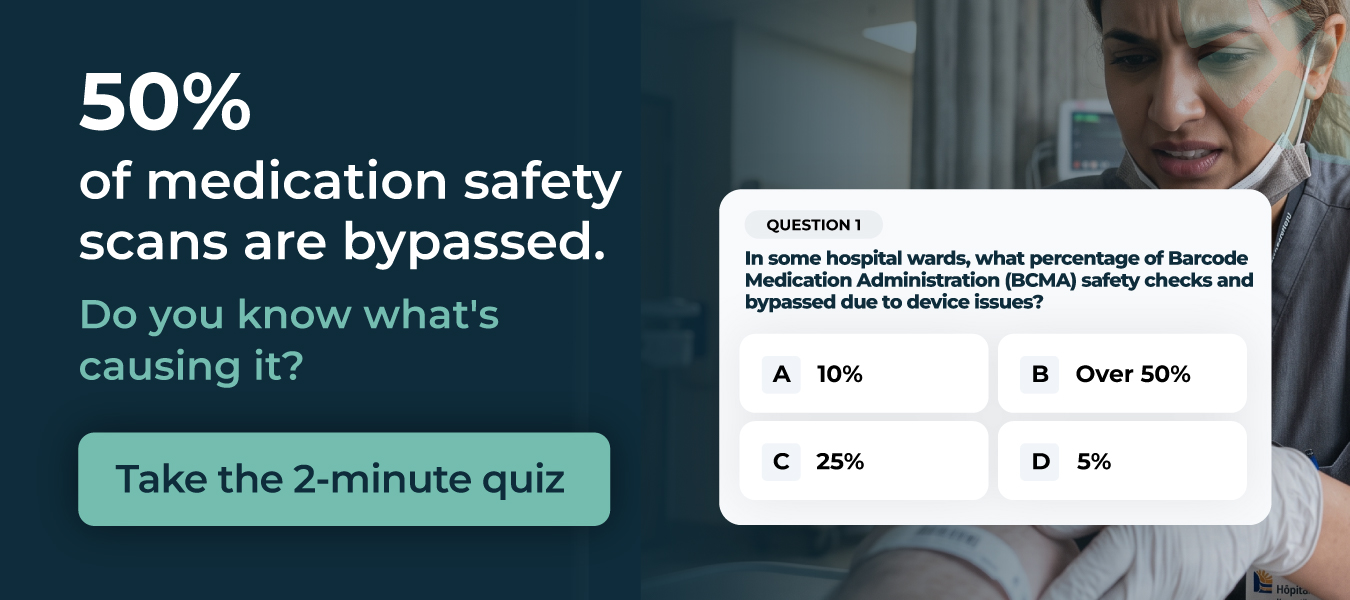
Healthcare mobility is not a convenience — it is a patient safety requirement. Clinicians use mobile devices for electronic health record (EHR) access, medication administration scanning, specimen tracking, and real-time communication. A nurse who cannot scan a patient’s wristband before administering medication is working without a critical safety check. A lab technician whose handheld fails during specimen collection creates a chain-of-custody gap that can compromise test results.
The regulatory environment compounds the operational stakes. Healthcare organizations in Canada must comply with PIPEDA, and those in Ontario face additional obligations under PHIPA. Quebec’s Law 25 introduces further data-handling requirements. Every device that touches patient data must be secured, encrypted, monitored, and — when retired — wiped to certified standards. Managing this compliance burden across a fleet of shared clinical devices, each used by multiple staff across multiple shifts, is a full-time job in itself.
PiiComm’s MDMaaS provides 24/7 monitoring and management of clinical device fleets by certified, Canadian-based MDM administrators using platforms like SOTI and 42Gears. Policies are enforced remotely: application whitelisting, encryption settings, and automatic lock-and-wipe for lost or stolen devices. Staging & Deployment ensures that new devices arrive on the ward floor pre-configured with the correct EHR applications, network profiles, and security settings — no IT staff intervention needed at the point of care. When devices are retired, Secure Decommissioning provides documented, NIST 800-88 compliant data erasure with full chain-of-custody records, satisfying audit requirements under PIPEDA and PHIPA.
PiiComm’s healthcare experience is detailed in the healthcare case study.
Visit the healthcare industry page for more on PiiComm’s clinical mobility capabilities.
Government and public safety
Government agencies and public safety organizations operate under stringent security, procurement, and compliance frameworks. Mobile devices in this sector support everything from field inspections and permit processing to emergency dispatch and law enforcement operations. The devices often operate in sensitive environments where data security is non-negotiable and where procurement rules restrict how technology is acquired, configured, and disposed of.
Three challenges stand out. First, procurement cycles in government are long and complex, involving formal RFP processes, vendor qualification requirements, and multi-year contract structures. An MMS partner that understands Canadian government procurement can accelerate sourcing and reduce administrative overhead. Second, security requirements are heightened — devices may contain personally identifiable information about citizens, law enforcement case data, or infrastructure details. MDM policies must be rigorously enforced, and any gap in device management creates audit and liability exposure. Third, end-of-life disposition must be documented and certifiable. A government device that is improperly decommissioned is a data breach waiting to happen.
PiiComm’s Strategic Sourcing team navigates Canadian government procurement requirements, and the company’s Premier partnerships with Zebra Technologies, Brady, and Samsung provide priority access to ruggedized devices suited for field operations. MDMaaS ensures that security policies are enforced across the fleet in real time, while Secure Decommissioning delivers NIST 800-88 certified erasure with the chain-of-custody documentation that government auditors require.
The government and public safety case study provides a detailed example of PiiComm’s work in this sector.
Learn more on the government and public safety industry page.
Manufacturing
Manufacturing floors are hostile environments for mobile devices. Dust, vibration, extreme temperatures, chemical exposure, and constant physical handling take a toll on even ruggedized hardware. Yet manufacturers depend on mobile devices and radio-frequency identification (RFID) systems for production tracking, quality control scanning, inventory management, and shipping verification. A device failure on a production line does not just inconvenience one worker — it can halt an entire process.
The operational reality for manufacturing IT teams is that devices need to be purpose-selected for the specific environment. A scanner used in a refrigerated food processing facility has different requirements than one used in a steel fabrication shop. Getting the hardware wrong means higher failure rates, more downtime, and wasted capital. Beyond device selection, manufacturers need tight integration between their mobile devices, MDM platforms, and enterprise systems (ERP, WMS). Misconfigurations or update failures can disrupt production workflows.
PiiComm’s Strategic Sourcing service matches the right ruggedized hardware — Zebra, Brady, or Samsung — to the specific environmental and operational demands of each facility. Staging & Deployment configures devices with the correct firmware, applications, and MDM profiles before they ship, reducing time-to-productivity on the floor. Lifecycle Management handles ongoing repairs, firmware updates, and fleet analytics through the Asset Intelligence Manager (AIM) portal, giving plant managers real-time visibility into device health and utilization.
PiiComm helped a steel processing facility eliminate costly shipping errors by deploying RFID and rugged mobile technology, replacing manual processes that were causing mis-shipments and production delays. Read the manufacturing case study for the full story.
Explore PiiComm’s manufacturing capabilities on the manufacturing industry page.
Field services
Field service technicians work alone, in remote locations, on unpredictable schedules. Their mobile devices are their primary connection to dispatch, work orders, customer records, and compliance documentation. When a device fails in the field, there is no IT department down the hall — the technician is stranded, the job stalls, and the customer waits.
Field service organizations face a particular challenge with chain-of-custody and compliance documentation. In regulated industries — healthcare services, environmental remediation, utilities — field workers must capture time-stamped, geotagged records at every step of a service call. A device failure does not just delay the job; it creates a compliance gap that may need to be reported or remediated.
PiiComm’s Lifecycle Management and spare pool management program are built for this reality. When a field technician’s device fails, a pre-configured replacement is shipped same-day to the technician’s next job site or home location. MDMaaS ensures that the replacement device arrives with the same applications, security profiles, and access credentials as the failed unit — no manual setup required. For organizations that want to remove device ownership from their balance sheet entirely, PiiComm’s Device as a Service (DaaS) bundles hardware, staging, management, and support into a predictable monthly cost per device.
PiiComm’s work with a healthcare services field operation demonstrates how managed mobility supports chain-of-custody compliance in distributed workforces. Read the field services case study.
Visit the field services industry page for more detail.
Warehouse and distribution
Warehouse operations run on mobile devices: barcode scanners, RFID readers, vehicle-mounted terminals on forklifts, and wearable devices for hands-free picking. A single warehouse may have hundreds of devices in constant use across multiple shifts. The devices are shared between workers, exposed to drops and impacts, and expected to perform reliably in environments ranging from ambient-temperature dry goods storage to sub-zero freezer sections.
The management challenge is scale and speed. When a warehouse runs three shifts, there is no maintenance window — devices need to be updated, repaired, and replaced without disrupting operations. A failed scanner during a peak shipping window means missed picks, delayed shipments, and unhappy customers. Maintaining an adequate spare pool, tracking device health across hundreds of units, and ensuring that every device has the correct firmware and application versions is a full-time operational function.
PiiComm manages warehouse device fleets from sourcing through decommissioning. Strategic Sourcing ensures that the right devices are selected for each function — a forklift-mounted terminal has different specifications than a handheld pick scanner. Staging & Deployment configures devices at PiiComm’s Canadian facilities and ships them ready to scan on arrival. Lifecycle Management, supported by the AIM portal, provides real-time fleet visibility so warehouse managers know which devices are healthy, which are degrading, and which need replacement before they fail. Secure Decommissioning handles end-of-life processing with certified data erasure — important for warehouses handling pharmaceutical, food safety, or customer order data.
The warehouse case study details how PiiComm supports high-volume distribution center operations.
Learn more on the warehouse and distribution industry page.
Why a managed mobility partner matters
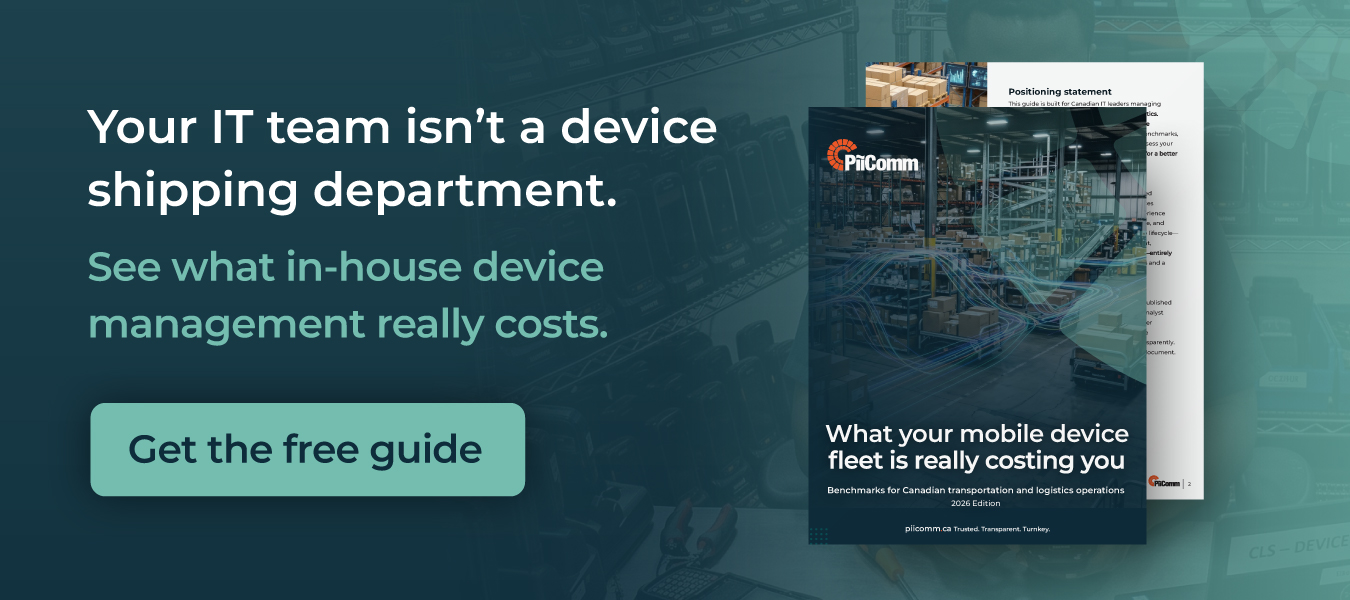
Managing a mobile device fleet internally sounds straightforward until the numbers are real. A mid-sized organization with 2,000 devices across 50 locations needs people to source hardware, negotiate carrier contracts, configure and ship devices, manage MDM policies, handle break-fix, track warranties, and securely dispose of retired units. That is not one job — it is several, and most internal IT teams are already stretched thin.
The cost goes beyond headcount. Internal teams face longer procurement cycles because they lack volume purchasing relationships with OEMs. They absorb higher device failure rates because they cannot stage and test at scale before deployment. They carry larger spare inventories because they do not have a national logistics program to ship replacements same-day. And they accept greater compliance risk because tracking chain-of-custody across thousands of devices and dozens of locations is difficult without purpose-built systems.
The internal team managing a multi-thousand-device fleet across dozens of locations is handling sourcing, carrier negotiations, deployment, MDM, break-fix, warranty tracking, and secure disposal — simultaneously. Most IT departments are not resourced for that scope. PiiComm covers the full device lifecycle through five service pillars: Strategic Sourcing, Staging & Deployment, Lifecycle Management, MDM as a Service, and Secure Decommissioning. Every function is executed in Canada by PiiComm’s own team — Canadian staging facilities staffed by in-house certified technicians, a 24/7 bilingual (English/French) service desk, and Canadian-hosted data infrastructure. No core operational function is outsourced or offshored.
The proof is in the operational record: 500,000+ devices managed across thousands of Canadian locations, two decades of managed mobility operations, Premier partnerships with Zebra Technologies (highest tier), Brady, and Samsung, and certifications on SOTI and 42Gears MDM platforms. PiiComm also holds NIST 800-88 certification for data erasure, ensuring that decommissioned devices meet the most rigorous security standards.
For organizations that want to shift from capital expenditure to a predictable operating cost, Device as a Service (DaaS) bundles hardware, staging, management, and support into a single monthly fee per device — backed by the same in-house Canadian operations.
Key takeaways
Managed mobility services remove the operational burden of device sourcing, staging, management, and decommissioning from internal IT teams. Industries with distributed, frontline-dependent workforces — transportation, retail, healthcare, government, manufacturing, field services, and warehouse operations — see the most measurable impact. The common thread across all seven verticals is that device downtime has a direct, quantifiable cost, and a specialist MMS partner reduces that cost more reliably than an in-house team working at the margins of its capacity.
Getting started with managed mobility
Every organization’s device fleet is different, with different industries, different devices, different compliance requirements, and different scale. The first step is an honest assessment of what your internal team is spending (in time, budget, and risk) to manage mobile devices today versus what a managed approach would deliver.
PiiComm works with IT and operations leaders to evaluate their current fleet, identify gaps in device management, and build a managed mobility program tailored to their operational requirements. Whether you are managing 500 devices or 50,000, the conversation starts the same way: what are your devices, where are they, who uses them, and what is going wrong?
Contact PiiComm to start that conversation.