You are staring at a quarterly wireless bill that spans Bell, Rogers, and TELUS, covers 2,000+ lines across six terminals, and somehow increased by $18,000 this month. Your carrier reps cannot explain it. Your AP team cannot trace it. Nobody in your organisation can tell you whether this is a billing error, a rate change, or just the accumulated cost of lines that should have been cancelled months ago.
This is not a technology problem. It is a visibility problem — and it is costing your fleet real money every billing cycle.
Choosing a telecom expense management solution for transportation and logistics operations in Canada requires evaluating criteria that generic TEM buyers’ guides rarely cover. This post is not a feature checklist borrowed from a US vendor’s website. It is an evaluation framework built around the specific realities of Canadian T&L fleets: the carrier landscape, the regulatory environment, the operational patterns that make fleet wireless different from corporate smartphones.
Consider the baseline: billing issues accounted for 46% of all complaints raised with the CCTS in 2024–25 — the highest level in five years. And that is for consumers and small businesses who have regulatory protection. Large enterprise fleets do not qualify for CCTS dispute resolution. Proactive TEM is your only safety net.
When every TEM vendor claims to save you money, what actually separates a platform built for Canadian fleet wireless from one that treats Canada as a footnote?
Why generic TEM evaluation guides fall short for Canadian fleets
A procurement manager downloads three TEM vendor comparison guides, hoping to shortlist providers for an RFP. Not one of them mentions Bell, Rogers, or TELUS by name. The evaluation criteria reference AT&T pooled data structures, Verizon enterprise pricing tiers, and HIPAA compliance requirements — none of which apply to a Canadian T&L fleet with terminals from Vancouver to Moncton.
This is not an oversight. Most TEM content is written by US vendors for US buyers. The evaluation frameworks assume a market with four national carriers, dozens of enterprise MVNOs, and a regulatory environment that looks nothing like Canada’s.
The Canadian carrier landscape is fundamentally different. Canada’s three national carriers hold approximately 85.9% of mobile subscriber market share, creating a concentrated market with limited competitive pressure on enterprise pricing. That concentration has consequences: ISED’s 2024 price comparison study found Canadian mobile prices 11–76% higher than peer G7 countries at comparable service baskets.
Here is what that means for your TEM business case: when you manage fleet wireless in Canada, every percentage point of optimisation recovers more absolute dollars than the same percentage in a US deployment. A 10% saving on a $75/line Canadian plan is worth more than 10% on a $45/line US plan. The ROI math for TEM is structurally stronger in Canada — but only if your TEM platform actually understands Canadian carrier billing.
A US-built evaluation framework will not help you find that platform.
Multi-carrier invoice parsing across Bell, Rogers, and TELUS
There is no industry-standard enterprise invoice schema among Canadian carriers. Bell, Rogers, and TELUS each use proprietary PDF and CSV formats that differ not just by carrier but by account hierarchy within the same carrier. A TEM platform that parses Verizon and AT&T invoices natively and claims “international support” is not the same as one built to read a Bell Mobility enterprise invoice with 400 sub-accounts.
The adoption gap reflects this challenge. Only 20–30% of large Canadian enterprises use a dedicated TEM approach for wireless expense management in Canada; that figure drops to 5–10% for mid-market companies. Most organisations default to spreadsheets and manual review because the TEM platforms they evaluated could not actually handle their Canadian carrier invoices.
Here is what happens when the parsing fails: a T&L company signs with a global TEM vendor, uploads their Bell enterprise invoice, and the parser misclassifies pooled data charges as individual line overages. The parser was designed for AT&T’s pooling structure, not Bell’s. The “anomalies” it flags are actually normal Canadian billing conventions. Three months later, the finance team stops trusting the platform and goes back to spreadsheets.
The platform did not save money. It wasted time.
What “native parsing” actually means for Canadian carrier invoices
“Multi-carrier support” on a TEM vendor’s website tells you nothing. The question to ask: “Show me a parsed Bell, Rogers, or TELUS enterprise invoice from a Canadian fleet client — not a demo environment.”
Native parsing means the platform was built to understand Canadian carrier invoice structures from the start — not adapted from US formats with Canadian fields mapped in afterward. It means the parser knows that Bell’s enterprise invoice hierarchy differs from Rogers’, that TELUS structures pooled data differently, and that account numbers, sub-account relationships, and feature codes do not follow a universal standard.
If a vendor cannot demonstrate a live parse of a real Canadian enterprise invoice within the first meeting, their Canadian capability is marketing, not engineering.
Regional carrier coverage — SaskTel, Videotron, and Freedom Mobile
A fleet running Western Canada routes on SaskTel or Quebec terminals on Videotron needs regional carrier parsing, not just Big Three coverage.
SaskTel remains the dominant carrier in Saskatchewan. Videotron is increasingly competitive in Quebec enterprise accounts. Freedom Mobile (now owned by Quebecor) is expanding its enterprise footprint nationally. If your fleet operates in these regions, your TEM platform needs to parse these invoices natively — or you are managing a portion of your wireless spend manually regardless of what the platform covers.
Ask specifically: which regional carriers does the platform support today? Is regional carrier parsing on the current roadmap or a “future consideration”?
AI-powered billing anomaly detection — beyond basic variance reporting
Gartner’s 2024 Market Guide for Telecom Expense Management Services highlights the shift to proactive AI-driven analytics and predictive optimisation as a baseline expectation, not a premium feature. For a T&L fleet, this means the platform should detect that 47 ELD SIM lines in Alberta suddenly shifted to a higher-cost plan mid-cycle — not just flag that the total bill went up.
The scale of the problem justifies the capability. Gartner cites billing errors accounting for 5–12% of telecom expenses across North America. The CCTS reports billing issues at the highest level in five years, with nearly half of all complaints related to billing.
But here is the distinction that matters: the anomalies that cost T&L fleets the most money are not the dramatic ones. The $5,000 roaming charge gets caught — someone notices that. The quiet bleed is what kills you.
It is the $3.50/line/month plan feature that was supposed to be removed 18 months ago, now costing $84,000/year across 2,000 lines. It is the 23 lines that migrated to a legacy plan during a system update and have been overcharged by $8/line/month ever since. AI anomaly detection catches the quiet bleed, not just the loud spike.
The difference between variance alerts and true anomaly detection
A variance alert tells you that this month’s bill is higher than last month’s bill. That is basic math.
True anomaly detection tells you why — and flags patterns that variance thresholds would miss entirely. It identifies the 12 lines in your Winnipeg terminal that shifted to a different rate plan without authorisation. It catches the device insurance fee that appeared on 340 lines after a carrier system migration. It notices that your average per-line data consumption dropped 15% this quarter, which means your unlimited data plans are now oversized for actual usage.
Variance alerts are reactive. Anomaly detection is diagnostic.
Why per-line granularity matters for driver fleets
T&L fleets have a device mix that generic enterprise TEM platforms were not designed for. You have driver handsets, ELD telematics SIMs, in-cab tablets, handheld scanners, and vehicle-mounted computers — each with different usage patterns and plan requirements.
A platform that reports anomalies at the account level cannot tell you which driver’s line generated the overage. Per-line granularity means you can trace every charge to a specific device, a specific driver, a specific terminal — and take action at the right level instead of chasing averages.
The CFO asking “why did our wireless bill go up $18,000?” deserves an answer more specific than “increased usage.”
Zero-use line detection and driver line optimization
A driver leaves the company. HR processes the termination. Payroll stops. But the wireless line attached to that driver’s ELD device keeps billing for nine months because nobody told the carrier, and the carrier has no reason to tell you.
Multiply that by a fleet with 15–20% annual driver turnover.
The reconciliation gap between what carriers bill and what organisations actually use is structural in T&L. The typical gap between MDM device inventory and carrier-billed lines is 8–15% for unaudited Canadian organisations. On a 2,000-line fleet at $60/line/month, an 8% gap means 160 unused lines costing $115,200/year — enough to fund a TEM platform several times over.
Carriers themselves know this gap exists. Bell removed approximately 106,000 “very low to non-revenue generating business market subscribers” from its subscriber count in Q1 2024 — lines that enterprises had been paying for until the carrier cleaned its own books. The carrier caught them eventually. You paid for them in the meantime.
Correlating billed lines to MDM device inventory
The real complexity is not finding lines with zero usage — any report can show you that. It is knowing whether a zero-use line is genuinely orphaned or whether it is attached to a spare device sitting in a terminal manager’s drawer waiting for the next new hire.
A TEM platform that flags zero-use without correlating to MDM device status creates false positives. Your operations team investigates, finds the spare device, marks the alert as resolved — and stops trusting the platform’s recommendations. Trust erosion is the hidden cost of poor data correlation.
Effective zero-use detection requires integration between your TEM platform and your MDM environment. The platform should show you not just that a line has no usage, but whether that line is enrolled in SOTI, 42Gears, or Intune — and whether the associated device has checked in recently. That correlation separates actionable insight from noise.
Seasonal fleet scaling and the line-management challenge
T&L fleets do not operate at constant capacity. Peak season volume increases of 40–80% require deploying hundreds of devices — and activating hundreds of wireless lines — within days. When peak ends, those lines need to be suspended or cancelled promptly, or they become the next quarter’s zero-use waste.
Most organisations handle seasonal scaling poorly because the activation process is faster than the deactivation process. Getting a new driver a working device is operationally urgent. Cancelling a line after the seasonal driver leaves is administratively tedious. The asymmetry compounds over time.
A TEM platform should track seasonal line activations separately, flag lines approaching their expected deactivation date, and automate the carrier disconnect request workflow. If the platform cannot distinguish a permanent line from a seasonal line, your seasonal scaling becomes your permanent cost base.
The carrier contract terms matter here, too — and they are the next evaluation criterion that separates TEM platforms built for Canadian fleets from those that treat Canada as an afterthought.
Canadian carrier contract expertise and renewal leverage
When a Canadian T&L fleet enters a carrier contract renewal without its own usage data, the carrier rep controls the conversation. The rep knows your usage patterns better than you do. The “better plan” they offer is optimised for the carrier’s revenue, not your cost structure.
This is not speculation. AOTMP Research found 80% of organisations have overspent on telecom services due to poorly managed contracts. The pattern is predictable: the fleet signs a 36-month enterprise MSA based on the carrier’s proposal, discovers 18 months later that actual usage never matched the plan structure, and has no leverage to renegotiate until the next renewal window opens.
Most T&L organisations sign enterprise agreements with Bell, Rogers, or TELUS that lock in pricing for three years. The renewal window typically opens six to nine months before expiration. If your TEM provider cannot produce a 24-month usage trend report segmented by terminal, driver group, and plan type within two weeks of that window opening, you have already lost your negotiating position.
The carrier’s renewal offer will be based on their data, not yours.
What your TEM provider should deliver before a carrier renewal
The deliverable is not a summary report showing total spend by month. It is a negotiation package: usage trends by line category (driver handsets, ELD SIMs, tablets), data consumption distribution showing what percentage of lines actually need unlimited plans, seasonal patterns that justify flexible capacity terms, and benchmark data showing how your per-line costs compare to similar fleets.
A TEM provider with Canadian carrier expertise knows which contract terms are negotiable — early termination flexibility, device subsidy structures, pooled versus individual data allocation — and which are standard across all enterprise MSAs. That knowledge turns your usage data into leverage.

How the 2024 MVNO expansion changes fleet sourcing options
In October 2024, the CRTC expanded MVNO access to enterprise and IoT services for the first time. For T&L fleets, this creates sourcing options that did not exist 18 months ago.
Your ELD M2M SIMs and low-data driver handset lines may now qualify for MVNO plans at lower price points than the Big Three enterprise rates. A TEM provider with current knowledge of the post-2024 MVNO landscape can identify which portions of your fleet could move to alternative carriers — and calculate whether the savings justify the migration effort.
Most T&L organisations do not yet know this option exists. If your TEM provider does not mention it, they are not tracking Canadian regulatory developments.
Canadian data residency and privacy compliance
Every wireless invoice contains employee names, phone numbers, and usage data. Under PIPEDA, that is personal information. Under Quebec Law 25, transferring it to a US-hosted platform triggers a mandatory Privacy Impact Assessment with penalty exposure up to $25 million or 4% of worldwide turnover.
This is not a theoretical compliance footnote. It is a procurement requirement that eliminates most US-built TEM platforms from consideration for any fleet operating in Quebec.
Law 25 came into full force on September 22, 2024. The obligations are specific: before transferring personal information outside Quebec — including uploading employee telecom data to a US-hosted TEM platform — organisations must conduct a Privacy Impact Assessment, implement contractual protections, and document the legal basis for the transfer. The penalties for non-compliance are among the highest in Canadian privacy law.
A Canadian T&L company with terminals in Montreal and Quebec City chose a US-based TEM platform in 2023. When their legal team reviewed Law 25 obligations in late 2024, they discovered the platform stored all invoice data on AWS US-East. The Privacy Impact Assessment alone took four months and $40,000 in legal fees — and the conclusion was that they needed to migrate to a Canadian-hosted platform anyway.
The compliance cost exceeded the first year’s TEM savings.
PIPEDA obligations for telecom data in federally regulated transportation
Federally regulated transportation companies — interprovincial trucking, rail, marine, and air carriers — fall under PIPEDA regardless of which province they operate in. The Act requires that personal information be protected by security safeguards appropriate to the sensitivity of the information, and that organisations be accountable for personal information in their possession or custody.
Wireless invoice data includes call records, location-derived usage patterns, and employee identifiers. When that data sits on a US-hosted platform, it becomes subject to US law enforcement access under the CLOUD Act — without the Canadian legal protections that would apply to domestically hosted data.
For a federally regulated carrier, this is not a policy preference. It is a compliance exposure that procurement and legal teams increasingly flag during vendor selection.
Quebec Law 25 and Bill 96 — the dual compliance requirement for fleet operators
Quebec fleets face two simultaneous obligations that compound the challenge.
Law 25 governs data residency and cross-border transfers. Bill 96 governs the language of commercial documents, requiring that invoices, contracts, and business communications be available in French for any business with a Quebec establishment. Penalties under Bill 96 range from $3,000–$30,000 per offence, doubled for repeat offenders.
Together, these requirements functionally disqualify any TEM provider that hosts data outside Canada and cannot produce French-language reports natively. The question is not whether your TEM provider supports French — it is whether French output is built into the platform or requires a third-party translation delay.
Bilingual reporting and French-language invoice management
Bill 96 requires that invoices, contracts, and commercial documents be available in French for any business with a Quebec establishment. For a T&L company with terminals in Quebec — and Quebec represents roughly 17–20% of national for-hire trucking revenue — this means every TEM report, chargeback export, and dispute letter involving Quebec operations must be available in French.
As of June 1, 2025, businesses with 25+ employees must register with the OQLF and undergo francisation requirements. The compliance timeline is now, not future.
Ask any TEM vendor: “Can you produce a French-language executive summary report and a French-language dispute letter to Bell for our Quebec accounts?” If the answer involves a third-party translation service or a “future roadmap item,” that vendor cannot serve your Quebec operations compliantly today.
Bilingual capability is not a feature checkbox. It is an operational requirement with enforcement teeth.
Integration with MDM, ERP, and fleet telematics systems
A TEM platform that cannot correlate a billed wireless line to a specific device in your MDM environment is an expensive reporting tool, not a management tool. The value of TEM in T&L comes from connecting the bill to the device to the driver to the route — not from generating a prettier version of the invoice you already have.
The integration challenge is real. Effective TEM platforms require 2–3 internal FTEs at scale to operate without managed services — and much of that labour goes into manually reconciling TEM output with MDM inventory, ERP cost centres, and telematics device records. If the platform does not integrate natively, your team becomes the integration layer.
A well-managed fleet should maintain a device-to-line mismatch rate of less than 3%. Most unaudited fleets run 8–15%. The gap represents lines you are paying for that should not exist — but you cannot close the gap without integration between your TEM platform and your MDM environment.
MDM correlation — SOTI, 42Gears, and Intune
The specific question to ask: does the TEM platform pull device enrollment status from your MDM environment, or does it require manual inventory uploads?
Native integration with SOTI, 42Gears, or Microsoft Intune means the platform can show you not just that a line has zero usage, but whether the associated device is currently enrolled, when it last checked in, and whether it is assigned to an active user. That correlation separates actionable insight from noise.
Manual inventory uploads create a lag. By the time your team exports device data, uploads it to the TEM platform, and runs the reconciliation, the information is already stale. For a fleet with 15–20% annual driver turnover, weekly device changes are the norm — and monthly inventory snapshots cannot keep pace.
ERP and cost-allocation exports for multi-terminal fleets
The integration that matters most for finance teams is not a fancy API diagram — it is the ability to produce a chargeback file that allocates wireless costs by terminal, by fleet, or by cost centre and drops cleanly into NetSuite or SAP.
If the finance team has to manually reformat the TEM output every month to match their GL structure, the “automation” is an illusion. The platform saves time on invoice analysis and creates time on cost allocation — a wash at best.
Ask for a sample chargeback export file. Compare it to your ERP’s import requirements. The gap between those two formats is the manual labour your team will perform every billing cycle.
Pricing transparency and ROI timeline
TEM pricing models range from $1–$5 per line per month for software-only platforms to $2–$15 per line per month for managed services. The question is not which model is cheapest — it is which model delivers value faster than it costs.
For a T&L fleet with $500,000+ in annual wireless spend, the math usually favours a managed service with rapid time-to-insight. Industry ROI benchmarks range from 5:1 to 10:1 within 12 months for organisations with $1 million+ in annual telecom spend — but those benchmarks assume the platform is operational and delivering savings within the first quarter.
The hidden cost in TEM is implementation delay. Global enterprise TEM platforms typically require 120–180 days for full deployment; managed-service alternatives target 60–90 days. For a fleet leaking 10% of a $1 million annual wireless spend, a 180-day implementation means approximately $50,000 in unrecoverable waste before the platform has done anything.
Six months of billing errors that expire before you can claim credits. That is the real cost of a slow implementation.
Per-line, per-invoice, or percentage-of-savings — which model fits T&L
Per-line pricing scales predictably with fleet size. You know the cost before you sign. The risk is that a large fleet with low per-line complexity may overpay relative to the value delivered.
Percentage-of-savings pricing aligns vendor incentives with your outcomes. The risk is opacity — how does the vendor calculate “savings,” and against what baseline? A vendor claiming 25% savings against an inflated baseline is not delivering the same value as 15% savings against your actual prior-year spend.
Per-invoice pricing works for organisations with few billing accounts but high invoice complexity. For a T&L fleet with dozens of terminal accounts across three carriers, per-invoice pricing can scale unpredictably.
The right model depends on your fleet’s size, complexity, and internal capacity. The wrong model creates misaligned incentives that erode value over time.
What a realistic first-year savings timeline looks like
Month one: invoice upload and initial analysis — immediate visibility into billing anomalies and zero-use lines.
Months two through three: zero-use line elimination and obvious billing error disputes — the quick wins that fund the platform.
Months four through six: plan optimisation and rate structure review — matching actual usage to appropriate plan tiers.
Months seven through twelve: carrier contract preparation and renewal negotiation — the strategic savings that compound over subsequent years.
A platform that promises 30% first-year savings but cannot show you 5–8% in the first 90 days is projecting, not delivering. The early wins validate the platform; the later wins justify the ongoing investment.
What good looks like — a TEM evaluation checklist for Canadian T&L
After evaluating TEM platforms for Canadian fleet operations over 15 years, these are the non-negotiable capabilities and the questions that separate credible providers from marketing claims.
| Capability | What to ask | Green flag | Red flag |
|---|---|---|---|
| Native Canadian carrier parsing | “Show me a parsed Bell/Rogers/TELUS enterprise invoice from a Canadian fleet client — not a demo environment.” | Live demonstration within the first meeting | “We support international invoices” without Canadian-specific proof |
| AI anomaly detection | “Walk me through an anomaly your platform caught that a variance threshold would have missed.” | Specific example with dollar impact | Generic “we flag billing errors” response |
| Zero-use line correlation | “How does your platform distinguish an orphaned line from a spare device awaiting assignment?” | MDM integration showing device enrollment status | Zero-use report without device correlation |
| Carrier contract support | “What deliverables do you provide before a carrier renewal negotiation?” | Usage trend reports segmented by line category, benchmark data | “We provide spend reports” without negotiation-specific output |
| Canadian data residency | “Where is invoice data stored, and under what legal jurisdiction?” | Canadian-hosted infrastructure, documented compliance | US hosting with “we can discuss Canadian options” |
| Bilingual reporting | “Can you produce a French-language executive summary and dispute letter today?” | Native French output demonstrated | Third-party translation or roadmap item |
| ERP integration | “Show me a sample chargeback export file for NetSuite/SAP.” | Format matches common ERP import requirements | Manual reformatting required |
| Pricing transparency | “What is the all-in cost per line per month, including implementation?” | Clear per-line or per-invoice pricing with no hidden fees | Percentage-of-savings with undefined baseline |
The single best qualifying question in a TEM RFP: “Show me a live demo using a real Bell or TELUS enterprise invoice from a Canadian fleet client.” Any vendor that cannot do this within the first meeting is not ready for your deployment.
How ClearSight TEMs AI addresses these criteria for Canadian fleets
The evaluation criteria above are demanding because the Canadian T&L wireless environment is demanding. Most global TEM platforms were built for a different market — US carrier formats, US data residency, English-only output. Retrofitting Canadian capability onto a US foundation creates the parsing failures, compliance gaps, and integration friction that erode trust.
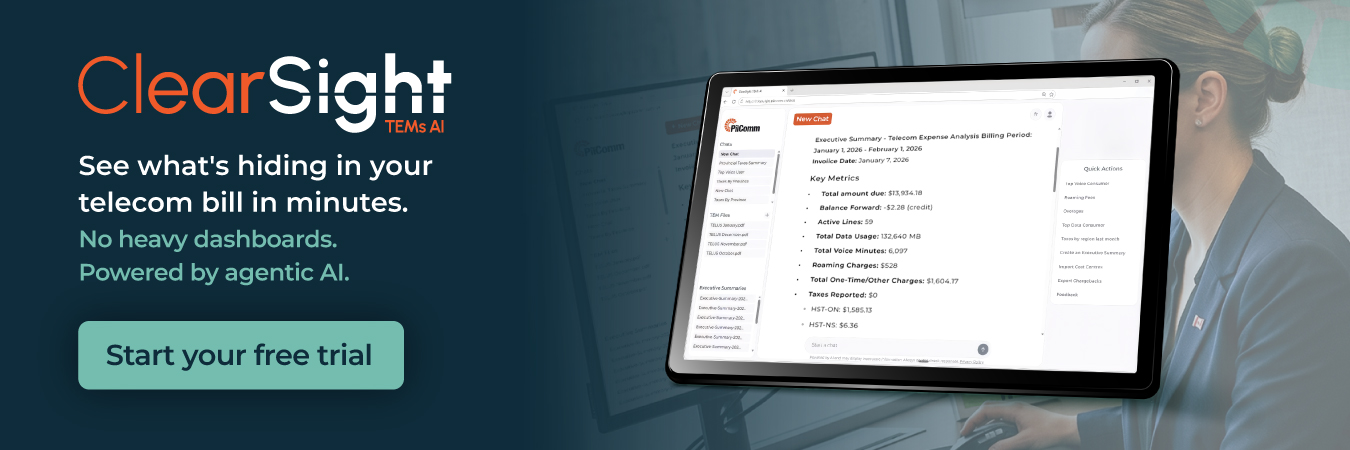
Among the providers purpose-built for Canadian carrier complexity, PiiComm’s ClearSight TEMs AI represents a specific approach: agentic AI that parses 100% of Canadian carrier invoice data and delivers conversational analysis within minutes of upload.
The platform reduces per-invoice analysis from 18.5 minutes to under 10 seconds at 99% anomaly detection accuracy. Priced at $99/month per billing account, it eliminates the enterprise-scale pricing barrier that makes global TEM platforms impractical for mid-market fleets.
Canadian-headquartered alternatives exist. Adaptis Mobile, based in Calgary, explicitly markets Bell, Rogers, TELUS, and SaskTel compatibility and serves the Canadian market credibly. Global platforms like Tangoe and Calero offer enterprise-scale TEM but typically require $5 million+ in annual telecom spend for ROI and default to US data residency — creating Law 25 compliance friction for any fleet with Quebec operations.
The distinction is not that ClearSight is the only option. It is that ClearSight was built by a team that has managed 500,000+ enterprise devices across Canadian carriers for 15+ years. The invoice parsers were not adapted from US carrier formats — they were built from Canadian carrier invoice structures first.
Canadian carrier invoice parsing and AI anomaly detection
ClearSight’s AI agents parse Bell, Rogers, and TELUS enterprise invoices natively — including regional carriers like SaskTel and Videotron. The parsing is not a field-mapping exercise layered onto a US invoice structure. It understands Canadian carrier billing conventions: pooled data allocation, sub-account hierarchies, feature codes specific to each carrier’s enterprise billing system.
The anomaly detection goes beyond variance thresholds. Users interact through a conversational interface — asking plain-language questions like “Why did our bill spike this month?” or “Which lines had zero usage in the last 90 days?” — and receiving specific, line-level answers within seconds.
Bilingual output and Canadian data residency
ClearSight produces bilingual English and French output natively — executive summaries, chargeback exports, and anomaly reports in either language without third-party translation delays. For fleets with Quebec operations, this is not a feature; it is a compliance requirement satisfied.
The platform operates on Canadian-hosted infrastructure with isolated tenant environments. Invoice data stays in Canada, under Canadian legal jurisdiction, without the Privacy Impact Assessment burden that US-hosted alternatives create.
From TEM insight to full lifecycle management
ClearSight serves as an entry point to PiiComm’s broader managed mobility services for transportation and logistics. The fleet metadata captured through invoice analysis — device inventory, carrier contracts, spending trends — provides the scoping intelligence for lifecycle management for enterprise mobile devices, managed MDM administration, or Device as a Service proposals.
The connection matters because TEM insight without operational action is incomplete. Identifying 160 zero-use lines is valuable. Having a managed mobility partner that can coordinate the carrier disconnections, reconcile the MDM inventory, and prevent the same gap from reappearing next quarter — that is the difference between a report and a result.
Talk to a mobility expert about your fleet’s wireless spend — a no-obligation conversation about whether managed TEM fits your fleet’s size and complexity. Or upload a carrier invoice to ClearSight and see your first analysis in minutes at $99/month per billing account.
Questions to ask any TEM provider before signing
Before you shortlist a TEM provider, put these questions in your RFP. The answers will tell you more than any demo.
- “Show me a parsed Bell, Rogers, or TELUS enterprise invoice from a Canadian fleet client.” Green flag: live demonstration in the first meeting. Red flag: demo environment only, or “we support international invoices” without Canadian-specific proof.
- “Where is my invoice data stored, and under what legal jurisdiction?” Green flag: Canadian-hosted infrastructure with documented compliance. Red flag: US hosting with vague promises about Canadian options.
- “Can you produce a French-language executive summary and dispute letter today?” Green flag: native bilingual output demonstrated. Red flag: third-party translation service or future roadmap item.
- “How do you distinguish a zero-use line from a spare device awaiting assignment?” Green flag: MDM integration showing device enrollment status and last check-in. Red flag: zero-use report without device correlation.
- “What deliverables do you provide before a carrier renewal negotiation?” Green flag: usage trend reports segmented by line category, plan optimisation recommendations, benchmark data. Red flag: generic spend reports without negotiation-specific output.
- “What is the all-in cost per line per month, including implementation?” Green flag: clear pricing with no hidden fees, implementation timeline specified. Red flag: percentage-of-savings model with undefined baseline.
- “How long until I see my first actionable insight after contract signature?” Green flag: days to weeks for initial invoice analysis. Red flag: 120–180 day implementation before any value delivery.
- “Do you understand the CRTC’s 2024 MVNO expansion and its implications for fleet line sourcing?” Green flag: specific knowledge of enterprise MVNO options. Red flag: no awareness of post-2024 regulatory changes.
The vendors who answer these questions confidently and specifically are the ones ready for Canadian T&L deployments. The ones who deflect or generalise are telling you something important about their actual capability.
Frequently asked questions
What percentage of wireless spend can a TEM solution typically recover for a Canadian T&L fleet?
Most Canadian T&L fleets see 8–15% savings in the first year from zero-use line elimination and plan optimisation alone. Managed TEM engagements with continuous monitoring and carrier contract support can reach 25–35% first-year reduction. The higher Canadian per-line costs mean each percentage point recovers more absolute dollars than equivalent US deployments.
How do I know if my fleet has unused wireless lines?
If you cannot match every line on your Bell, Rogers, or TELUS invoice to a specific active device in your MDM environment, you almost certainly have unused lines. The typical unaudited Canadian fleet carries an 8–15% gap between billed lines and active devices — driven by driver turnover, device swaps, and seasonal scaling.
Does the CRTC Wireless Code protect my fleet from billing errors?
No. The CRTC Wireless Code’s overage and roaming caps apply only to individuals and businesses with fewer than 100 employees. Canadian T&L enterprises operate without regulatory bill-shock protection, making proactive telecom expense management the only mechanism to catch and recover billing errors.
What should I ask a TEM provider about Canadian carrier invoice parsing?
Ask the provider to demonstrate a live parse of a real Bell, Rogers, or TELUS enterprise invoice — not a demo environment. Ask specifically whether their parsers were built for Canadian carrier formats natively or adapted from US carrier structures. Ask about regional carrier coverage if your fleet operates in Saskatchewan or Quebec.
Do I need a TEM provider with Canadian data residency?
If your fleet operates in Quebec, yes — Law 25 requires a Privacy Impact Assessment before transferring personal information outside the province. Even outside Quebec, PIPEDA governs federally regulated transportation companies. Canadian data residency eliminates this compliance burden entirely.
How long does a typical TEM implementation take for a T&L fleet?
Global enterprise TEM platforms typically require 120–180 days for full implementation. Canadian-focused managed-service alternatives can deliver initial invoice analysis within days and full deployment within 60–90 days. For a fleet losing money monthly to billing waste, implementation speed directly affects total recoverable savings.
Can a TEM platform help with ELD SIM line management?
Yes — and it should. Every ELD requires an active wireless data plan under Transport Canada’s mandate. A TEM platform should track ELD SIM lines separately from driver handset lines, flag any ELD SIM approaching suspension due to billing issues, and ensure plan sizing matches actual data consumption. A lapsed ELD SIM is not just a cost issue — it is a compliance violation.
What is the difference between a TEM software platform and a managed TEM service?
A TEM software platform gives you the tools; a managed TEM service operates those tools on your behalf. Most T&L organisations lack the 2–3 dedicated FTEs needed to run a TEM platform effectively. Managed services handle invoice ingestion, anomaly investigation, carrier disputes, and reporting — delivering outcomes rather than requiring internal capacity.
The $18,000 mystery increase on your quarterly wireless bill has an explanation. The question is whether you find it before the 12-month credit recovery window closes — or after.
Canadian T&L fleets operate in a wireless environment that rewards visibility and punishes neglect. Higher per-line costs than any peer G7 country. A concentrated carrier market with limited competitive pressure. Regulatory protections that explicitly exclude enterprises your size. Compliance requirements in Quebec that most TEM platforms cannot satisfy.
The evaluation criteria in this guide are not theoretical preferences. They are the capabilities that determine whether a TEM platform delivers value in the Canadian market or becomes another reporting tool your finance team stops trusting after three months.
The carriers will keep billing. The question is whether you keep paying for lines that should not exist.