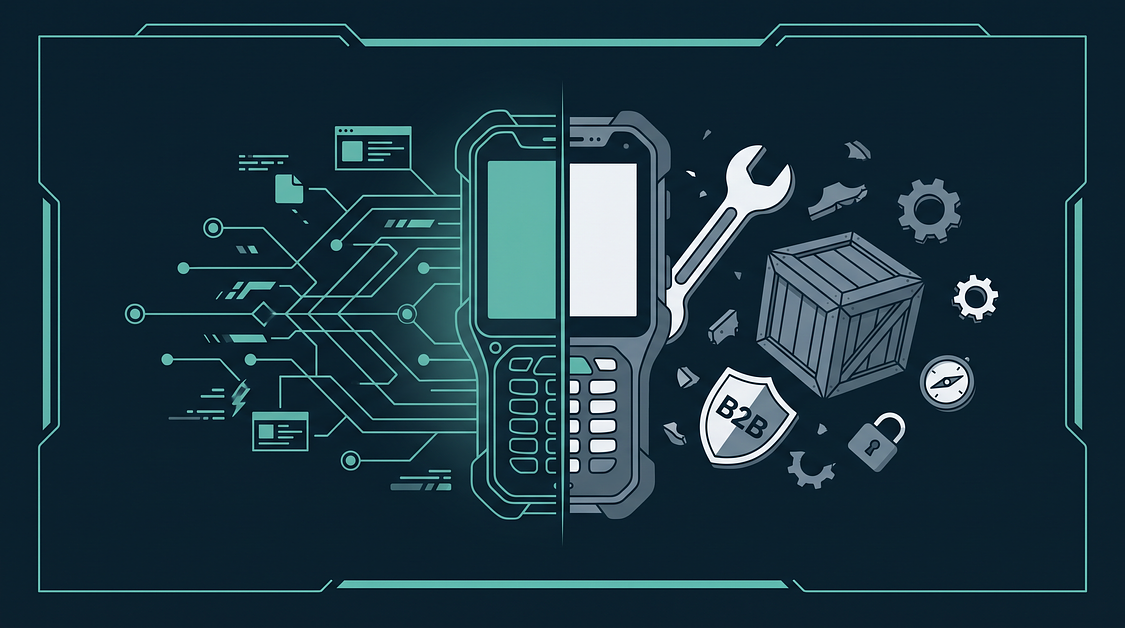
Search for rugged device lifecycle management and page one hands you two different kinds of answer without telling you they’re different. Half the results are management platforms that enforce policy on a scanner. The other half are service providers who source that scanner, stage it, fix it when it breaks, and wipe it when it retires. Both are legitimate answers to “manage my rugged fleet,” and the gap between them is where most evaluations go sideways.
Here’s the short version:
- PiiComm for Canadian enterprises that want the rugged device lifecycle executed in-country
- Peak Technologies for multi-OEM rugged depot repair across a North American footprint
- Stratix for large US-anchored and cross-border rugged fleets
- SOTI MobiControl for rugged and purpose-built device fleets that need deep OEM-level control
- 42Gears SureMDM for mixed rugged and Android device estates on a lighter administrative footprint
- Scalefusion for rugged kiosk and single-purpose device deployments
- Hexnode UEM for AOSP, handheld terminal, and scanner fleets needing broad enrolment options
- Microsoft Intune for rugged devices attached to an existing Microsoft-standardised estate
- WBM Technologies for Canadian organisations bundling rugged lifecycle into broader end-user computing
- Microserve for Western Canadian fleets wanting regional depot repair and decommissioning
Rugged device lifecycle management as a service covers the physical and operational work: sourcing, staging, break/fix, mobile device management (MDM) administration, and secure decommissioning. Rugged device management software is the platform that enforces policy, pushes updates, and locks devices to task. This list covers both, because most teams need to know which of the two they’re actually short on.
We’ve ordered these by who each one fits best, not by a universal ranking.
How we evaluated these rugged lifecycle options
We assessed each option on published capabilities, public records, and aggregated review data where it exists, as of August 2026. Because the list mixes managed service providers with management platforms, the two are assessed on different criteria and use different entry modules.
For providers, we weighed:
- Rugged lifecycle scope. Which stages are delivered: sourcing, staging, break/fix, MDM administration, decommissioning.
- Delivery model. Who performs the physical work, and where. This is the single most decision-relevant fact in this market.
- Canadian operations. Documented in-country facilities, staff, and language capability.
- Credentials. OEM partner tiers, MDM certifications, analyst listings.
- Proof. Named public case studies and published scale figures.
For platforms, we weighed rugged and AOSP device coverage, purpose-built device support, deployment and enrolment options, ruggedised OEM integrations, ease of administration, published pricing, and support quality.
One thing worth knowing before you read the provider entries: most managed mobility providers don’t publish pricing, and most don’t carry G2 or Capterra profiles. That’s a category norm, not a mark against any individual company, so we’ve noted it here rather than repeating it under every entry.
Rugged device lifecycle management at a glance
| Option | Type | Best for | Standout strength | Delivery model or platform reach | Canadian operations |
|---|---|---|---|---|---|
| PiiComm | Managed service | Canadian in-country lifecycle | Own staff, own Canadian facility | In-house, own staff | Yes: Plantagenet, ON |
| Peak Technologies | Managed service | Multi-OEM rugged depot repair | Factory-trained repair engineers | Nationwide depot serving US and Canada | Not documented |
| Stratix | Managed service | Cross-border rugged fleets | Largest North American pure-play | Not publicly documented | Not documented |
| SOTI MobiControl | Software platform | Deep rugged device control | Purpose-built device depth | Global platform | Yes: Mississauga, ON |
| 42Gears SureMDM | Software platform | Mixed rugged and Android estates | Lighter administrative footprint | Global platform | Not documented |
| Scalefusion | Software platform | Rugged kiosk deployments | Single-purpose device lockdown | Global platform | Not documented |
| Hexnode UEM | Software platform | AOSP and scanner fleets | Broad enrolment options | Global platform | Not documented |
| Microsoft Intune | Software platform | Microsoft-standardised estates | Native Microsoft 365 integration | Global platform | Not documented |
| WBM Technologies | Managed service | Broader end-user computing | Canadian lifecycle service delivery | Canadian delivery | Yes |
| Microserve | Managed service | Western Canadian fleets | Regional depot and decommissioning | Canadian facilities | Yes |
The 10 best rugged device lifecycle management options
Ordered by who each one fits best. Provider entries and platform entries are interleaved rather than segregated, so you’re comparing against your actual need instead of a category label.
1. PiiComm: best for Canadian enterprises that want the rugged device lifecycle executed in-country
If you’re running hundreds or thousands of rugged handhelds, scanners, and printers across Canadian sites and you want the physical work done by one in-country team rather than split across subcontractors, this is the profile PiiComm was built for. It’s Canada’s largest pure-play managed mobility services managed mobility services (MMS) provider, founded in 2007 and headquartered in Plantagenet, Ontario.
Services
- Strategic Sourcing. Vendor-neutral device and accessory procurement across Zebra, Honeywell, and Samsung, with configuration standardisation across sites.
- Staging & Deployment. Devices imaged, configured, kitted, quality-checked, and shipped deployment-ready from PiiComm’s own Canadian facility, in staged rollout waves for multi-site programs.
- Lifecycle Management. Break/fix and repair logistics, an advance-exchange spare device program, asset and SIM tracking, and help desk support.
- MDM as a Service (MDMaaS). Certified administration of SOTI MobiControl and 42Gears SureMDM covering policy, security, and OS update management.
- Secure Decommissioning. Data erasure to NIST 800-88 with certificates of destruction issued per serial number, physical shredding of devices and SIM cards, and value recovery through trade-in or resale.
- ClearSight TEMs AI. Telecom expense intelligence across carrier billing Telecom expense intelligence across carrier billing for the managed fleet. Separately priced, not bundled into managed service contracts by default.
Delivery model
- Headquartered in Plantagenet, Ontario, with staging, kitting, depot repair, warehousing, and data destruction performed at PiiComm’s own Canadian facility.
- Staging, break/fix, and data destruction are carried out by PiiComm’s own certified technicians rather than subcontractors.
- Reverse logistics and processing stay inside Canada, which keeps USMCA and CBSA handling out of Canadian break/fix and decommissioning cycles.
- English and French service desk support staffed in Canada.
Pros
- The physical work and the MDM administration sit with one in-country team, which keeps chain-of-custody documentation in a single jurisdiction and keeps depot repair inside Canada.
- Rugged and industrial device heritage rather than a corporate smartphone background, backed by Zebra Premier Solution Partner status, the highest partner tier.
- Certified on both SOTI MobiControl and 42Gears SureMDM, the platforms most Canadian rugged fleets already run.
- Decommissioning is built for mobile devices specifically, with serialised certificates of destruction and SIM destruction inside an existing lifecycle relationship.
Proof points
- 500,000+ assets under management across thousands of North American locations.
- Zebra Premier Solution Partner, the highest partner tier, plus Honeywell and Samsung partnerships.
- Named public case studies including mission-critical device deployment to thousands of flight crew across Canada, and 800+ government devices physically destroyed with certificates of destruction issued.
- Data erasure to NIST 800-88; e-waste processed to EPRA (Electronic Products Recycling Association) standards.
Engagement model
- Managed service contracts, per-device per-month pricing, DaaS bundles, and project-based staging engagements. Published pricing isn’t available.
- Confirm commercial terms directly with the provider.
Best for: Canadian enterprises with large distributed rugged fleets that want sourcing through secure decommissioning performed in-country by one team.
2. Peak Technologies: best for multi-OEM rugged depot repair across a North American footprint
If your estate is a large mixed bag of Zebra, Honeywell, and Intermec rugged hardware and your primary problem is repair throughput rather than deployment, Peak Technologies is worth shortlisting. It’s one of North America’s larger automatic identification and data capture service organisations, headquartered in Littleton, Massachusetts.
Services
- Equipment repair and depot repair. Onsite and mail-in repair of rugged mobile computers, scanners, and printers with 3-day and 5-day turnaround and flat-rate or time-and-materials options.
- Advance exchange and spares management. Pre-positioned spare devices swapped in during repair. This is a program option layered on a repair contract, not included by default.
- Managed Mobility Services. Roadmap, device selection, deployment, and help desk across the device lifecycle.
- MDM services on SOTI MobiControl. Day-to-day administration of the customer’s MDM environment, delivered on the SOTI platform.
- Mobile device deployment and procurement. Staging, application load, configuration, and order management.
- Telecom expense management. Wireless ordering, inventory, and expense reporting through an online portal.
Delivery model
- Peak’s locations page lists North American facilities in the United States only, alongside sites in the UK, Ireland, Belgium, the Netherlands, and Australia.
- Its service pages describe a nationwide depot repair centre supporting customers in the US and Canada through mail-in RMA.
- French or bilingual support isn’t publicly documented.
Pros
- Deep multi-OEM authorised repair under a single contract, with 150+ factory-trained customer service engineers averaging 15+ years of experience.
- Defined repair turnaround options and an advance-exchange spares program for rugged hardware.
- Runs MDM managed services on SOTI MobiControl, which offers platform continuity if your fleet already sits there.
- Lifecycle breadth from procurement through Device as a Service (DaaS) under one vendor.
Cons
- Canadian break/fix appears to route to a US depot, so ask what customs handling and transit add to a repair cycle on a production floor.
- No standalone secure decommissioning or ITAD offering is published; retirement is referenced inside the DaaS narrative.
- Public scale figures are customer counts rather than devices under management, which makes benchmarking managed-fleet scale against peers difficult.
Proof points
- Active customers 13,000+, Fortune 500 customers 60%, 40+ years of experience.
- SOTI ONE Platform Partner, with MDM delivered on SOTI MobiControl.
- Partner listings across Zebra, Honeywell, Samsung, SOTI, and Datalogic.
- Not named in the Gartner Market Guide provider set reviewed.
Engagement model
- Managed service contracts, repair service contracts, and DaaS subscriptions priced per device. No published pricing.
- Confirm commercial terms directly with the provider.
Best for: Large AIDC and rugged estates across a North American footprint wanting multi-OEM authorised repair, spares, and MDM administration under one contract.
3. Stratix: best for large US-anchored and cross-border rugged fleets
If your rugged fleet is anchored in the United States with Canadian sites attached, Stratix is the scale option to shortlist. It’s the largest pure-play managed mobility services provider in North America, with its own asset management platform and a long enterprise track record.
Services
- Full-lifecycle managed mobility. Sourcing, deployment, support, and DaaS across enterprise device fleets.
- itrac360 asset management platform. Fleet visibility and asset tracking across the managed estate.
- Staging and deployment. Configuration and rollout for multi-site enterprise programs.
- Break/fix and repair logistics. Device support across the fleet lifecycle.
- Secure decommissioning. End-of-life handling within the managed lifecycle scope.
Delivery model
- Headquartered in Peachtree Corners, Georgia, with a North American service footprint.
- Canadian delivery arrangement is not publicly documented.
- French or bilingual support is not publicly documented.
Pros
- The largest North American pure-play in this category, which matters if you want one consolidator across a multi-thousand-device cross-border estate.
- Listed in the Gartner Market Guide for Managed Mobility Services, which helps in procurement processes that score analyst recognition.
- Proprietary asset management tooling rather than a reseller’s dashboard.
- Long enterprise track record across large distributed fleets.
Cons
- Canadian in-country delivery arrangements aren’t documented publicly, so ask directly who performs the physical work on Canadian sites and where.
- Bilingual service capability isn’t published, which matters if you have Quebec operations or federal language obligations.
- Scale is aimed at large enterprise programs, so it may be more than a single-province fleet needs.
Proof points
- Listed in the Gartner Market Guide for Managed Mobility Services.
- itrac360 asset management platform.
- Acquisitions of Vox Mobile in 2023 and Mobility CG in 2025.
- No G2 or Capterra profile.
Engagement model
- Managed service contracts and DaaS structures. Published pricing is not publicly documented.
- Confirm commercial terms directly with the provider.
Best for: Large enterprises running US-anchored or cross-border rugged fleets that want a single North American consolidator.
4. SOTI MobiControl: best for rugged and purpose-built device fleets that need deep OEM-level control
If your fleet is rugged handhelds, vehicle-mounted computers, and industrial printers rather than corporate smartphones, SOTI MobiControl is built for that profile. It’s an enterprise mobility management platform with unusually deep purpose-built device support, developed by SOTI, which sells direct from Mississauga.
PiiComm is certified on SOTI MobiControl and administers it as a managed service through MDM as a Service (MDMaaS).
Key features
- Purpose-built and rugged device management. Policy, security, and OS update control across rugged handhelds, scanners, and industrial hardware.
- OEM-level device control. Deep integration with ruggedised hardware from major AIDC manufacturers.
- Remote support and diagnostics. Remote view and control for troubleshooting field devices.
- Printer management. Device management extending to enterprise printers through SOTI Connect.
- Android, Windows, and iOS coverage. Multi-OS management across a mixed estate.
- Deployment and enrolment tooling. Provisioning and staged rollout support for large fleets.
Pros
- Rugged and purpose-built depth that general-purpose unified endpoint management (UEM) platforms don’t match.
- Widely adopted across Canadian rugged fleets, which makes hiring and outsourcing administration easier.
- Vendor is headquartered in Mississauga with direct Canadian sales presence.
- Extends beyond handhelds to printers and other endpoint classes.
Cons
- Depth comes with administrative complexity, so plan for someone on your team owning the platform properly or for outsourcing that administration.
- Pricing isn’t published, so comparing licence cost against platforms with public tiers takes a quote cycle.
- Breadth across non-rugged corporate device management is less of a differentiator than its rugged capability.
Ratings
- Not listed on G2 · Not listed on Capterra
Pricing
- Custom quote.
- Verify current pricing with the vendor.
Best for: Rugged and industrial fleets where device-level control over purpose-built hardware is the primary requirement.
5. 42Gears SureMDM: best for mixed rugged and Android device estates on a lighter administrative footprint
If you’re managing a mix of rugged Android handhelds and general-purpose devices and you don’t want a platform that demands a full-time administrator, 42Gears SureMDM is worth a look. It’s a device management platform with strong Android and rugged coverage.
PiiComm is certified on 42Gears SureMDM and administers it as a managed service through MDMaaS.MDMaaS.
Key features
- Rugged and Android device management. Policy and security management across rugged Android hardware.
- Kiosk and lockdown modes. Single-app and multi-app lockdown for task-specific devices.
- Remote support. Remote troubleshooting and device diagnostics.
- Multi-OS coverage. Android, Windows, and iOS management from one console.
- Deployment and enrolment. Provisioning options for staged fleet rollouts.
Pros
- Lighter administrative overhead than the deepest rugged platforms, which suits teams without a dedicated MDM owner.
- Strong Android and rugged Android coverage for mixed frontline estates.
- Kiosk and lockdown functionality for task-specific device deployments.
- Widely used across Canadian rugged fleets, so administration expertise is available.
Cons
- The lighter footprint means less OEM-level depth than platforms built specifically around industrial hardware, so check your device models against its integrations.
- Pricing tiers aren’t documented in this research, so expect a quote cycle to compare against published-price alternatives.
- Multi-OS breadth is real but the rugged Android strength is where it differentiates, which matters if your estate skews elsewhere.
Ratings
- Not listed on G2 · Not listed on Capterra
Pricing
- Custom quote.
- Verify current pricing with the vendor.
Best for: Mixed rugged and Android estates that want solid device control without a heavyweight administrative commitment.
6. Scalefusion: best for rugged kiosk and single-purpose device deployments
If your rugged devices are locked to one task, a scanner running a single warehouse app or a mounted tablet running a driver workflow, Scalefusion is built for that use case. It’s a device management platform with a focus on kiosk and single-purpose deployments.
Key features
- Kiosk lockdown. Single-app and multi-app kiosk modes for task-locked devices.
- Android and Windows device management. Policy and security control across mixed endpoints.
- Remote troubleshooting. Remote support tooling for field-deployed devices.
- Content and app management. Distribution and control of applications on managed devices.
- Enrolment options. Provisioning for staged deployments.
Pros
- Kiosk and lockdown functionality is the core of the product rather than a bolted-on mode.
- Suits single-purpose rugged deployments where you want devices doing one job reliably.
- Administration is lighter than platforms built for full corporate endpoint governance.
Cons
- If your rugged fleet needs deep OEM-level control across industrial hardware classes, the specialists above go further.
- Best fit narrows as your device use cases broaden beyond single-purpose deployments.
- Confirm which of your specific rugged models are supported before committing.
Ratings
- Not listed on G2 · Not listed on Capterra
Pricing
- Custom quote.
- Verify current pricing with the vendor.
Best for: Rugged kiosk, scanner, and single-purpose device deployments where lockdown reliability matters more than management breadth.
7. Hexnode UEM: best for AOSP, handheld terminal, and scanner fleets needing broad enrolment options
If you’re running Android Open Source Project (AOSP) devices, handheld terminals, and scanners and enrolment flexibility is your bottleneck, Hexnode UEM is worth shortlisting. It’s a unified endpoint management platform with documented rugged and AOSP coverage.
Key features
- AOSP device management. Support for devices running Android without Google Mobile Services.
- Handheld terminal and scanner coverage. Management across rugged handheld device classes.
- Broad enrolment options. Multiple provisioning and enrolment paths for fleet rollouts.
- Multi-OS endpoint management. Coverage across Android, Windows, iOS, and macOS.
- Kiosk and lockdown. Task-locking for single-purpose deployments.
Pros
- AOSP support matters for rugged devices that ship without Google services, which several industrial OEMs do.
- Range of enrolment paths reduces friction on large staged rollouts.
- Multi-OS coverage in one console if your estate mixes rugged handhelds with corporate endpoints.
Cons
- Rugged depth sits below the platforms built specifically around industrial hardware, so validate against your device models.
- UEM breadth means some administrative surface you may not need on a rugged-only fleet.
- Support quality across high ticket volumes is worth testing during a pilot before committing.
Ratings
- Not listed on G2 · Not listed on Capterra
Pricing
- Custom quote.
- Verify current pricing with the vendor.
Best for: AOSP, handheld terminal, and scanner fleets that need enrolment flexibility across a mixed endpoint estate.
8. Microsoft Intune: best for rugged devices attached to an existing Microsoft-standardised estate
If your organisation already runs Microsoft 365 and your endpoint management is standardised on Intune, adding rugged devices to that estate is the path of least resistance. Microsoft Intune is a cloud endpoint management platform covering mobile devices and PCs.
Key features
- Cloud endpoint management. Device and application management across Windows, Android, iOS, and macOS.
- Conditional access integration. Policy enforcement tied to Microsoft identity and access controls.
- Application deployment and protection. App distribution and data protection policies.
- Compliance policy enforcement. Device compliance rules across the managed estate.
- Android Enterprise support. Management of Android devices through Google’s enterprise framework.
Pros
- If your team already administers Intune, adding devices costs no new platform learning curve.
- Identity, access, and endpoint policy sit in one control plane alongside Microsoft 365.
- Broad general-purpose endpoint coverage across PCs and mobile.
Cons
- Rugged and purpose-built device depth doesn’t match the specialists above, so check whether your industrial hardware supports the management features you need.
- Standardising rugged handhelds here can mean giving up OEM-level control that a rugged-first platform provides.
- Expect to pair it with device operations support, because the platform manages policy and someone still has to stage, repair, and retire the hardware.
Ratings
- Not listed on G2 · Not listed on Capterra
Pricing
- Custom quote.
- Verify current pricing with the vendor.
Best for: Organisations already standardised on Microsoft endpoint management that want rugged devices in the same estate.
9. WBM Technologies: best for Canadian organisations bundling rugged lifecycle into broader end-user computing
If rugged devices are one part of a wider Canadian end-user computing estate and you’d rather not run a separate mobility contract, WBM Technologies is worth a look. It’s a Canadian technology services provider with a published device lifecycle management service line.
Services
- Device lifecycle management. Lifecycle service delivery across managed device estates.
- Staging and deployment. Configuration and rollout for organisational device programs.
- Procurement. Device and technology sourcing.
- Managed mobility services. Mobility management within the broader services portfolio.
- MDM services. Device management administration.
- Device as a Service. Bundled hardware and lifecycle subscription options.
- Endpoint management. Endpoint administration across the managed estate.
Delivery model
- Canadian company with Canadian service delivery.
- Rugged-specific facility detail is not publicly documented.
- Bilingual support capability is not publicly documented.
Pros
- Canadian delivery, which keeps lifecycle work and chain-of-custody documentation in one jurisdiction.
- Breadth across end-user computing means rugged devices can sit inside a wider technology services relationship.
- Published device lifecycle management service line rather than lifecycle language buried in a procurement page.
Cons
- Category breadth means rugged and industrial device depth is less specialised than an AIDC-focused provider, so ask about experience with your specific device classes.
- Rugged-specific proof points and case studies aren’t published, which makes verifying that depth harder.
- If your only problem is rugged fleet operations, a mobility specialist is a closer fit than a broad end-user computing provider.
Proof points
- Published device lifecycle management service page.
- Canadian service delivery.
- No G2 or Capterra profile.
- No analyst listing found in the Gartner Market Guide provider set reviewed.
Engagement model
- Managed service contracts, DaaS structures, and project-based engagements. Published pricing is not publicly documented.
- Confirm commercial terms directly with the provider.
Best for: Canadian organisations that want rugged lifecycle handled inside a broader end-user computing and IT services relationship.
10. Microserve: best for Western Canadian fleets wanting regional depot repair and decommissioning
If your rugged estate sits across British Columbia, Alberta, and the Prairies and you want repair and end-of-life handling close to your sites, Microserve is worth shortlisting. It’s a Canadian IT services provider with documented staging, repair, and decommissioning scope.
Services
- Staging and deployment. Device configuration and rollout from Canadian facilities.
- Break/fix and repair. Hardware repair services across managed estates.
- Secure decommissioning. End-of-life device handling and disposition.
- Procurement. Device sourcing and order management.
- Device as a Service. Bundled per-device subscription options.
- Endpoint management. Managed endpoint administration.
- Lifecycle management. Coordinated device lifecycle service delivery.
Delivery model
- Canadian company with Canadian facilities and in-country service delivery.
- Geographic strength is concentrated in Western Canada.
- Bilingual support capability is not publicly documented.
Pros
- Canadian facilities performing staging, repair, and decommissioning, which keeps those cycles domestic.
- Regional depth in Western Canada shortens logistics on repair and refresh cycles for fleets concentrated there.
- Documented decommissioning scope rather than end-of-life referenced only inside a DaaS narrative.
Cons
- Geographic concentration in Western Canada means national coverage across Ontario, Quebec, and Atlantic sites is worth confirming directly.
- Rugged and AIDC-specific depth is less specialised than a dedicated rugged services provider, so validate experience with your device classes.
- Rugged-specific named case studies aren’t published.
Proof points
- Documented staging, repair, and decommissioning service lines.
- Canadian facilities performing physical work.
- No G2 or Capterra profile.
- No analyst listing found in the Gartner Market Guide provider set reviewed.
Engagement model
- Managed service contracts, DaaS, and project-based engagements. Published pricing is not publicly documented.
- Confirm commercial terms directly with the provider.
Best for: Western Canadian organisations with rugged fleets that want regional depot repair and secure decommissioning close to their sites.
Matching a rugged lifecycle option to your fleet
Start with which half of the problem you’re actually short on. If nobody on your team owns the management platform, a rugged-capable MDM or UEM and someone to administer it is your gap. If the platform is fine but devices sit broken in a box for weeks, the gap is operational and you need a provider who performs the physical work, so ask who touches the device at each stage and in which country.to evaluate providers on who performs the physical work, asking who touches the device at each stage and in which country.
Geography narrows it fast from there: a fleet concentrated in one region and a cross-border estate call for different answers.
If in-country execution across the rugged device lifecycle is on your requirements list, talk to us. We’ll walk you through how we’d run your fleet.
Frequently asked questions
What is rugged device lifecycle management?
Rugged device lifecycle management covers every stage of a purpose-built device’s working life: sourcing and procurement, staging and deployment, break/fix and spares, MDM administration, and secure decommissioning at end of life. It applies to handhelds, scanners, vehicle-mounted computers, and industrial printers used by frontline workers, where downtime stops operations rather than inconveniencing an office.
What is the difference between rugged device management software and managed rugged lifecycle services?
Software enforces policy on the device: security settings, app control, OS updates, kiosk lockdown. Managed lifecycle services cover the operations around the device: sourcing it, staging it, fixing it, tracking it, and wiping it at retirement. Many providers also administer the software for you. You can own an excellent platform and still have nobody managing the fleet.
Is MDM software enough to manage a rugged fleet?
Not on its own. MDM handles configuration, policy, and remote supportNot on its own. MDM handles configuration, policy, and remote support. It doesn’t image and kit devices before they ship, arrange a repair when a scanner fails on a loading dock, hold spare stock, or issue a certificate of destruction when hardware retires. Most teams that struggle here have the platform and lack the operations underneath it.
What are the phases of rugged device lifecycle management?
Typically five: sourcing and procurement, staging and deployment, in-life support covering break/fix and spares, ongoing MDM administration, and secure decommissioning. Some providers deliver all five, some deliver one or two well. The useful question in an evaluation is which phases a given option covers and who physically performs the work in each.
What mistakes do teams make when managing a rugged device fleet?
Three come up repeatedly: treating rugged hardware like corporate smartphones and picking a platform without checking OEM-level support, buying a management platform when the real gap is operations, and leaving decommissioning unplanned until devices pile up in a storage room. The fourth is not asking a provider who performs the physical work and where.
How much does rugged device lifecycle management cost?
Providers quote on fleet size, device mix, and service scope, usually as a managed service contract, per-device per-month pricing, or a project-based staging engagement. Management platforms sometimes publish per-device tiers, though several in this category quote instead. None of the options here publishes rugged-specific pricing, so verify current terms directly with each vendor.
Does it matter whether your rugged lifecycle provider operates in Canada?
It can. A US-based depot adds customs handling and transit time to every Canadian repair cycle. PIPEDAIt can. A US-based depot adds customs handling and transit time to every Canadian repair cycle. PIPEDA is the operative federal privacy standard, Quebec’s Law 25 is in force and requires privacy impact assessments before out-of-province data transfers, and Bill 96 French-language obligations apply to Quebec operations. Bill C-27 died on prorogation in January 2025 and is not law.
Can one provider handle both the rugged devices and the MDM platform?
Yes. Several providers on this list administer a third-party MDM platform as a managed serviceYes. Several providers on this list administer a third-party MDM platform as a managed service alongside the physical lifecycle work, which puts device operations and platform administration under one contract. If you go that route, confirm which platforms the provider is certified on, because certification depth varies considerably by platform.
What happens to rugged devices at end of life?
A documented decommissioning process erases data to a recognised standard, issues certificates of destruction, physically destroys devices and SIM cards that can’t be reused, and recycles or resells what can. Ask for serialised documentation rather than a bulk certificate, and confirm where the physical destruction happens, because that determines which jurisdiction holds the chain of custody.
Why do teams pick PiiComm for rugged device lifecycle management?
Usually because the rugged device lifecycle is executed in-country by PiiComm’s own team rather than split across subcontractors: staging and kitting from its own Canadian facility in Plantagenet, Ontario, break/fix with an advance-exchange spare device program, certified administration of SOTI MobiControl and 42Gears SureMDM, and NIST 800-88 erasure with serialised certificates of destruction at retirement. It manages 500,000+ assets across thousands of North American locations.