

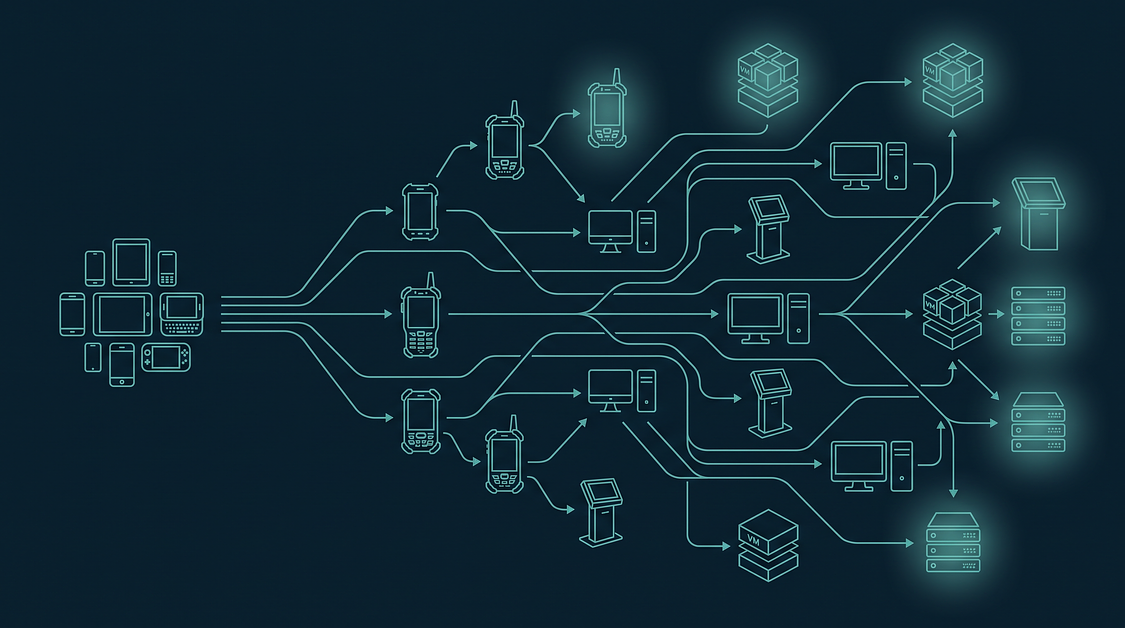
If you have managed enterprise devices for more than five years, the category name for what you do has changed at least three times, from MDM (mobile device management) to EMM (enterprise mobility management) to UEM (unified endpoint management) to plain “endpoint management.” Those renames were not just analyst branding exercises. Each one reflected a genuine expansion in what organizations needed to control, secure, and support. The practical question in the MDM vs endpoint management debate is not which acronym is current. It is what you actually manage, and whether your tooling and your operational model cover it.
The terminology problem is an operational problem
You have sat in this meeting. A vendor rep runs a deck where slide four says “MDM,” slide nine says “UEM,” and slide fourteen says “modern endpoint management”, and each term appears to mean something slightly different depending on which product tier is being pitched. You leave without knowing whether you need a new platform or just a new label for the one you already own.
That confusion is not a failure of your attention span. The industry manufactured it.
Gartner renamed its own evaluation from MDM to EMM around 2012–2013, then to UEM around 2018, then again in January 2026 when it published its inaugural Magic Quadrant for Endpoint Management Tools. Forrester followed within months, retitling its Wave from “Unified Endpoint Management” to Endpoint Management Platforms. Two of the most influential research houses in enterprise IT changed the name of the category inside a single fiscal year.
Here is what actually happens when that occurs. Procurement rewrites RFP requirement language to match the new terminology. Vendors reposition products that did not change functionally under the new label and raise the tier price. Your team spends two quarters re-evaluating tools you already own, because nobody can confirm whether “endpoint management” is a capability gap or a marketing refresh.
The cost is not the confusion. It is the delayed refresh decisions and the misaligned license spend that follow it.
MDM — where device control started
MDM is not outdated. It is the operational core of every category that came after it. The problem is never MDM itself — it is treating MDM as though it already covers everything that got layered on top.
Microsoft describes the function plainly in its own Intune documentation: devices are enrolled, and the platform then manages the whole device — settings, security, and apps — with the ability to wipe it if it is lost or stolen. That is the foundational contract of MDM. You own the device, you enroll it, you control it.
And it remains the layer organizations use most. MDM still accounts for roughly 62% of managed mobility services market share in 2025, according to Mordor Intelligence. Read that as confirmation, not nostalgia: even inside broader service frameworks, the functions buyers depend on daily are enrolment, policy enforcement, and remote actions. The question is not whether MDM matters. It is whether MDM alone is sufficient for your estate.
In practice, MDM is what stands between a locked-up scanner and a stalled shift. A warehouse supervisor in Mississauga hits a frozen Zebra TC58 at 2 a.m., and someone pushes a remote restart from a console. It is the layer that enforces the passcode policy on a nurse’s tablet before she opens a charting app. Every layer above MDM depends on MDM working correctly underneath.
What MDM controls — and where it stops
MDM’s functional boundary is the device itself: enrolment and provisioning, configuration profiles, policy enforcement, app installation, telemetry collection, and remote actions like lock, restart, and wipe.
What it does not cover is where the confusion starts. MDM does not manage data inside applications, distribute and control corporate content, federate identity, manage desktops and laptops, or orchestrate operating system patching across mixed platforms.
For a closer look at the operational gaps that persist even with a well-configured platform, see what your MDM license is not telling you.
EMM — when apps and content entered the picture
Around 2012–2013, IT teams started hearing something new from business units. Controlling the device was no longer the point. Sales wanted managed access to CRM apps on personal phones. Clinicians wanted secure document sharing on tablets they carried between wards. The device was locked down; the data moving through it was not.
IBM, citing Gartner in 2014, put it directly: as requirements broadened to more applications and access to more sources of content, MDM evolved into a broader set of technologies commonly referred to as EMM.
EMM added three layers on top of MDM — mobile application management (MAM), mobile content management (MCM), and mobile identity management (MIM).
The real trigger was BYOD (bring your own device). Here is what actually happened in those conversations: an employee needed corporate email and SharePoint on a personal phone, IT enrolled the device under full MDM, and then someone in HR or legal asked what happens when that employee resigns. Wiping a personal device is not a defensible action. MAM — managing the app container without owning the hardware — was the capability that made BYOD operationally viable.
Why EMM is no longer a buying category
Gartner has since stated that enterprise mobility management is transitioning to unified endpoint management. That transition is complete on the vendor side.
MAM, MCM, and MIM did not disappear. They were absorbed into UEM platforms as standard functionality. If you go to market today, you will not find a standalone EMM suite to evaluate.
The term survives in two places: legacy contract language and older vendor documentation. If your renewal paperwork still says “EMM,” the capabilities almost certainly exist under a UEM or endpoint management label now — usually at a different price point.
UEM — the convergence of mobile and desktop management
For most of the 2010s, enterprise IT ran two parallel management worlds. Laptops and desktops went through SCCM and Group Policy. Phones, tablets, and handhelds went through MDM or EMM. Same IT team, same workforce, same users — two completely separate toolchains with no shared visibility.
UEM was the answer to a question every IT director had already asked out loud: why can I not see all of this in one place?
Gartner moved its Magic Quadrant from EMM to UEM around 2018 to reflect that convergence of mobile management with client management tools for PCs. IDC’s Phil Hochmuth framed the current state of it in the IDC MarketScape for Worldwide UEM Software 2025–2026, noting that endpoint estates now span laptops and workstations through smartphones and tablets to specialized and connected equipment, and that IT teams have to keep pace with converged platforms. Read that as a scope statement, not a product pitch: the boundary of what counts as a managed endpoint keeps moving outward, and single-purpose consoles cannot follow it.
The real-world trigger was never the console. It was the help desk. A user calls about a laptop, and the technician works in one system. The same user calls twenty minutes later about their phone, and the technician switches tools — different login, different asset record, no shared ticket history, no way to see that both devices belong to the same person having the same authentication problem. UEM did not just unify the technology. It unified the support workflow.
What UEM covers that MDM and EMM did not
The additions are concrete: cross-platform policy enforcement across Windows, macOS, iOS, Android, ChromeOS, and Linux; conditional access tied to live device compliance state; desktop patching and configuration management; and a single asset record per user spanning every device they carry.
This is why platforms like Microsoft Intune, Omnissa Workspace ONE, and SOTI MobiControl now function as the operational console for most enterprise fleets rather than as mobile-only tools.
The catch is that a UEM license describes what the console can do. It does not describe what your team has actually configured — and for organizations running rugged handhelds, kiosks, or shared devices, that gap is wider than most IT leaders expect. Which brings us to what the analysts changed in 2026.
Endpoint management — the current analyst category and what it actually means
In January 2026, Gartner published its inaugural Magic Quadrant for Endpoint Management Tools, dropping “Unified” from the name entirely. That was not a cosmetic refresh.
The definition expanded to include “managing, discovering, configuring, patching and securing physical, virtual, and cloud-hosted endpoints.” Cloud-hosted endpoints. Virtual machines. IoT devices. Suddenly the scope included categories that UEM was never built to address.
The vendor set reflected the expansion. The 2026 evaluation included 18 vendors — up from 11 in the final 2022 UEM Magic Quadrant. NinjaOne, Kaseya, Atera, N-able — platforms that originated in the RMM (remote monitoring and management) world for MSPs — now sat alongside Microsoft, Omnissa, and IBM in the same competitive framework. Apple specialists like Jamf made the cut. So did hardware OEMs like Samsung and Google.
For IT directors, this means the tools you are now being asked to compare came from fundamentally different operational contexts. A platform built for MSP server monitoring is not interchangeable with one built for mobile-first enterprises, even though both now appear in the same analyst quadrant. Understanding which discipline — MDM, UEM, or full endpoint management — fits your actual estate matters more now, not less.
How the vendor landscape shifted with the new category
The 2026 Critical Capabilities framework introduced four distinct use cases: autonomous endpoint management, unified endpoint management, security-centric management, and frontline device management.
That last one matters if you run rugged handhelds, kiosks, or shared devices. Gartner now formally recognizes that managing a Zebra scanner on a loading dock is a different operational challenge than managing a knowledge worker’s MacBook. The two require different enrolment models, different policy structures, different support workflows. Analyst evaluations finally acknowledge that reality — which means your RFP requirements can too.
Mapping the right discipline to your device estate
The right question is not “which acronym should I use?” It is “what am I actually managing, and does my current tooling cover it?”
IoT Analytics reports that connected IoT devices reached 18.5 billion globally in 2024 and are projected to hit 39 billion by 2030. That trajectory is not abstract. It shows up in your asset register as kiosks, wearables, vehicle-mounted computers, and sensor arrays that were not there three years ago — and that your original MDM platform was never configured to handle.
The inflection point is usually not a technology decision. It is a fleet composition change. An organization that managed 500 iPhones with MDM acquires 200 rugged scanners and 50 self-service kiosks through an operational expansion. The MDM platform technically supports Android Enterprise, but nobody has configured OEMConfig profiles, shared-device mode, or peripheral management. That is the moment MDM stops being sufficient.
A practical scope comparison
| Dimension | MDM | EMM | UEM | Endpoint Management |
|---|---|---|---|---|
| Device types | Mobile only (phones, tablets, handhelds) | Mobile only | Mobile + desktop + laptop | Mobile + desktop + virtual + IoT + cloud-hosted |
| Key capabilities | Enrolment, policy, remote wipe, app deployment | MDM + MAM + MCM + identity | EMM + cross-platform desktop management, conditional access | UEM + patch orchestration, autonomous operations, frontline device management |
| Typical buyer | IT teams with homogeneous mobile fleets | (Legacy — absorbed into UEM) | IT teams with mixed mobile and desktop estates | IT teams with mixed estates including rugged, IoT, virtual endpoints |
| Market status | Active — foundational layer | Retired as standalone category | Active — dominant enterprise model | Current analyst category (2026+) |
When your current MDM platform is enough
MDM remains the right answer for organizations with homogeneous mobile-only fleets. If you manage fewer than 500 devices, run a single operating system, and operate from a limited number of sites, MDM covers the use case. Not every organization needs UEM, and overshooting your actual requirements creates license cost and administrative overhead you will not recover.
If your fleet is MDM-scale and you are evaluating platforms, our buyer’s guide to MDM software covers the features and operating models that matter most.
The operational layer these categories do not cover
Every category discussed so far — MDM, EMM, UEM, endpoint management — is a software layer.
Software configures devices. Software monitors compliance. Software pushes policies and triggers remote wipes. What software does not do is ship devices, repair them, manage the carrier contract behind the SIM card, or certify data erasure when the device reaches end-of-life.
For organizations running large distributed fleets, that gap between what the software manages and what the operation requires is where most of the unplanned cost and downtime actually lives.
The global average cost of a data breach reached USD $4.44 million in 2025, according to IBM. That figure does not distinguish between breaches caused by software misconfiguration and breaches caused by a device sent to an uncontrolled repair depot or improperly decommissioned without chain-of-custody documentation. The risk is not confined to the software layer. A lost device, a repair that crosses a border, a tablet wiped without a certificate — these create exposure that no MDM policy can prevent after the fact.
Here is a scenario that plays out regularly. An IT director has a well-configured UEM environment — policies enforced, compliance dashboards green. A Zebra scanner breaks at a distribution centre in Alberta. The replacement process involves four emails, a spreadsheet lookup, and a two-week wait for the refurbished unit to arrive from a depot in another province. The UEM console shows the device as “offline.” The warehouse floor shows a worker without a tool.
That is not a software gap. It is a lifecycle management gap — and the software categories do not address it because they were never designed to.
The same applies at end-of-life. An MDM platform tracks a device while it is enrolled. The moment that device is unenrolled for decommissioning, it falls outside the software’s visibility. PHIPA auditors in Ontario do not ask whether the device was enrolled when it contained patient data. They ask for certified data erasure and chain-of-custody documentation proving what happened after it left the fleet.
Where managed mobility services fit in the endpoint management stack
Organizations that have resolved the MDM-vs-UEM question and chosen the right software platform often discover that the software decision was the easier half.
The harder half is the operational model. Who stages devices before they ship? Who manages repairs when a scanner breaks at 11 p.m. in a Quebec distribution centre and the worker needs service in French? Who handles the carrier contracts — the zero-use lines you are still paying for, the rate plan mismatches that inflate your monthly spend? Who ensures that every device leaving the fleet has documented erasure that will satisfy an auditor two years from now?
Managed mobility services (MMS) sit alongside endpoint management software, not above or below it. The software layer handles configuration and compliance. The operational layer handles everything the software assumes someone else is doing.
PiiComm operates that layer for Canadian organizations — managing 500,000+ devices across thousands of locations from its own Canadian staging facilities, with a 24/7 bilingual service desk staffed in-country and in-house certified technicians. The company is certified on SOTI and 42Gears MDM platforms and offers managed MDM administration where PiiComm’s Canada-based administrators operate the client’s MDM environment day-to-day.
For organizations running mixed fleets — Zebra scanners in warehouses, Samsung tablets in retail, iPhones for field staff — the MDM platform is one decision. The operational model around it is a separate decision that determines whether the fleet actually runs smoothly.
Bridging the software layer and the operational layer
MMS providers integrate with endpoint management platforms rather than replacing them. The five service pillars — Strategic Sourcing, Staging & Deployment, Lifecycle Management, MDMaaS, and Secure Decommissioning — map to the physical lifecycle that software categories assume is handled elsewhere.
The software tells you a device is non-compliant. The operational layer gets a replacement into a worker’s hands by the next shift. The software unenrolls a device at end-of-life. The operational layer documents the erasure and stores the certificate.
If you are evaluating how your endpoint management platform fits into a broader device lifecycle strategy, learn how managed mobility services complement your existing tools.
To see how other Canadian organizations are managing their device fleets, explore PiiComm’s customer stories.
Frequently asked questions
Is UEM just a rebranding of MDM?
No. MDM controls individual mobile devices — enrolment, policy enforcement, remote wipe. UEM adds management of laptops, desktops, and multiple operating systems from a single console, plus application lifecycle management and conditional access tied to compliance state. Gartner formally transitioned the category from MDM to EMM to UEM between 2012 and 2018. The capabilities are genuinely different even when vendors use the terms loosely.
Is EMM still a relevant category?
EMM as a buying category is effectively retired. Its core capabilities (mobile application management, content management, and identity management) were absorbed into UEM platforms. If your vendor contract still references “EMM,” the capabilities almost certainly exist under a UEM or endpoint management label today, usually at a different price tier.
What is the difference between endpoint management and endpoint security?
Endpoint management covers configuration, patching, policy enforcement, and device lifecycle. Endpoint security (EDR/EPP) covers threat detection, malware prevention, and incident response. Gartner publishes separate Magic Quadrants for each — different authors, different vendor sets, different evaluation criteria. Most organizations need both, but they are purchased and operated separately.
Do I need UEM if I only manage mobile devices?
If your fleet is exclusively mobile with a single operating system and fewer than 500 devices, MDM may be sufficient. UEM becomes necessary when your estate includes laptops, desktops, or multiple operating systems — or when you need conditional access policies that span device types. MDM still accounts for roughly 62% of managed mobility services market share in 2025, confirming that mobile-only management remains a dominant use case.
How does the MDM-vs-endpoint-management distinction affect compliance in Canada?
Under PIPEDA, your organization is accountable for personal information on every managed device, regardless of which software category manages it. Broader endpoint management frameworks typically involve more third-party data processing (cloud-hosted endpoints, patch management services), each of which extends your compliance obligations. For Quebec operations, Law 25 adds cross-border transfer requirements that affect where your MDM infrastructure is hosted and who operates it.
What is the role of RMM in endpoint management?
RMM (remote monitoring and management) originated in MSP environments for server and desktop health monitoring. The 2026 Gartner Magic Quadrant included RMM-origin vendors like NinjaOne and Kaseya for the first time, confirming convergence with UEM. RMM excels at infrastructure telemetry and proactive maintenance; UEM excels at policy enforcement and mobile device management. Many organizations run both.
Does choosing an endpoint management platform replace the need for managed mobility services?
No. Endpoint management platforms are software tools that handle configuration and compliance. Managed mobility services cover the physical operations around those tools: sourcing hardware, staging devices, managing repairs, maintaining spare device pools, handling carrier contracts, and documenting end-of-life compliance. The two are complementary layers, not interchangeable options.
The terminology will keep shifting. Gartner will rename the category again within the decade — probably to accommodate AI-driven autonomous management or whatever comes after that. What will not change is the underlying question: does your tooling and your operational model actually cover what you manage?
That question has two parts. The software part is which console you use and what it can see. The operational part is who keeps the fleet running when the console shows a device offline and a worker needs a replacement before the next shift. Answer both, and the acronyms stop mattering.